 Start here
Emergency Water Extraction
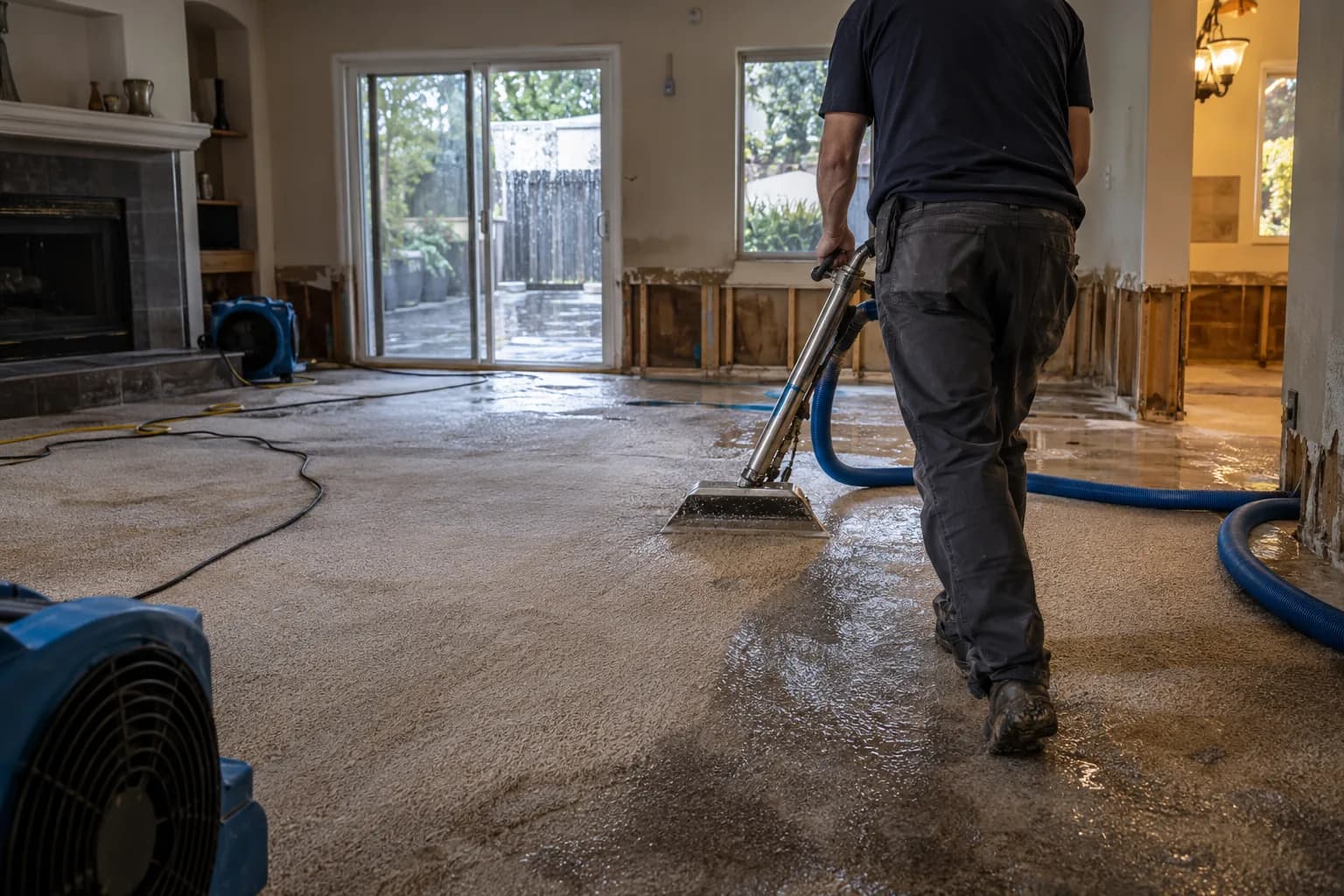
Fast removal of standing water with truck-mounted and portable units before it soaks into more material.
See emergency water extraction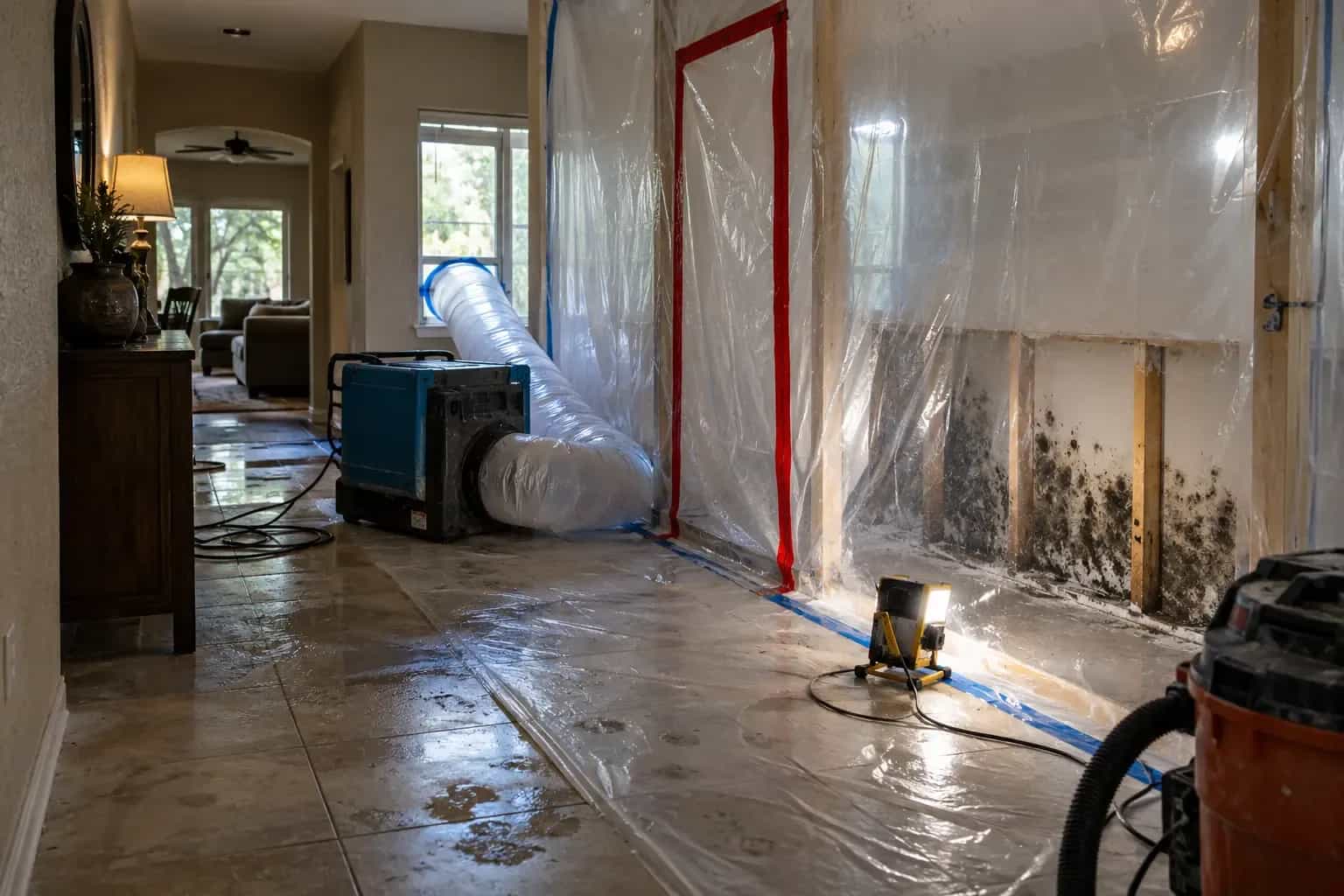
San Marcos, TX & Hays County · 24/7 response
Mold follows untreated moisture fast in Central Texas humidity. We contain the area, run HEPA filtration, and treat the material across San Marcos and Hays County.
Mold remediation is containment, HEPA filtration, removal of affected material, and antimicrobial treatment. Mold can start growing 24 to 48 hours after water intrusion (ANSI/IICRC S520). In Texas, any job covering 25 contiguous square feet or more requires a TDLR-licensed remediator working from a separate consultant's written protocol.
You found mold, or you smell it, and now you want to know how serious it is and how to make it stop. San Marcos sits in a humid subtropical climate that keeps indoor moisture high, and that humidity is what lets mold take hold fast after any leak or water intrusion. The real fix isn't scrubbing the spot you can see. It's finding and drying the water feeding it.
We handle mold remediation and removal across San Marcos and Hays County, following the ANSI/IICRC S520 standard the industry uses. That means containment, HEPA filtration, antimicrobial treatment, and proper removal of contaminated materials.
Mold can begin within 48 hours. In San Marcos and the humid Central Texas climate, high indoor humidity speeds that timeline, which is why the EPA recommends drying wet materials within 24 to 48 hours. Fast drying and proper remediation are what keep mold from spreading.
That window is short. A pipe that drips overnight or a leak nobody catches for a weekend is plenty of time for spores to colonize damp drywall and pad. You can read the full timeline in our guide on how fast mold grows after water damage.
Mold remediation is the controlled process of containing an affected area, removing contaminated materials, and drying out the moisture feeding the growth, following the ANSI/IICRC S520 standard. Cleaning wipes a stain off a wall. Remediation deals with the spores you can't see, the materials they've gotten into, and the leak that started it.
Anyone can wipe a surface, and that shortcut is exactly what fails.
Here's the insider truth. The mold you can see on the surface is rarely the whole story. The visible patch lies. That's why proper remediation starts by finding and drying the water source with a water damage inspection and a moisture meter, not by reaching for a sponge. Clean visible mold without fixing the leak or humidity behind it, and it comes back almost every time.
Order matters here. We work in a set order so spores stay contained and the moisture source actually gets addressed. Here that means containment goes up before anything is disturbed, HEPA filtration runs inside it, contaminated porous materials come out, then we dry until meters confirm a documented standard.
Containment does the heavy lifting. It's the difference between fixing one room and contaminating the whole house. We seal the work area with barriers and run negative air, which keeps the pressure inside the containment lower than the rest of the home so spores can't drift into clean rooms. HEPA filtration runs inside that bubble, capturing fine particles down to a size you'd never see, which is the entire reason the work happens behind a barrier. Skip containment, and disturbing the mold can spread it further than it ever would have spread on its own.
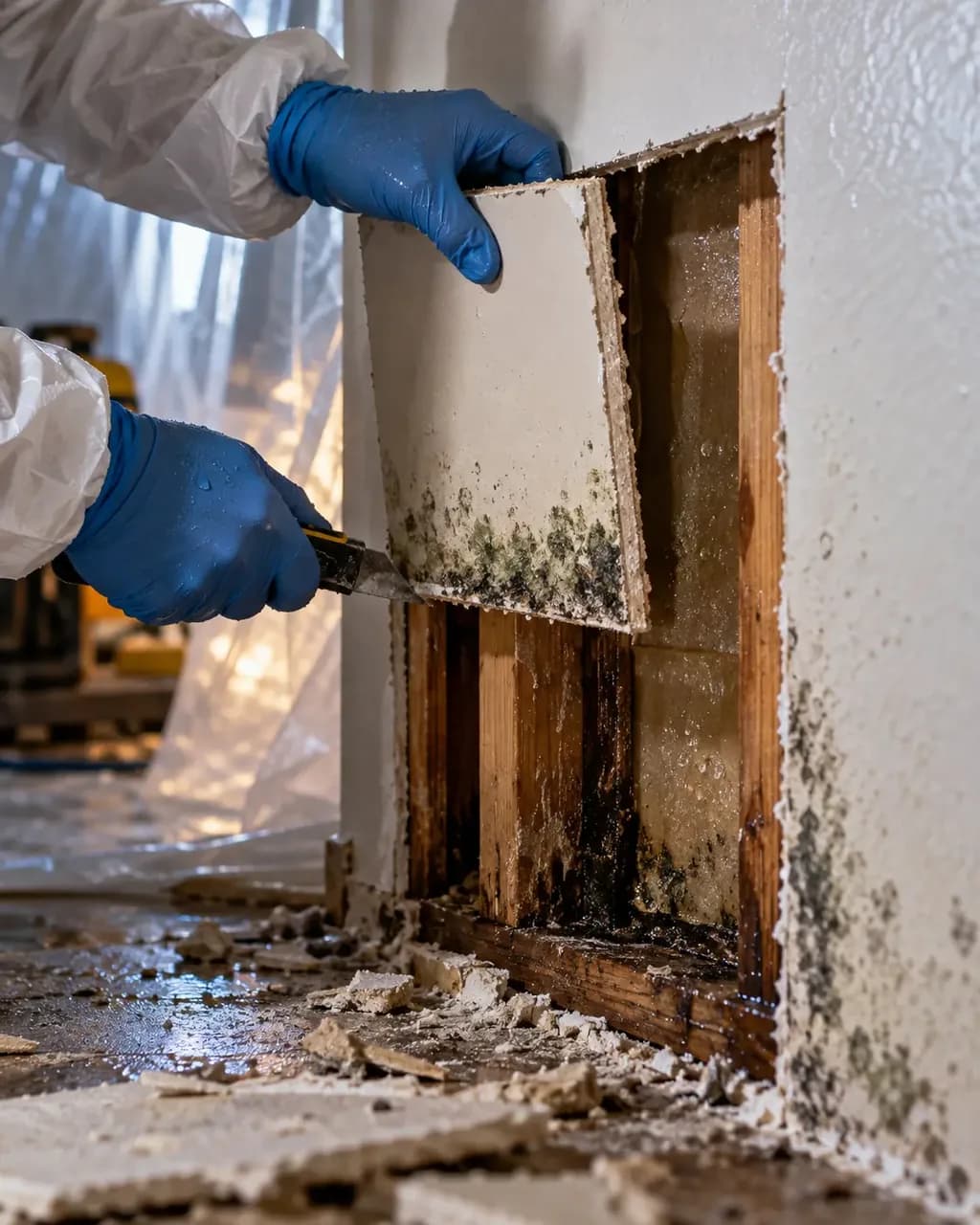
Porous materials hold mold in ways cleaning can't reach. Drywall, insulation, and carpet pad absorb moisture and spores into their structure, so wiping the surface leaves colonies living inside. Hard, non-porous surfaces can be cleaned and sanitized. Tile and sealed metal wipe down fine. The judgment call between salvage and removal is most of what you're paying a professional for, because guessing wrong means the mold returns.
Stop the damage from spreading. Request a mold inspection →
Mold announces itself in a few ways. Not all are visible. A persistent musty smell in a closed room is often the first sign, before any staining appears. Visible growth on drywall or grout, a leak that returns to the same spot, and allergy-like reactions that ease when you leave all warrant an inspection.
Notice that last one is described carefully. We're not diagnosing anyone. We're saying that if symptoms track with a room, the building is worth inspecting. A musty smell with nothing visible usually means hidden moisture, which we cover in our guide on a musty smell but no visible mold.
Take it seriously. Black mold should be handled carefully, though reactions vary from person to person, and we treat it as a building and indoor-air problem rather than a medical one, because only a doctor can speak to health effects. What we can tell you is how to handle it without making it worse.
Disturbing growth the wrong way is how spores travel into rooms that were fine an hour ago.
The safe approach is the same one we'd use for any significant growth. In practice that means containment, HEPA filtration, and removal of contaminated porous materials so spores aren't spread through the home. If you're seeing dark growth spreading across drywall or smelling a strong musty odor, that's the point to get a professional inspection rather than disturb it yourself.
Small jobs, sometimes. Big or hidden jobs, no. You can usually handle a surface spot under about ten square feet on a hard, non-porous surface, with proper ventilation and care. Beyond that size, or when mold is in drywall, behind walls, inside HVAC, or tied to an ongoing leak, you need containment and HEPA filtration.
Two things tend to go wrong. You spread spores by disturbing them without containment, and you miss the hidden moisture source, so the mold simply grows back. When you're unsure, get it inspected before you touch it.
Local climate is the whole story here. Central Texas has a humid subtropical climate, so indoor humidity stays high, especially through the long summer along the San Marcos and Blanco River corridor. That ambient moisture keeps crawlspaces, slab-edge rooms, and closed-up homes damp enough for mold to take hold within days.
Days, not weeks. To limit that risk, the EPA recommends keeping indoor relative humidity below 60 percent, ideally in the 30 to 50 percent range (EPA), which is harder to hold through a Central Texas summer than in a dry climate.
The source splits by neighborhood. New-build subdivisions around Kyle and the growing edges of San Marcos see mold from supply-line failures and appliance leaks in homes that are only a few years old. Older homes in the Historic District near the Square get it from aging plumbing that seeps slowly behind walls. Either way, controlling humidity and drying fast are what keep it from returning. Our Central Texas humidity and mold risk guide goes deeper, and our piece on a musty smell but no visible mold covers the hidden cases.
Mold remediation runs about $15 to $30 per square foot of affected area, and most residential jobs total roughly $1,200 to $3,750 (industry market data). What sets your number is how much porous material leaves the building, not the size of the patch you can see. Our mold remediation cost guide for San Marcos publishes the full ranges by area of the home, from a contained bathroom through attic, ductwork, and whole-house spread, along with what a standalone mold inspection costs.
Those figures are published market data for mold work, not a rate card of ours. Underneath them, five things move your number.
| What drives the price | Lower end | Higher end |
|---|---|---|
| Material affected | Tile, grout, sealed metal, finished wood that cleans in place | Drywall, insulation, carpet pad, all of which get cut out and disposed of |
| Containment | One doorway sealed, a single air scrubber | Multi-room barriers, negative air, HVAC isolation |
| Moisture source | Already repaired by a plumber before we arrive | Still running, so drying and source work join the scope |
| HVAC | Ducts clear of growth | Spores pulled through the system, so ducts join the scope (mold in air ducts and HVAC systems) |
| Project size | Under 25 contiguous square feet | 25 contiguous square feet or more, which changes the legal process entirely |
That last row is the one San Marcos homeowners almost never get told about, so here it is plainly.
Texas does not require a mold licence for remediation affecting less than 25 contiguous square feet. At 25 contiguous square feet or more it does. The work must be performed by a TDLR-licensed remediator, following a written protocol produced by a separately licensed mold assessment consultant, with a notification filed to the Texas Department of Licensing and Regulation before work starts. Two licences, two different companies, by rule.
So ask any company you call which side of 25 square feet your job sits on, and ask who is writing the protocol. A single firm offering to both assess and remediate a job above that threshold is describing something Texas rules do not permit. We would rather lose the call than pretend the threshold does not exist.
Sometimes, and the cause decides it. Mold traced to a sudden covered loss, a supply line that let go last week, is treated very differently from mold that grew behind a shower pan over two years, which carriers commonly exclude as a maintenance issue. Texas policies also often carry a specific mold sublimit or endorsement, so read your declarations page instead of assuming.
One rule worth knowing for after the work is done. A Certificate of Mold Damage Remediation, issued when licensed remediation is completed, can be given to your insurer, and where the statutory requirements are met the carrier may not then make an adverse underwriting decision on your residential property policy based on that prior mold damage (Texas Department of Insurance). Keep that certificate. It protects your renewal and your resale, not just the current claim.
Our guide on whether insurance covers mold walks through the policy wording.
Removal means taking visible growth off a surface. Remediation is the controlled process around it. The short version is containing the area, filtering the air, removing material that cannot be cleaned, drying the moisture that fed the growth, then verifying the result. Removal is one task inside remediation, and performed on its own it usually fails.
| Mold removal | Mold remediation | |
|---|---|---|
| What it addresses | The growth you can see | The growth, the material holding it, and the water feeding it |
| Containment | Often none | Sealed barriers held under negative air pressure |
| Air handling | None | HEPA filtration and air scrubbing inside the containment |
| Porous material | Wiped, bleached or painted over | Cut out and disposed of |
| Moisture source | Usually untouched | Found, dried, and confirmed repaired |
| Verification | It looks clean | Moisture readings plus a clearance check before close |
| Usual outcome | Comes back, often inside a few months | Stays gone as long as the source stays fixed |
In everyday conversation nobody in the trade splits those two words that carefully, so a company saying "removal" is not automatically cutting corners. Ask what they do about containment and about the water source. That answer tells you which one you are actually buying.
Most single-room mold jobs run three to five days from containment to clearance. Setting containment and pulling material is usually one day, drying the cavity to a documented standard takes another two to four, and clearance readings come last. Rebuild is a separate phase that starts after that.
| Stage | Typical duration | What is happening |
|---|---|---|
| Inspection and moisture mapping | 1 to 2 hours | Locating the source, mapping the wet footprint, marking the cut line |
| Containment and setup | Half a day | Barriers up, negative air established, HEPA scrubbers running |
| Removal of affected material | Half to a full day | Porous material out and bagged, hard surfaces cleaned and treated |
| Drying to standard | 2 to 4 days | Readings logged daily until they match the unaffected reference |
| Clearance and close | 1 to 2 hours | Verification, documentation, equipment out |
Central Texas humidity stretches the drying stage far more than the removal stage. A wet wall cavity in a San Marcos August dries slower than the same cavity in a dry climate, which is why we size dehumidification against the outdoor dew point rather than by counting rooms.
Before and after
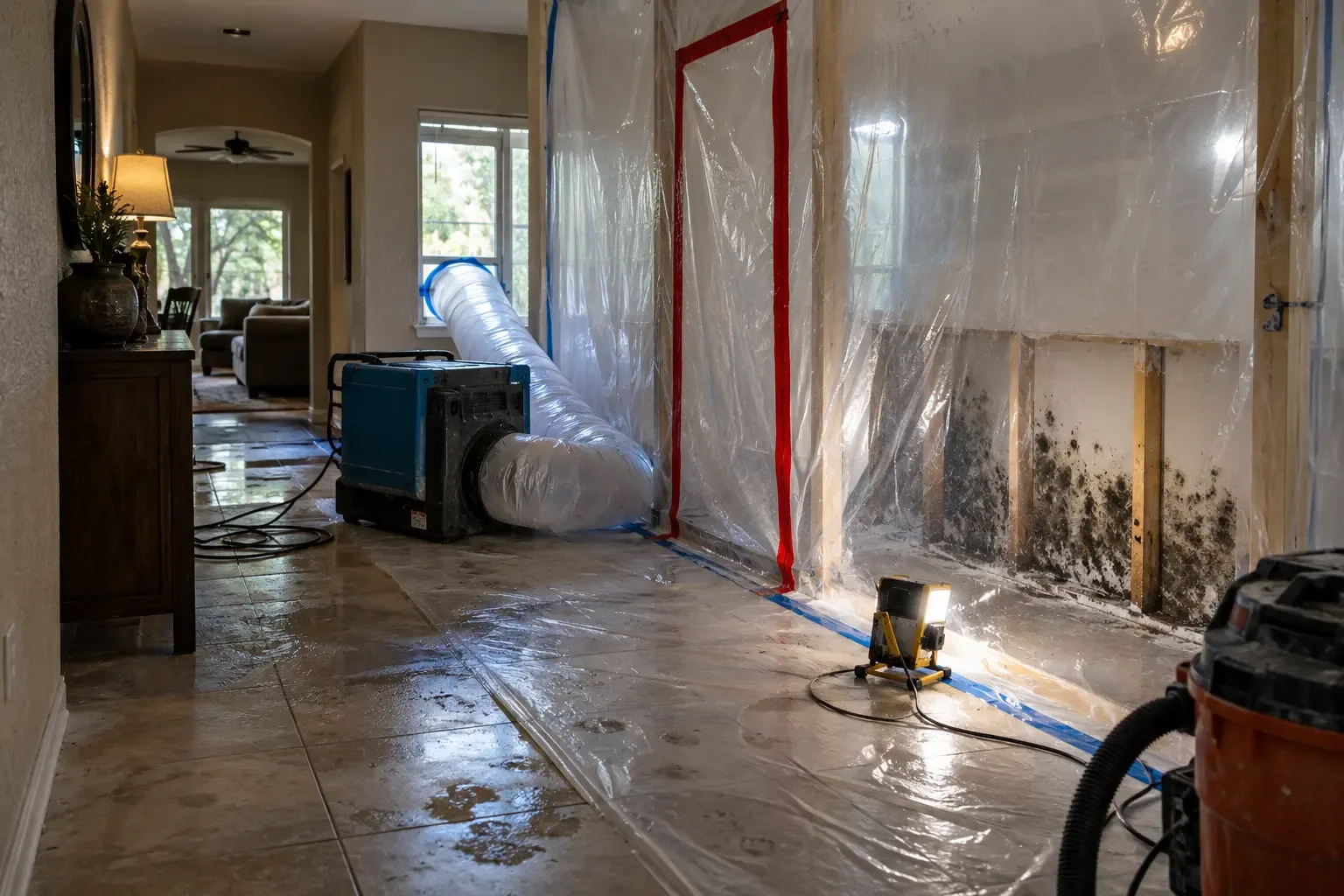
The visible patch is the smallest part of the job. Containment goes up before anything is disturbed, because cutting into growth without negative air spreads spores into rooms that were fine an hour earlier.
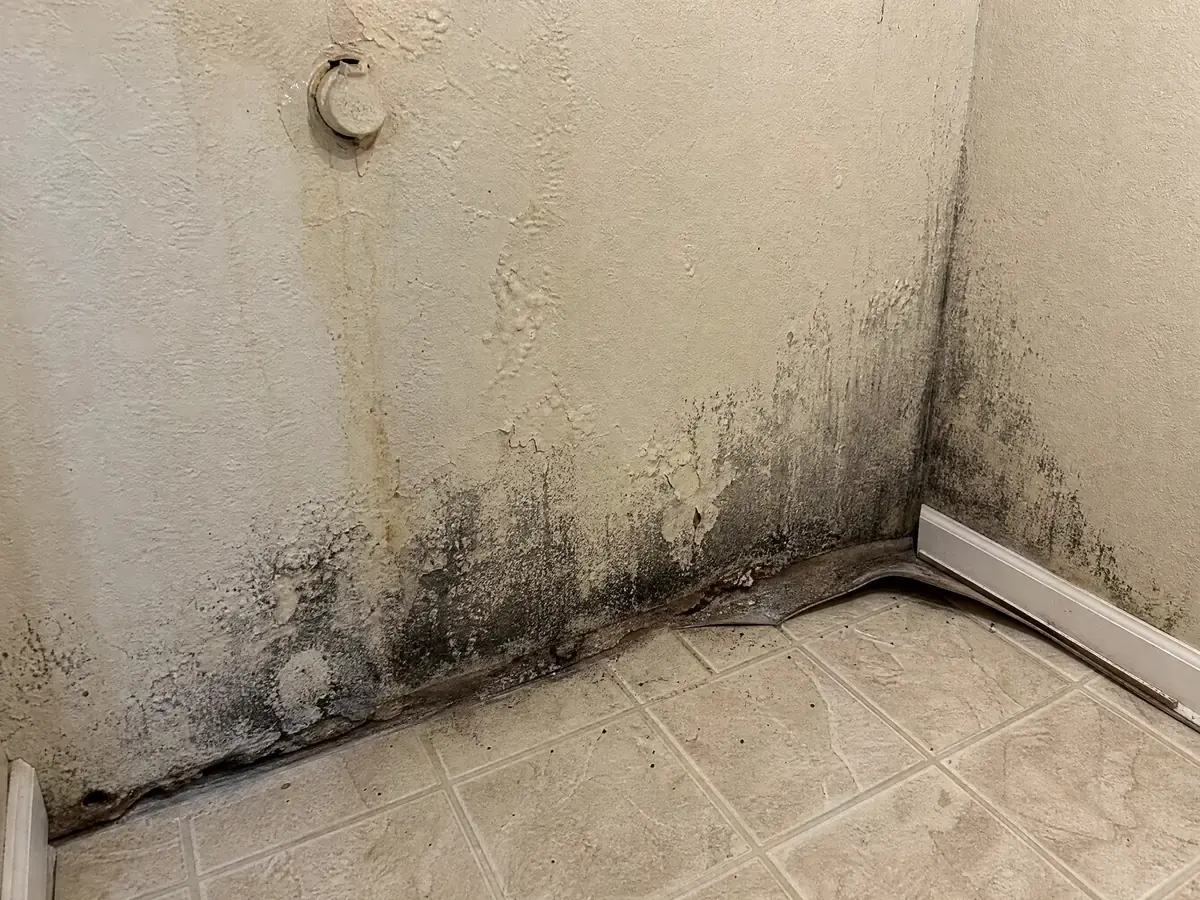 Before, growth and moisture source
Growth on the lower drywall with an active moisture source behind it. Indoor humidity sits above the level the EPA says lets mold take hold.
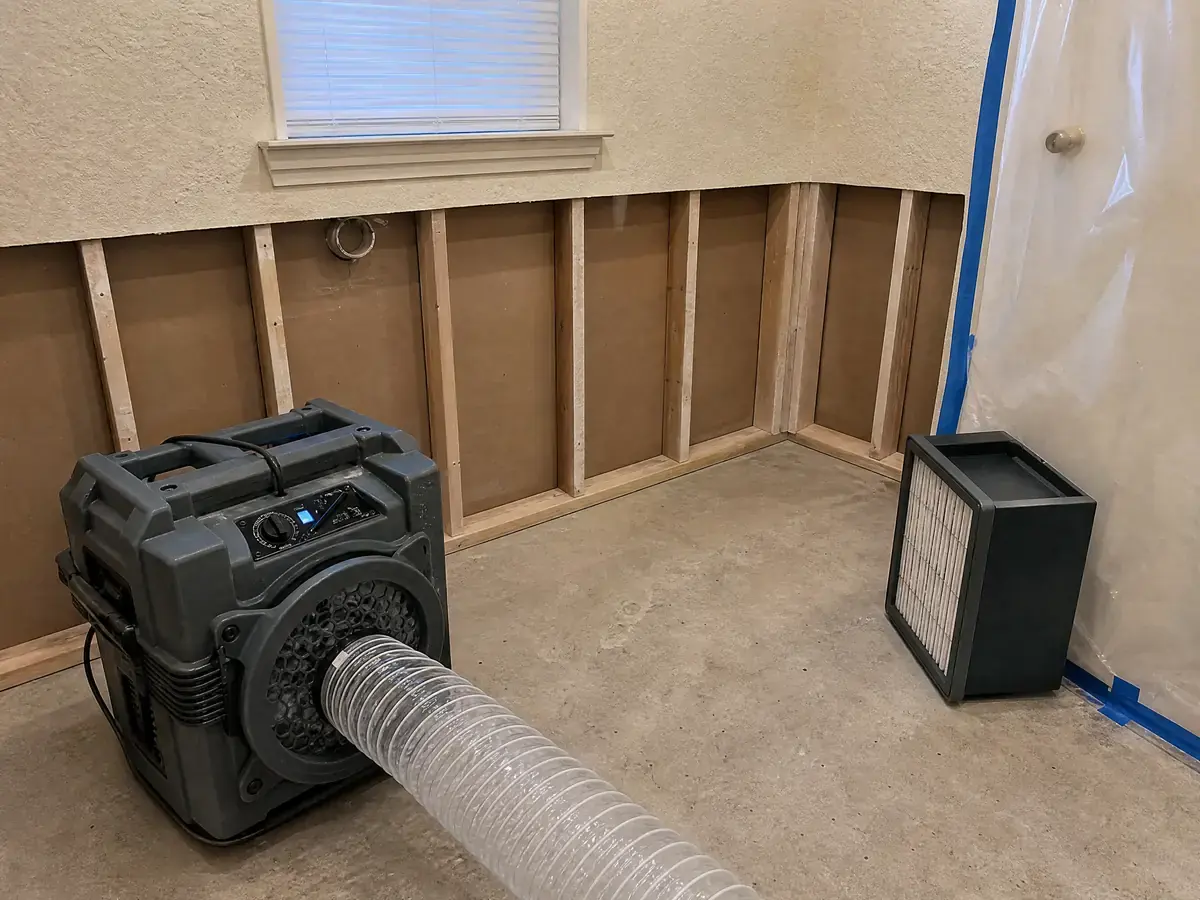 After, removed, dried, verified
Contaminated porous material removed inside containment under HEPA filtration, cavity dried to standard, humidity held in the 30 to 50 percent band the EPA recommends.
Standing water? Call now, we answer 24/7.
A real local person picks up, then a crew heads your way.
Who we are
We put the things most companies keep vague in writing: real price ranges for this market, the standards we work to, and a moisture log your adjuster can read.
24/7
A real local person answers, day or night
24-48 hrs
The critical window to limit secondary damage
~25 mi
Served from our San Marcos hub across Hays, Comal & Caldwell
S500
The ANSI/IICRC drying standard our process follows
One local team handles every stage, so you are not juggling separate vendors.
Start hereFast removal of standing water with truck-mounted and portable units before it soaks into more material.
See emergency water extraction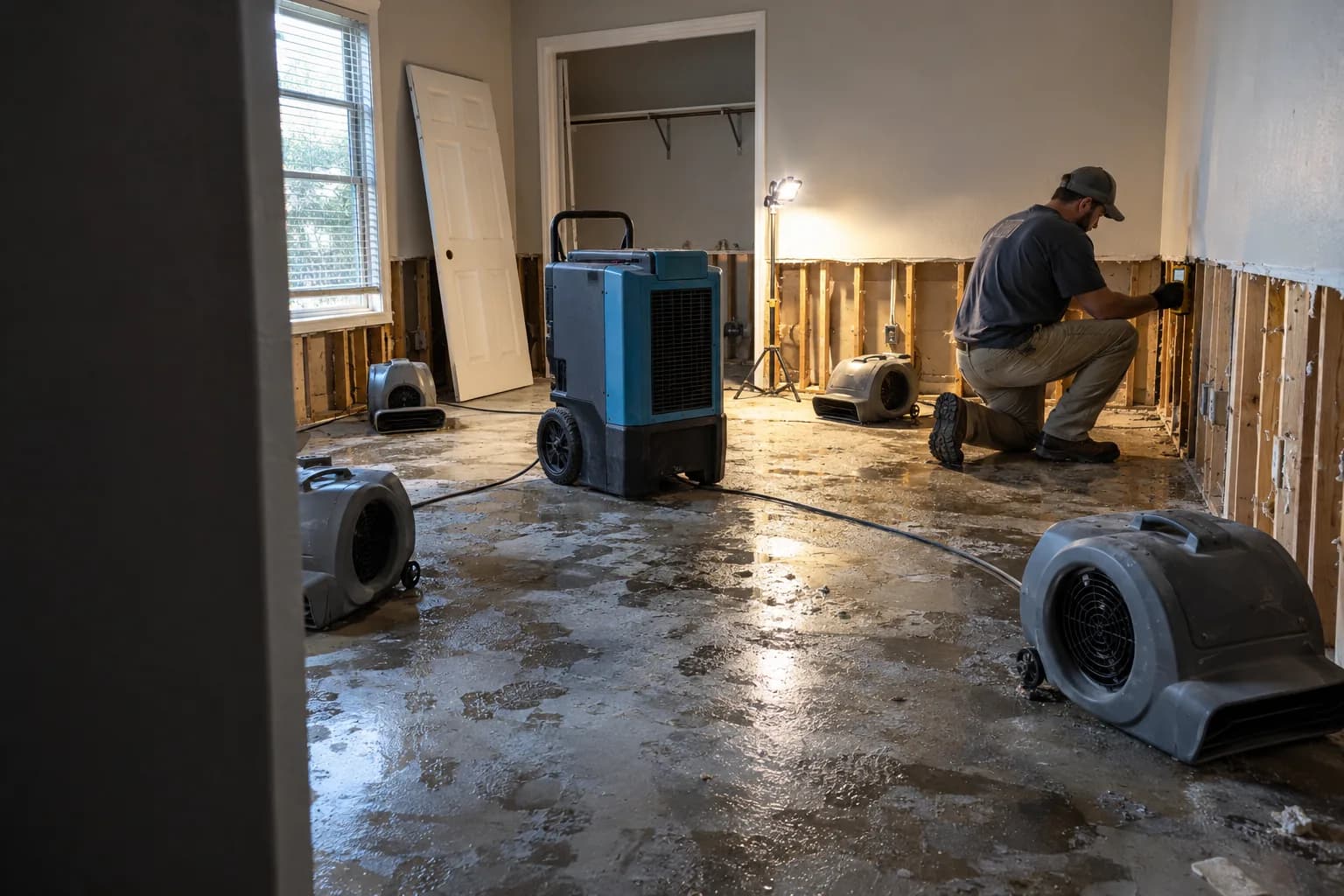
Air movers and LGR dehumidifiers with daily moisture readings, dried to a documented standard.
See structural drying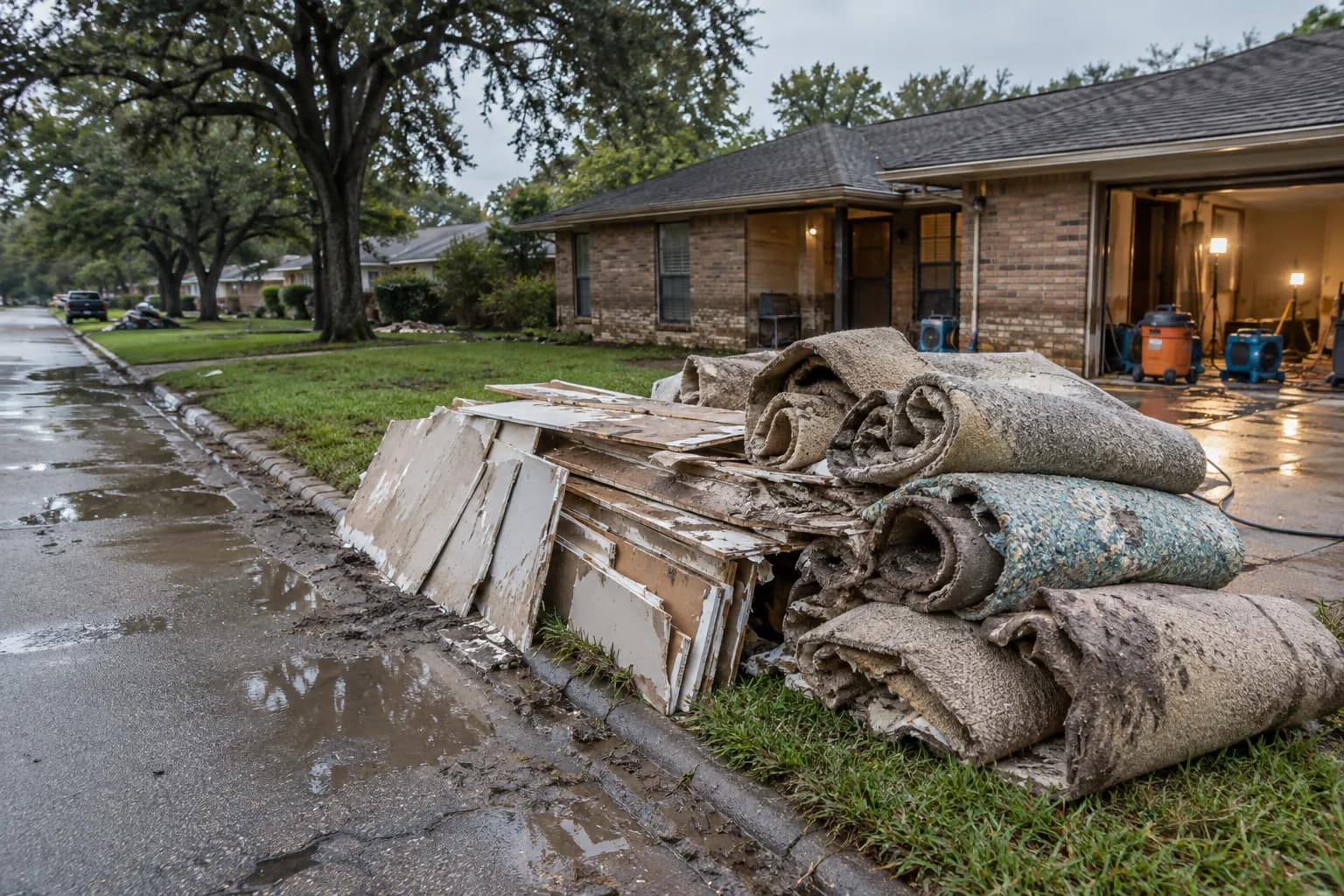
Muck-out and restoration after river flooding and flash floods along the San Marcos and Blanco Rivers.
See flood damage cleanupFAQ
Straight answers to what San Marcos homeowners ask most, on cost, insurance, mold timelines, and what to do first.
24/7
A real local team across Hays, Comal & Caldwell counties. Every job dried to a documented standard.
Have a question on your mind?
Get a quoteMold can start growing within 24 to 48 hours after a leak or water intrusion. In San Marcos, the humid Central Texas climate keeps indoor moisture high, so that window can feel even shorter, which is why the EPA recommends drying any wet materials inside the same 24-to-48-hour window. So a fresh leak is urgent. We start by finding and drying the moisture source rather than scrubbing the spot you can see. You can read more in our guide on how fast mold grows after water damage.
Treat it seriously, and handle it carefully. Reactions vary from person to person, and we focus on it as a building and indoor-air problem rather than a medical one, since only a doctor can speak to health effects. The safe approach stays the same. Containment, HEPA filtration, and removing contaminated porous materials keep spores from spreading through the home. If you're seeing dark growth spreading on drywall or smelling a strong musty odor, it's worth a professional inspection.
Sometimes, yes. Small spots are fair game. You can usually clean a surface spot under about ten square feet on a hard, non-porous surface yourself with proper care and ventilation. Beyond that, or when mold is on drywall, behind walls, in HVAC, or tied to an ongoing leak, you need a professional with containment and HEPA filtration that home cleaning can't match. The risk with DIY is spreading spores and missing the hidden moisture source, so the mold simply returns. When in doubt, inspect first. Get it looked at before you disturb it.
It varies with the job. Mold remediation cost depends on how much area is affected, where the mold is, and whether contaminated materials need removal and rebuild. A small contained area costs far less. Whole-room remediation behind walls or under flooring runs much higher, and we aim to be transparent and give you a clear scope before work begins, plus a no-cost inspection to assess it. Our San Marcos water damage cost guide breaks down the factors so you know what drives the price.
Blame the humidity. Central Texas has a humid subtropical climate, so indoor moisture stays high, especially in summer along the San Marcos and Blanco River corridor, and that moisture lets mold take hold quickly after any leak or water intrusion. New-build neighborhoods see it from supply-line and appliance leaks. Older homes near the Square get it from aging plumbing instead. Controlling humidity and drying fast are the keys to keeping it from coming back, which we cover in our Central Texas humidity and mold guide.
Tell us straight what is happening and we will tell you the next step. We pick up, then we are on the way.
A real local person answers, 24/7. Tell us what is happening and we are on the way.