 Start here
Emergency Water Extraction
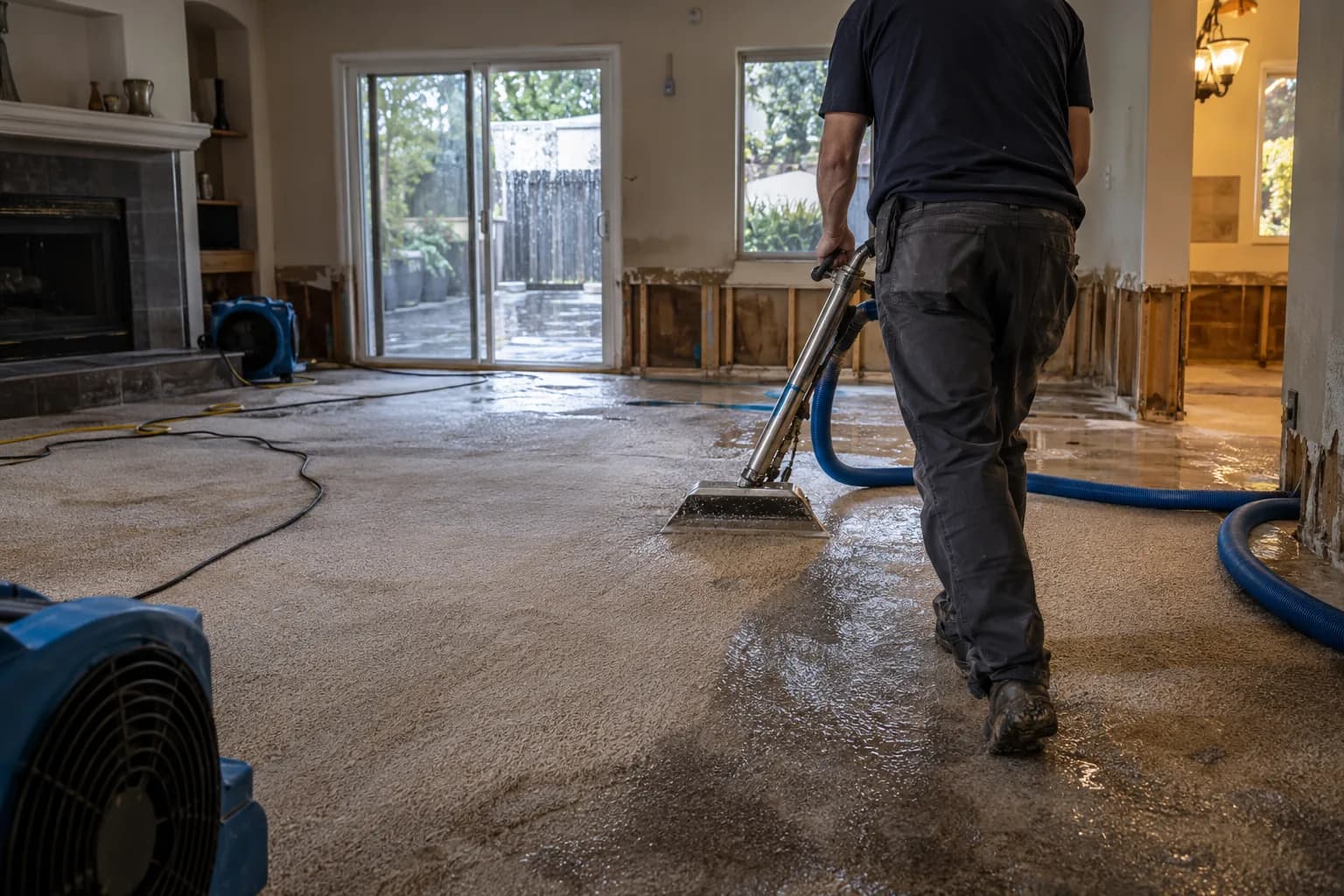
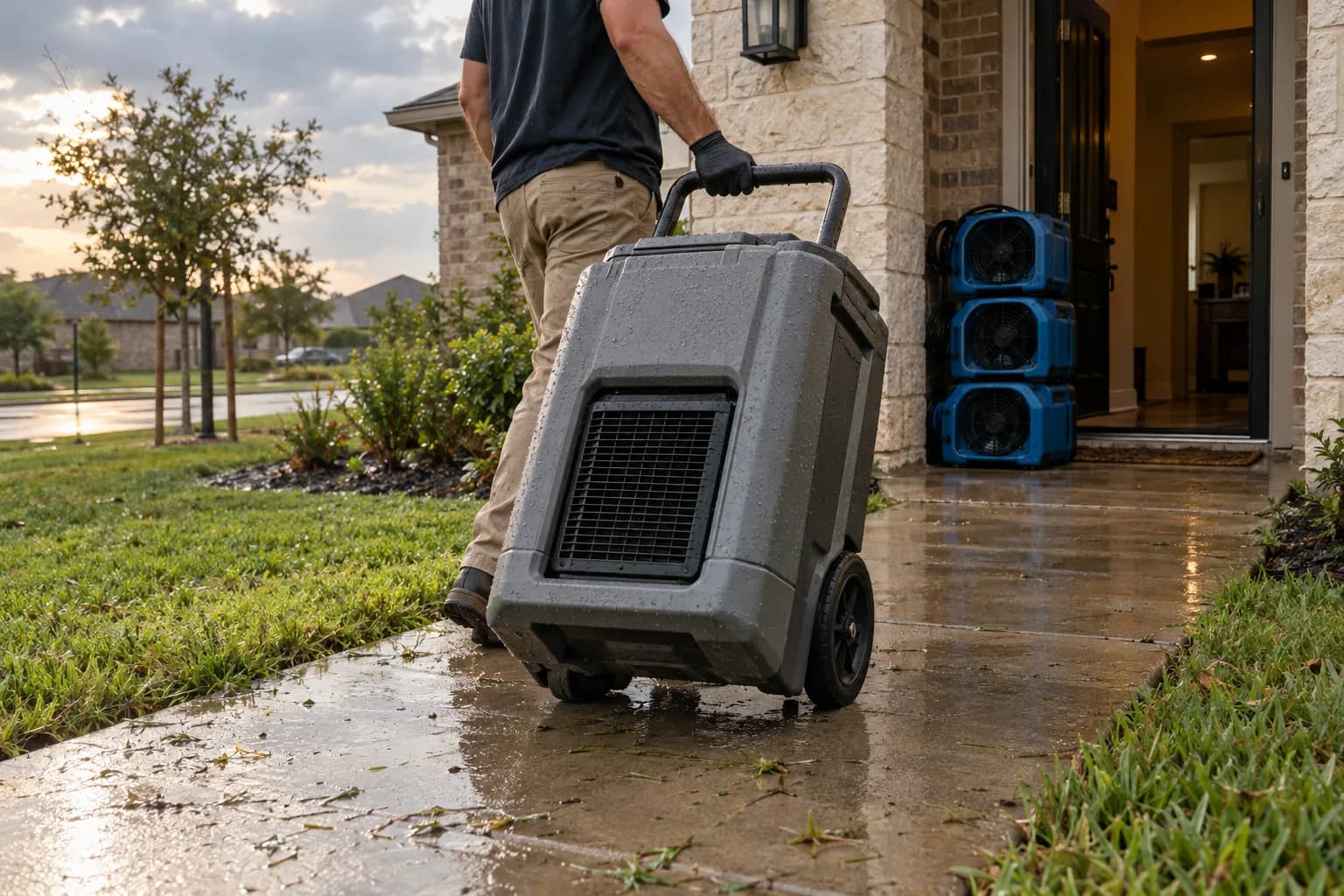
Fast removal of standing water with truck-mounted and portable units before it soaks into more material.
See emergency water extraction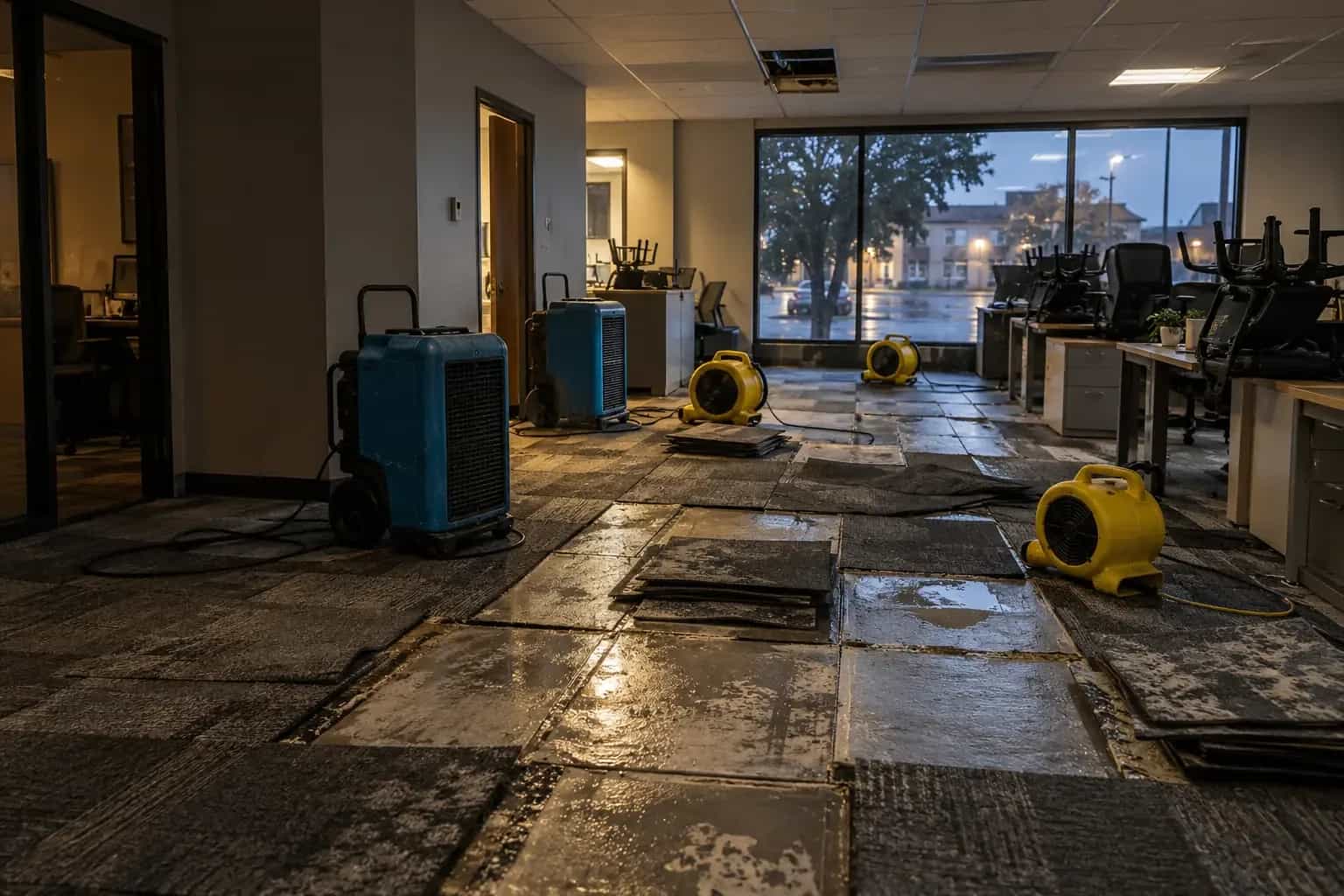
Commercial & multi-unit
Offices, retail units, rental portfolios, and student housing near Texas State need the water gone and the doors open. We work after hours so operations keep running. 24/7.
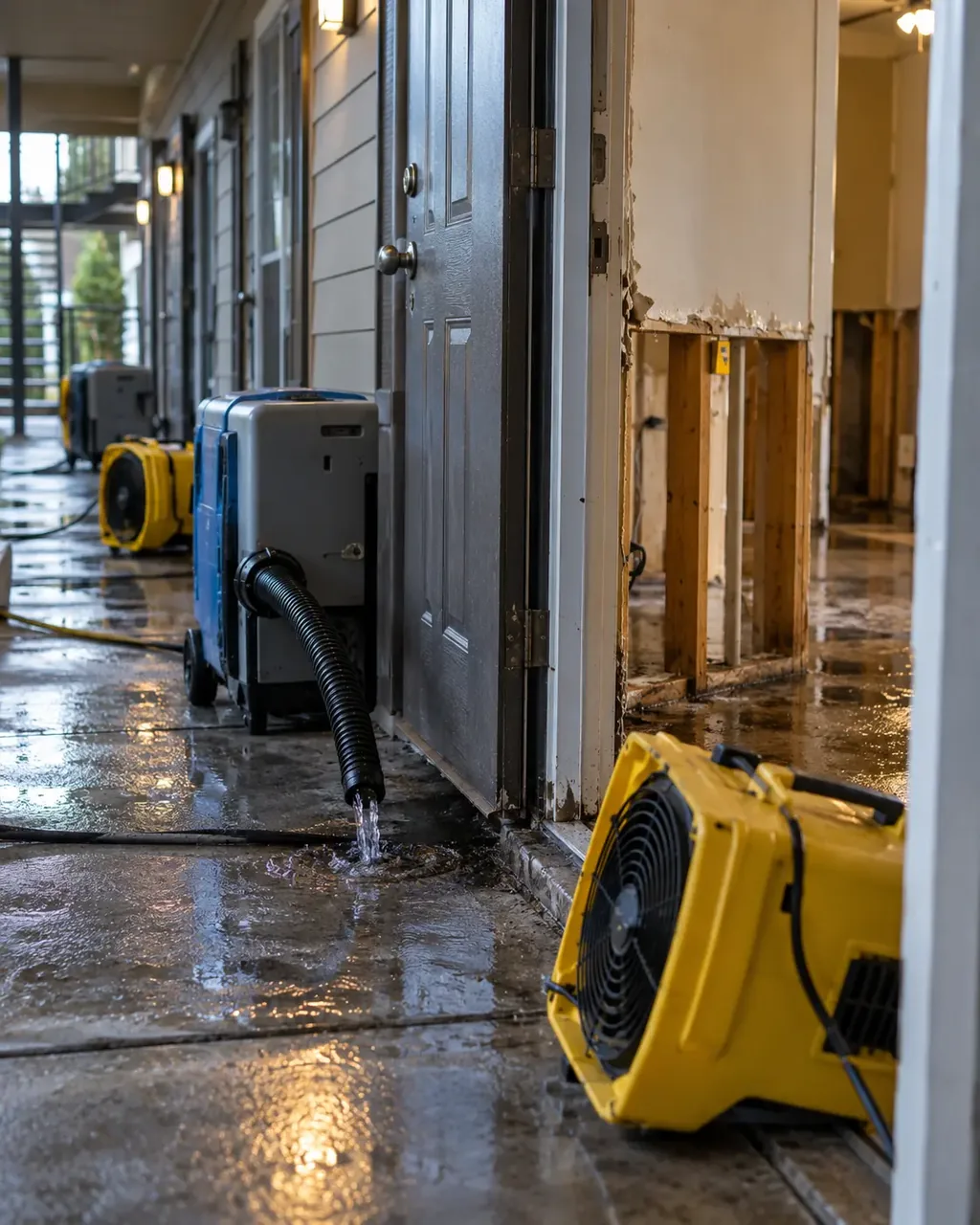
Commercial water damage restoration covers multi-unit and business property: offices, retail, rentals, and student housing around Texas State University. The constraint is downtime as much as moisture, so extraction and drying run after hours where possible, with documentation formatted for insurers and property managers. The 24 to 48 hour window still governs.
A unit floods at 2 a.m. A supply line lets go in a restaurant before open. For a property, the clock is money, and you need a partner who works on your timeline and writes down every step. We're on the way. Call now for after-hours commercial response.
This page is for the people who answer to an owner, a tenant, or an insurer, not for homeowners. If you manage a rental block near campus, run a storefront on The Square, or keep an office open along I-35, the numbers below are about downtime, units, and documentation, because that's what a commercial loss actually costs you.
Commercial restoration prioritizes business continuity. It means after-hours response to limit downtime, capacity for larger losses and multiple units across offices, retail and student housing near Texas State University, and the documentation property managers and insurance adjusters need. The goal is reopening or re-leasing fast while keeping a defensible per-unit record.
That last point is where commercial work really diverges from a house call. For a commercial loss, the documentation is half the job. A property manager answers to an owner and an insurer, so a restoration partner that shows up with moisture readings, a scope of work, and a clear per-unit record is the difference between a clean reimbursement and a disputed one. The first 24 to 48 hours decide two things at once. How much spreads, and how defensible the claim ends up being. Scale changes the logistics too, but the paperwork is what protects the people who hired you.
Different properties, different pressures. We work across offices, retail storefronts, restaurants and food service, multi-unit apartment and student-housing blocks near Texas State, and rental properties managed on behalf of owners. Each carries a different tolerance for downtime, and that shapes how we sequence the work.
Water doesn't wait for business hours, and neither can the response. We answer 24/7. The first 24 to 48 hours decide how far water spreads between units and floors and how big the loss gets, so our model is built to start containment and extraction fast, night or weekend.
We don't present that as a guaranteed response-time contract; we present it as how we're set up to operate.
Containment comes first. Before extraction even starts, the priority is stopping water from reaching the spaces it hasn't hit yet, the unit below, the next storefront, the floor underneath. Contain, then extract, then dry. Skipping the containment step is how a single-room failure becomes a whole-floor loss, because water always finds the next path down when nobody blocks it first.
Need the paperwork side handled right? Get a per-unit scope of work, built for property managers and business owners.
Texas State University drives a large student-rental market in San Marcos, and student-housing restoration is a segment we serve directly. A burst supply line or roof leak frequently hits multiple occupied units at once, often with a tight turnover window between leases. That is not a single-family timeline.
When enrollment fills the apartment blocks and duplexes around campus, a whole building can empty and refill over a single August weekend. It needs a team comfortable working unit by unit, displacing as few tenants as possible, and turning spaces around before the next move-in date. A property manager running a portfolio of student leases is answering to an owner and a leasing calendar at the same time, which is why the work is scoped and documented per unit rather than per building.
The approach is containment between units first, then extraction and drying in each affected unit, with each one documented separately. Each unit, its own file. Why separate? Because an owner managing several leases needs a record per unit, and so does the insurer. A blended "the building got wet" report doesn't hold up the way a per-unit moisture log does. Our guide on student housing water damage in San Marcos covers how these losses typically unfold and what landlords should expect.
Documentation isn't a nice-to-have on a commercial job; it is what protects the owner's reimbursement. We're built around the records an adjuster and an owner both want. In practice that means moisture readings, a water Category classification, a per-unit scope of work, and a clear log of what was wet and what was done.
Paper, not promises. That gives the property manager something concrete to hand the owner, and the adjuster a defensible basis for the claim. We keep the PM and adjuster updated as drying progresses unit by unit. Our Texas water damage insurance claim guide explains how this documentation supports reimbursement.
San Marcos sits in Texas Flash Flood Alley, along the San Marcos and Blanco Rivers. The 2015 Memorial Day Flood and the October flooding that year showed how fast commercial properties along the I-35 corridor can take on water, which makes after-hours readiness a real operational requirement rather than a marketing line. Businesses here have watched it happen.
The older building stock adds its own risk. Old pipes fail. Downtown and the Historic District around The Square have commercial buildings with aging plumbing, where a single overnight failure can reach a ground-floor business and the occupied units above it in the same night. Combine river-fed flash flooding, an I-35 corridor that floods, and aging downtown plumbing, and you get a market where commercial losses aren't rare events. They're a recurring part of operating property in this city.
Commercial pricing follows the same Central Texas band as residential, about $3.00 to $7.50 per square foot with the water category setting where you land, roughly $3.00 to $4.00 for Category 1, $4.00 to $6.50 for Category 2, and $7.00 to $7.50 for Category 3 (industry cost data, scoped under ANSI/IICRC S500). What changes on a commercial floor plate is the multiplier, because square footage is the whole equation.
| Affected area | Category 1, clean | Category 2, grey | Category 3, black |
|---|---|---|---|
| 1,000 sq ft, one suite or unit | $3,000 to $4,000 | $4,000 to $6,500 | $7,000 to $7,500 |
| 2,500 sq ft, a retail floor or small office | $7,500 to $10,000 | $10,000 to $16,250 | $17,500 to $18,750 |
| 5,000 sq ft, a floor of a building | $15,000 to $20,000 | $20,000 to $32,500 | $35,000 to $37,500 |
| 10,000 sq ft, a large-loss event | $30,000 to $40,000 | $40,000 to $65,000 | $70,000 to $75,000 |
That is published market arithmetic against a floor area, not a quoted price, and it is mitigation only. Rebuild, contents, and any business interruption claim sit outside it.
The category line is the one that decides the size of that bill, and it is not a judgment call. It is a classification under S500 set by what the water is, so a documented category read on the scope of work is what keeps the number defensible when the owner, the property manager and the adjuster all review it. Multiply a Category 3 rate across a flooded retail floor and the difference between a defensible classification and a casual one runs into tens of thousands.
Two commercial-only cost drivers that do not appear on a residential scope. The short version is after-hours and night work, which is often cheaper overall because it avoids closing the business, and phased handback, where zones are dried and released one at a time so trading continues. Both are scoping decisions made before the first machine goes in, not adjustments made later.
Commercial floor assemblies behave nothing like residential carpet over pad, and the drying plan changes completely depending on what is underfoot. The question is always the same. Can water get out through the surface, or is it trapped against the slab.
| Floor type | Water behaviour | Extraction and drying approach | Usually salvageable? |
|---|---|---|---|
| Carpet tile over concrete | Water passes through the tile into the adhesive layer and the slab | Lift affected tiles, extract, dry the slab, relay or replace tiles individually | Often yes, and tiles can be replaced piecemeal |
| Glue-down broadloom over concrete | Water sits in the backing and the adhesive | Extract heavily, then decide, since delamination is common | Sometimes |
| VCT or LVT over concrete | Surface is nearly impermeable, water travels under the tile and stays there | Lift a section to vent the slab, then dry the slab directly | Tiles usually yes, adhesive bond often no |
| Sheet vinyl, welded seams | Traps water completely against the slab | Must be cut or lifted, ambient drying cannot reach underneath | Rarely at the affected area |
| Sealed or polished concrete | Nothing traps the water, but the slab itself absorbs | Surface extraction, then in-situ RH probes to test slab moisture | Yes, and this is the easiest commercial floor to dry |
| Raised access flooring | Water pools in the plenum under the panels, out of sight | Lift panels, extract the plenum, dry the void and the underside | Panels usually, plenum contents case by case |
The slab is the part that catches people out. A concrete slab that took water reads dry at the surface long before it is dry inside, and flooring installed over a slab that is still releasing moisture fails months later, usually as adhesive bond failure or cupping. That is why we test slabs with in-situ relative humidity probes rather than a surface meter, and why a rushed reinstall is the most expensive mistake available on a commercial job.
The drying physics are identical. Everything around the drying is different.
| Residential | Commercial | |
|---|---|---|
| Who decides | The homeowner | Property manager, owner, tenant and often a carrier, all at once |
| Main cost pressure | The repair bill | Downtime, which usually dwarfs the repair bill |
| Working hours | Daytime, occupant present | Nights and weekends, to keep the business trading |
| Zoning | Rarely needed | Standard, so unaffected areas stay open |
| Documentation | One scope, one claim | Per zone or per unit, because tenants and policies differ |
| Floor assemblies | Carpet over pad, wood, tile | Glue-down, VCT, raised access, sealed slab |
| Access | Simple | Keys, alarms, loading docks, after-hours building access |
| Contents | Household | Stock, records, equipment, each with its own handling requirement |
For student housing near Texas State the calendar is a hard constraint on top of all of that. A unit that has to be dry, rebuilt and inspected before a move-in date is a scheduling problem first and a drying problem second, and we scope it that way from the first call.
Before and after
In a commercial loss the drying is rarely the hard part. Sequencing is. Work gets zoned so the business keeps trading, and most of the noisy work moves to nights.
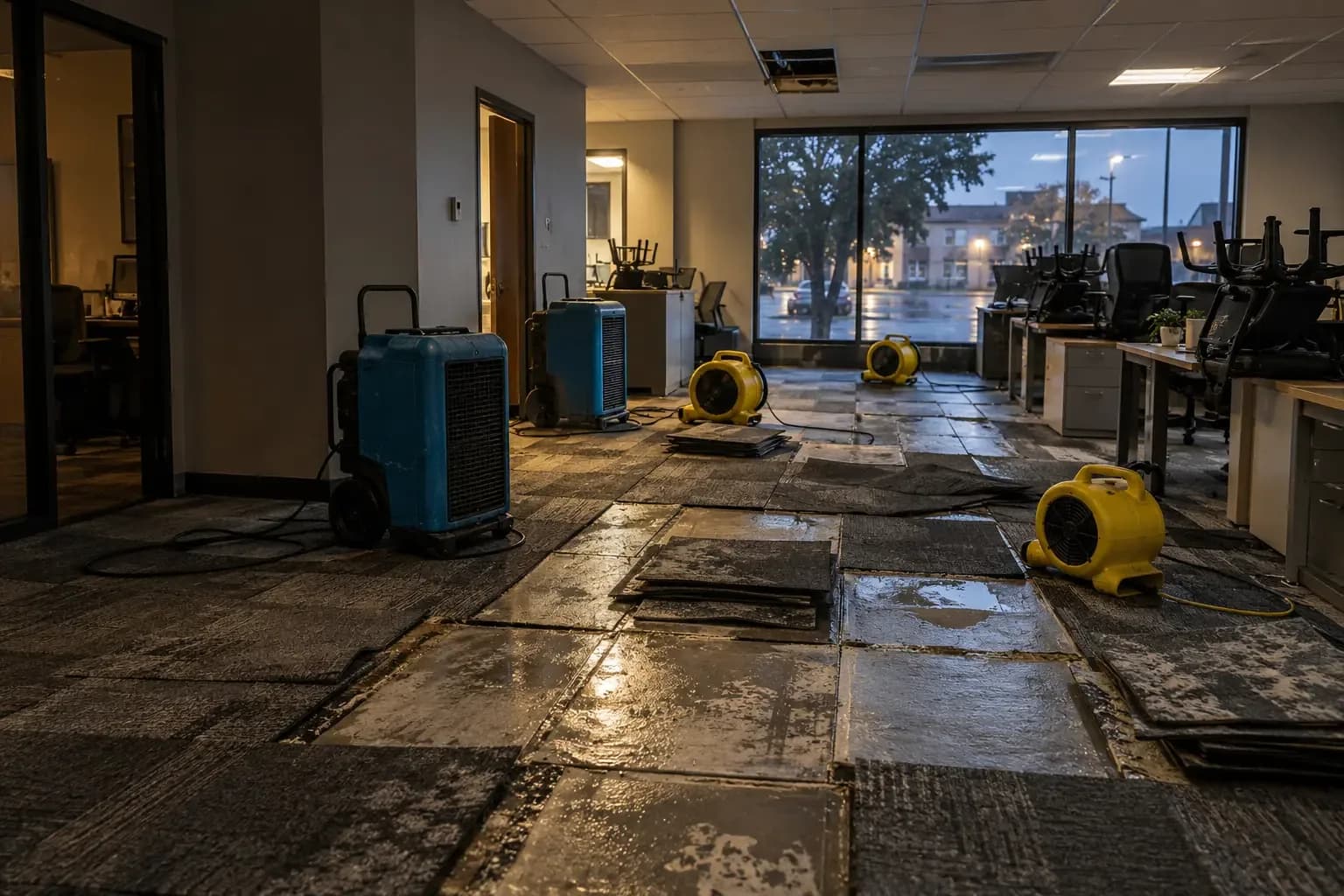
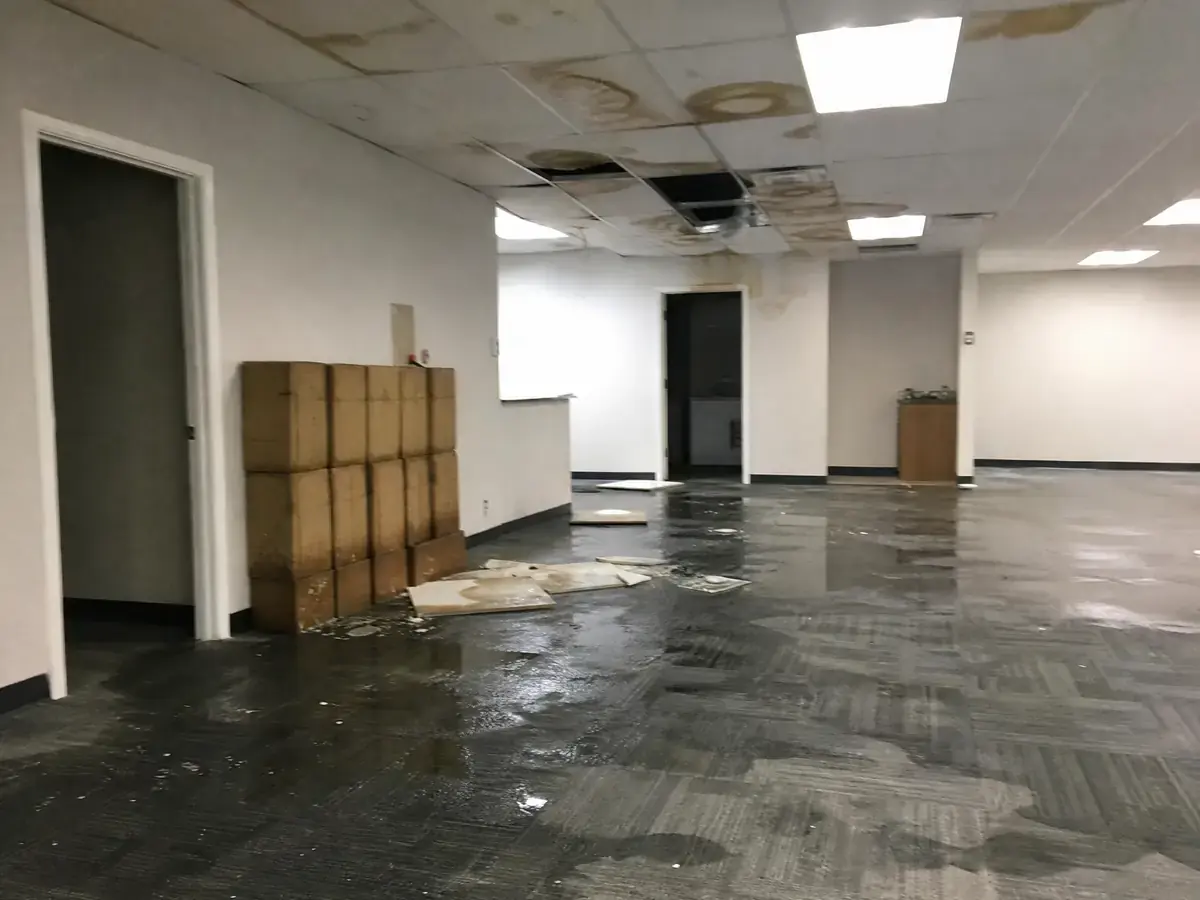 Before, trading floor affected
Water across glue-down commercial flooring and into the slab, with the affected zone crossing areas the business needs open tomorrow.
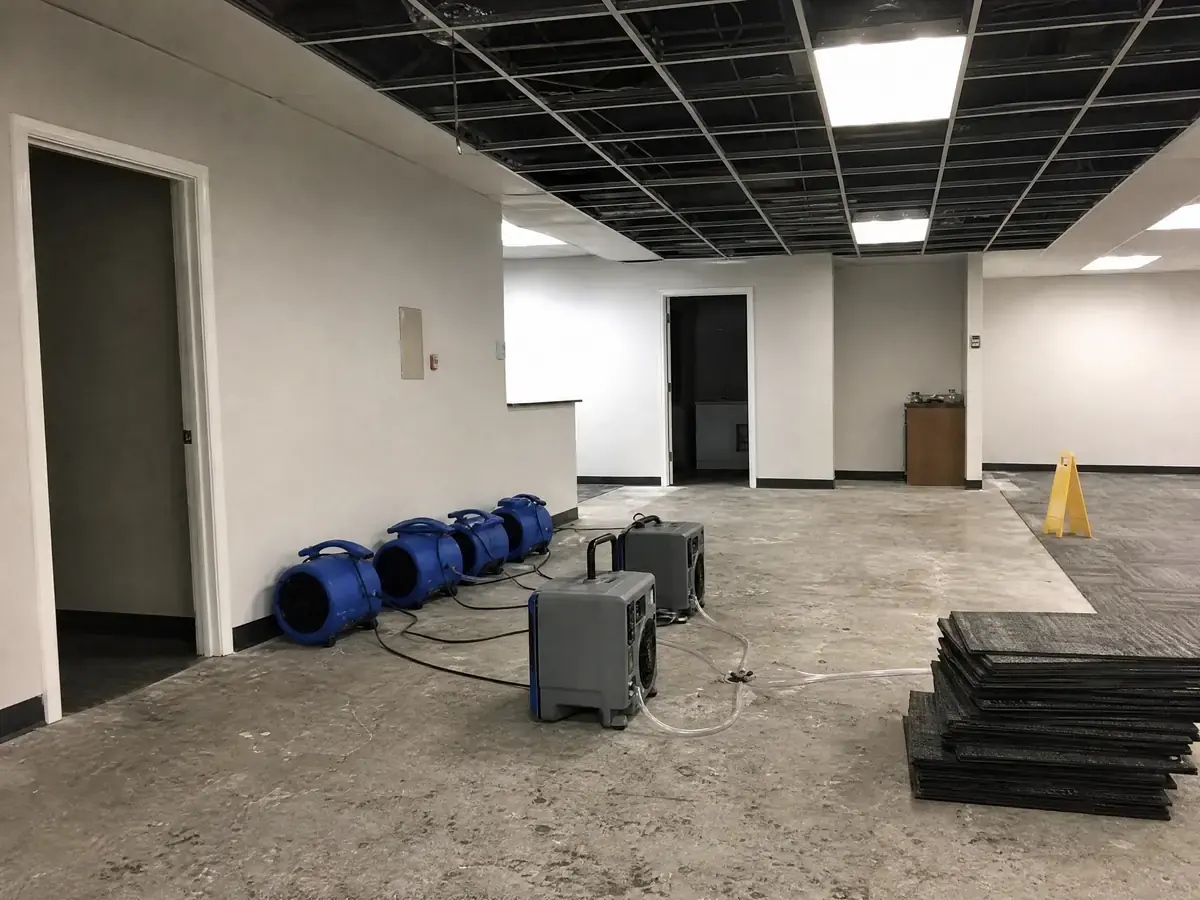 After, dried and handed back
Slab dried and tested with in-situ RH probes rather than a surface reading, equipment run overnight, area handed back zone by zone.
Standing water? Call now, we answer 24/7.
A real local person picks up, then a crew heads your way.
Who we are
We put the things most companies keep vague in writing: real price ranges for this market, the standards we work to, and a moisture log your adjuster can read.
24/7
A real local person answers, day or night
24-48 hrs
The critical window to limit secondary damage
~25 mi
Served from our San Marcos hub across Hays, Comal & Caldwell
S500
The ANSI/IICRC drying standard our process follows
One local team handles every stage, so you are not juggling separate vendors.
Start hereFast removal of standing water with truck-mounted and portable units before it soaks into more material.
See emergency water extraction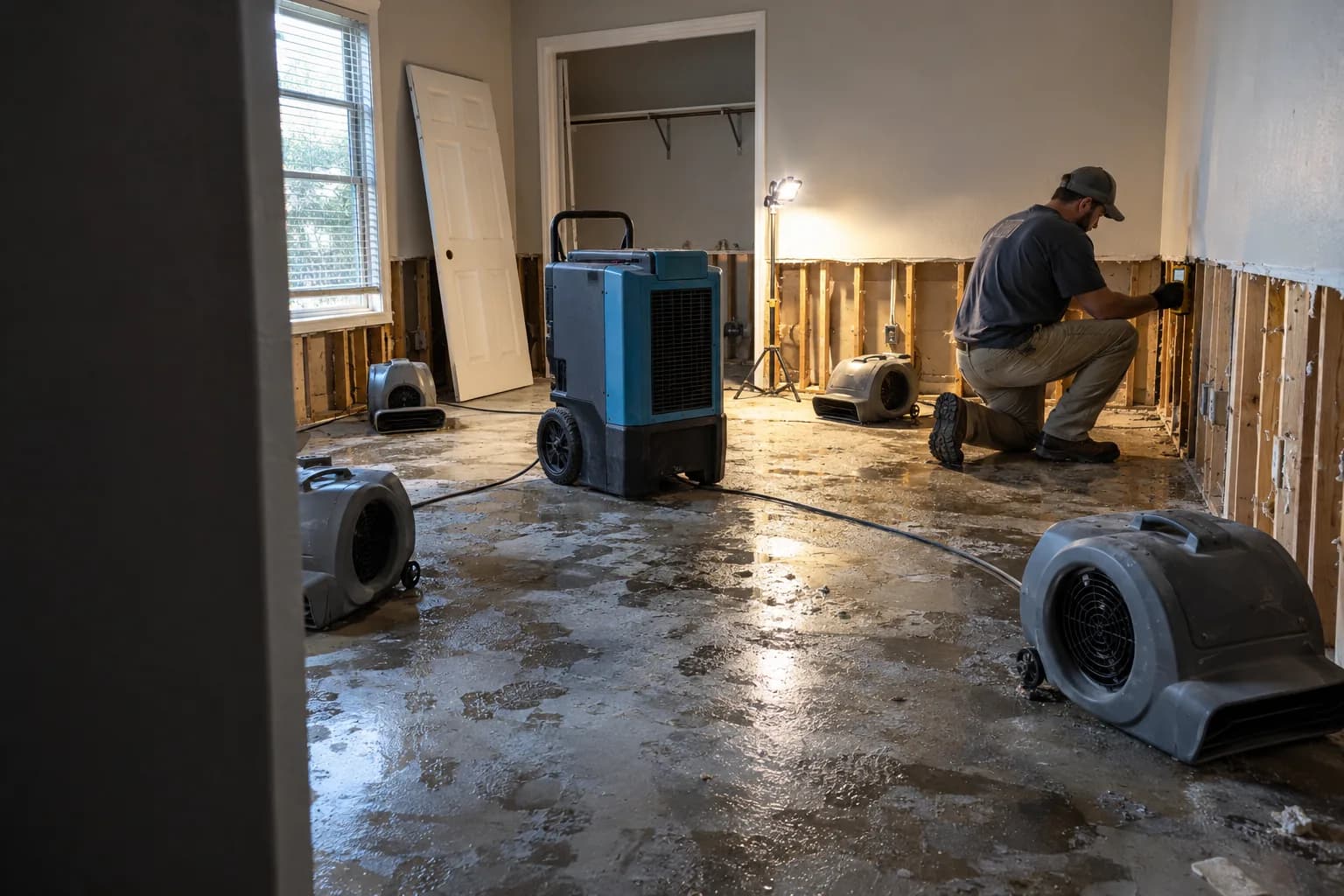
Air movers and LGR dehumidifiers with daily moisture readings, dried to a documented standard.
See structural drying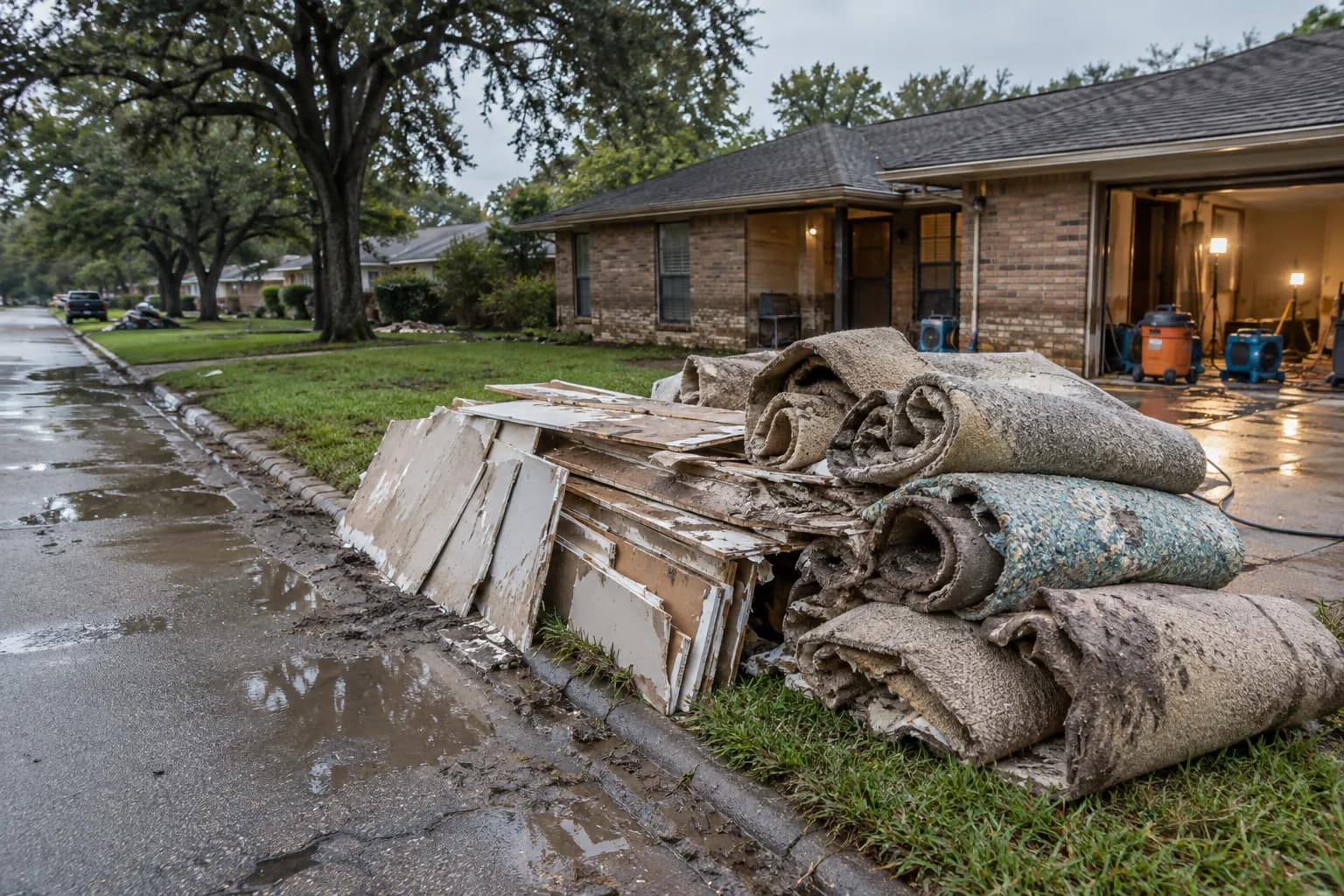
Muck-out and restoration after river flooding and flash floods along the San Marcos and Blanco Rivers.
See flood damage cleanupFAQ
Straight answers to what San Marcos homeowners ask most, on cost, insurance, mold timelines, and what to do first.
24/7
A real local team across Hays, Comal & Caldwell counties. Every job dried to a documented standard.
Have a question on your mind?
Get a quoteYes, our model is built for after-hours commercial response, because for a business or rental, downtime is the real cost. The first 24 to 48 hours decide how far water spreads and how big the loss gets, so we aim to start containment and extraction fast, day or night. Speed matters. Limiting spread early is what keeps a single-room failure from closing the whole floor. We work toward getting you reopened or re-leased as quickly as the drying allows, without skipping the steps that prevent a second failure.
Yes. Multi-unit losses near Texas State University are common when a supply line or roof leak hits an occupied rental block, and they need a team comfortable working unit by unit on a tight turnover window. We contain the spread between units and floors first, then extract and dry each affected unit while documenting it separately. Unit by unit. That per-unit record matters for an owner managing several leases and for the insurance claim. Our guide on student housing water damage in San Marcos covers how these losses typically unfold.
We're built around the documentation property managers and adjusters need. Here that means moisture readings, a Category classification, a per-unit scope of work, and a clear record of what was wet and what was done. That gives the property manager something concrete to share with the owner and gives the adjuster a defensible basis for the claim. Updates as we go. We can keep the PM and adjuster updated as drying progresses unit by unit. Our Texas water damage insurance claim guide explains how that documentation supports reimbursement.
We serve offices, retail storefronts, restaurants and food service, mixed-use buildings, and multi-unit and student-housing rentals across San Marcos and Hays County. Older buildings downtown and around The Square often have aging plumbing where one overnight failure reaches a ground-floor business and the units above it, so the approach is containment first, then extraction and drying by area. Restaurants and food service also face health-code pressure, which makes fast, documented drying especially important. Kitchens can't wait. If a loss involves contaminated water, our sewage cleanup service handles the Category 3 work safely.
Tell us straight what is happening and we will tell you the next step. We pick up, then we are on the way.
A real local person answers, 24/7. Tell us what is happening and we are on the way.