San Marcos water damage guide
Water Damage Restoration Insurance Claim Guide for Texas
A water damage restoration insurance claim in Texas lives or dies in the first hour, before the adjuster ever shows up. The sequence matters, which means document, call your insurer, get a written scope of work, then submit your proof of loss before the deadline. Get that order wrong, or skip the documenting part because you're busy hauling out soaked carpet, and you can quietly torpedo a claim that should have paid. There's also a decision buried in all this that nobody tells you about. Filing isn't automatic. Sometimes the math says pay it yourself.
Published · Updated
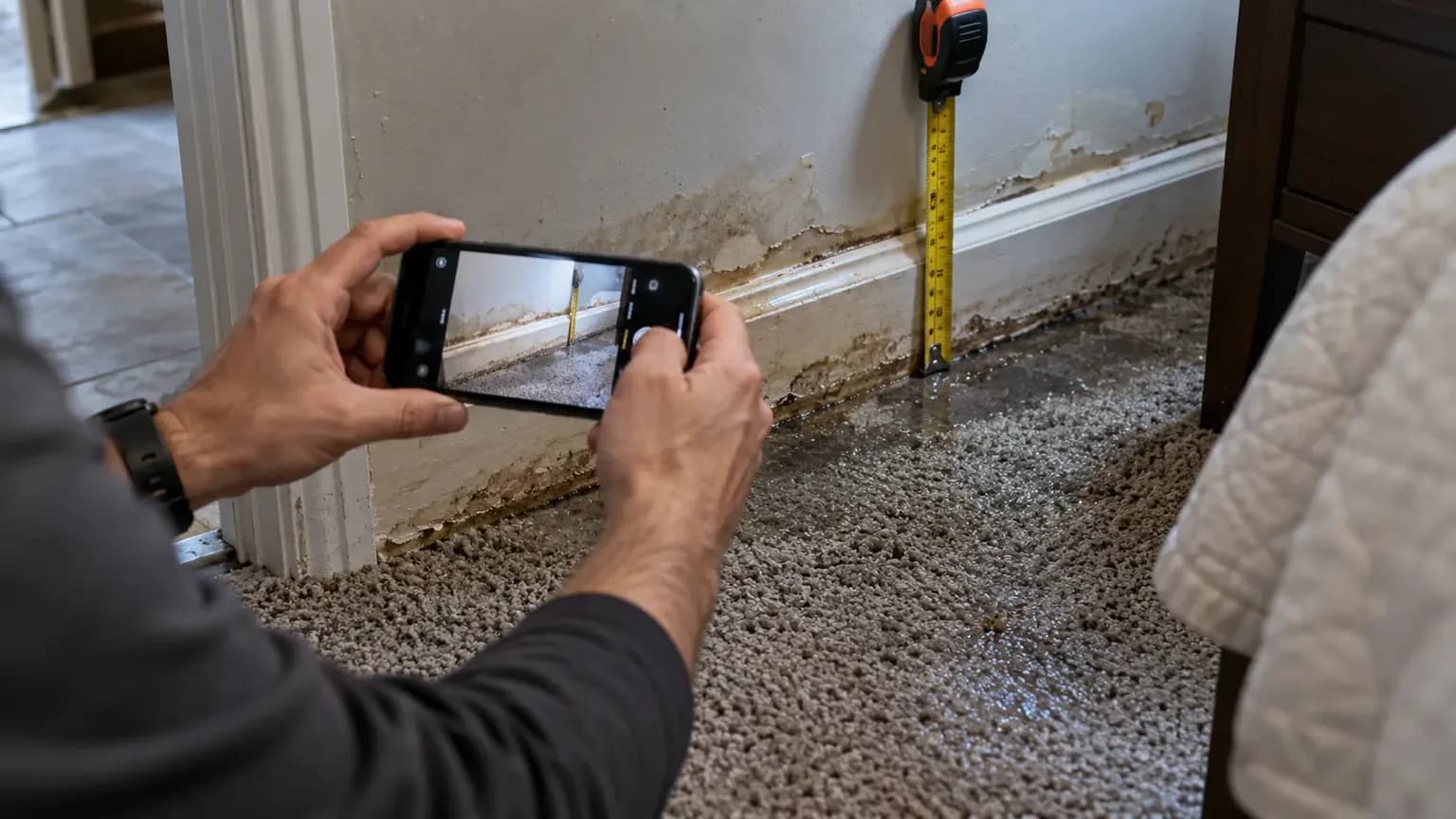
This guide walks the whole thing, in order, the way it actually unfolds when your kitchen floods on a Tuesday. For the coverage question underneath it all, start with whether homeowners insurance covers water damage in Texas.
How Do I File a Water Damage Insurance Claim in Texas?
Filing isn't one action. It's a sequence, and the early steps protect the later ones. Stop the water, document everything before you move it, notify your carrier promptly, get a professional moisture assessment, then submit a written proof of loss with a documented scope. Here's the order that keeps a claim clean.
- Stop the water source and make the area safe. Shut off the supply at the valve or the main, and kill power to any wet area before you wade in.
- Photograph and video everything before you move a single thing. Wide shots, close-ups, the failed part, the water line on the wall.
- Call your insurer to open the claim. Make the call. Get a claim number and write down who you spoke with.
- Get a written scope of work from a restoration company. This is the document the adjuster compares against, and a clean line-item version gives the carrier far less room to argue the repair down later.
- Keep every receipt and a moisture or drying log. Save it all. Fans, dehumidifiers, a hotel night if you had to leave.
- Submit your proof of loss before the policy deadline. Beat the clock. Most policies set a hard window.
- Don't discard wet materials until they're documented. Bag and label, don't toss.
Work it top to bottom. Each step backs up the one after it, and an adjuster can tell when a homeowner skipped straight to cleanup.
Should I File a Water Damage Claim or Pay Out of Pocket?
Ask this one first. It is the question that should come before any of the steps above, and almost nobody does. If the repair total sits near or below your deductible, filing gains you nothing and puts a claim on your record.
File a water damage claim when the repair clearly exceeds your deductible and the damage is significant; pay out of pocket when it falls at or below the deductible. In Texas, two or more claims in a few years can raise premiums or affect renewal, so a small job near the deductible is often cheaper to self-pay. Compare the estimate to your deductible first.
Do the arithmetic. Texas deductibles commonly run anywhere from $1,000 to $5,000, and some windstorm and hail deductibles are set as a percentage of the dwelling value, which can push them higher than people expect. If a contractor scopes the repair at $1,400 and your deductible is $1,000, you're filing a claim to recover four hundred dollars while putting a mark on your loss history. That's rarely worth it.
The premium side is where it stings later. A water claim in Texas can push your renewal up by roughly 10 to 20 percent, and that bump can ride for years. One sudden, accidental loss usually won't hurt you much. A pattern of claims is what makes carriers nervous, and a couple of them in a short window can affect whether they renew you at all. So a single big burst-pipe loss is a clear file. The pattern is what hurts. Two small ones in three years is a different calculation. Run the numbers before you pick up the phone, because once a claim is opened it's on your record whether or not it ever pays out.
What to Document (and the Mistake That Sinks Claims)
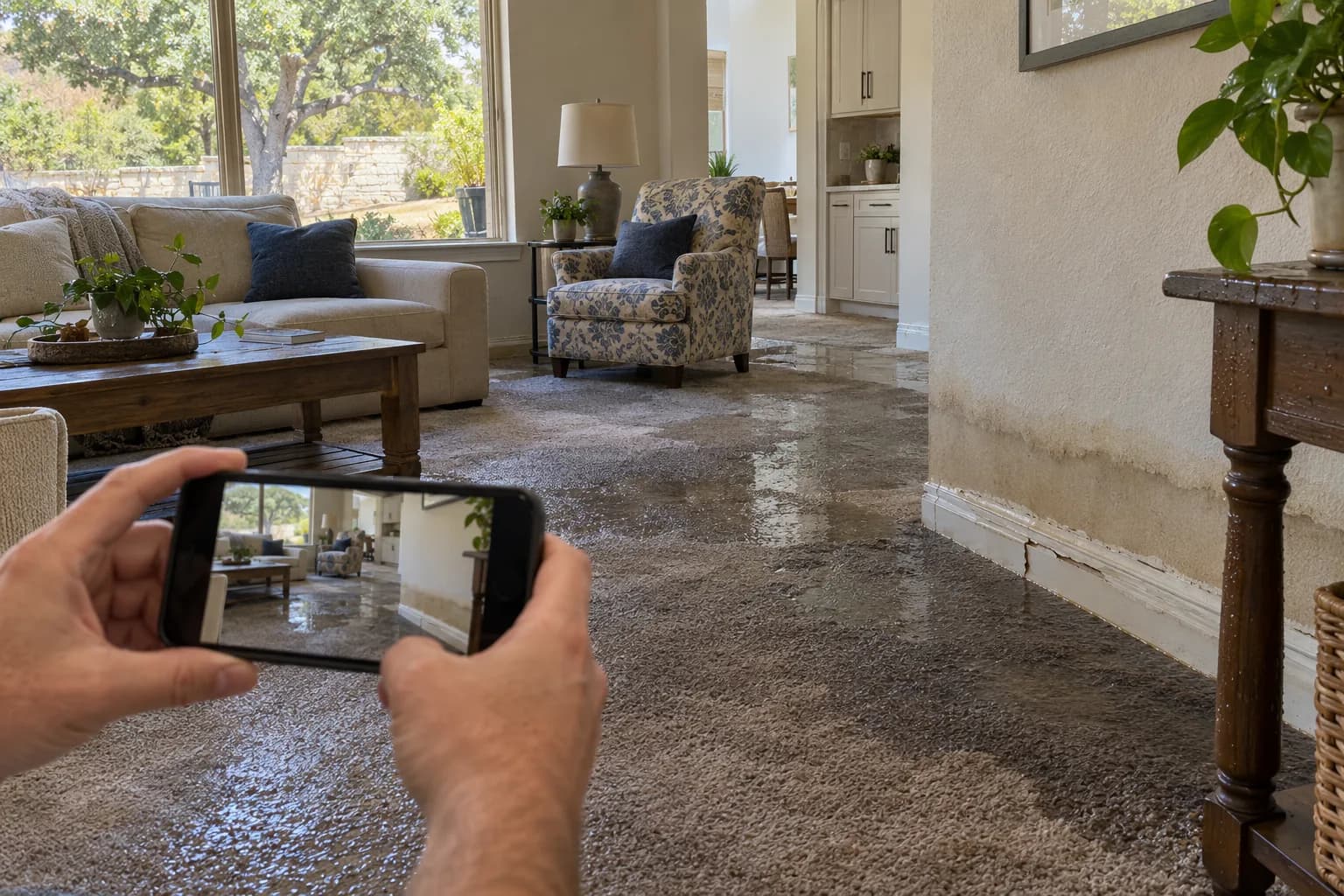
Document before you throw out. Here's the single most expensive mistake homeowners make, and it happens in the first panicked hour. They bin the wet stuff before anyone recorded it. Photograph the source, the standing water depth, and every damaged item where it sits.
Once the soaked carpet, the swollen baseboard, the ruined contents are at the curb, you've destroyed the evidence of their condition and their value. You can't prove what the laminate looked like or that the sofa was three years old, not eight, and once it's gone the carrier has no reason to take your word for any of it. The adjuster only has what you captured. So photograph and log everything before extraction, even while the water is still being pumped out. Shoot it all. Get serial numbers off the damaged appliances, model numbers off the water heater, dates on receipts if you have them. A drying log that shows daily moisture readings does double duty. It proves you mitigated promptly, which heads off a "you let it sit" argument later.
A practical rhythm that works. That means shoot a wide video of each affected room first, narrate what happened and when, then go close on the damage and the failed component. Save it to the cloud immediately so a dead phone doesn't take your proof with it. Back it up. The deeper checklist lives in our guide on how to document water damage for a claim.
What Is a Proof of Loss and Scope of Work?
Two pieces of paper. A proof of loss is your sworn statement of what was damaged and what it is worth, and a scope of work is the itemized plan for returning the property to pre-loss condition. Most people never hear of either.
A proof of loss is the sworn statement you submit to your insurer. You sign it. It lays out what was damaged, what caused it, and the dollar amount you're claiming, and you sign it under oath. It's backed by your photos, the scope of work, your receipts, and that moisture log. Paper backs it. Policies set a deadline to file it, sometimes tight, which is the whole reason this guide keeps hammering "document early." Miss the window and a valid claim can die on a technicality.
The scope of work is the line-item plan for the repair. Here that means extract the water, dry to standard, remove and replace this much drywall, this much flooring, and so on. The adjuster inspects, then approves a scope and a number. When the restoration company's scope and the adjuster's scope don't line up, that's where claims stall. The numbers must match. Restoration work is typically scoped to recognized drying standards, the same S500-style framework adjusters expect to see, so a clean scope speaks the adjuster's language. A documented water damage inspection is how you get that scope on paper from the start.
Filing a claim? Talk through your next step.
Filing a Flood Claim Is Different (NFIP)
Flood claims are different. If the water came from outside, rising up from the San Marcos River or sheeting in during a flash flood, almost everything above changes. They run through the NFIP, with their own adjusters, deadlines, and separate building and contents limits.
Flood losses don't go through your homeowners claim at all. They go through a separate flood policy under the National Flood Insurance Program, administered by FEMA, with its own adjuster, its own proof-of-loss timeline, and its own rules. Two policies, two claims, two processes, and they're handled independently. They never merge. After a 2015-style area-wide event, both systems get slammed at once. Adjusters get backlogged for weeks because everyone files in the same window, which is precisely why documenting early, before the rush, tends to move your file faster. A clean, complete claim that lands first gets worked first.
One more wrinkle people hit. A single storm can trigger both policies. Rising water that came in the doors is an NFIP claim, while a roof breach that let wind-driven rain in during the same storm is a homeowners claim. Sorting which water came from where decides which carrier pays for what. We lay out the full split in flood insurance vs homeowners insurance in Texas.
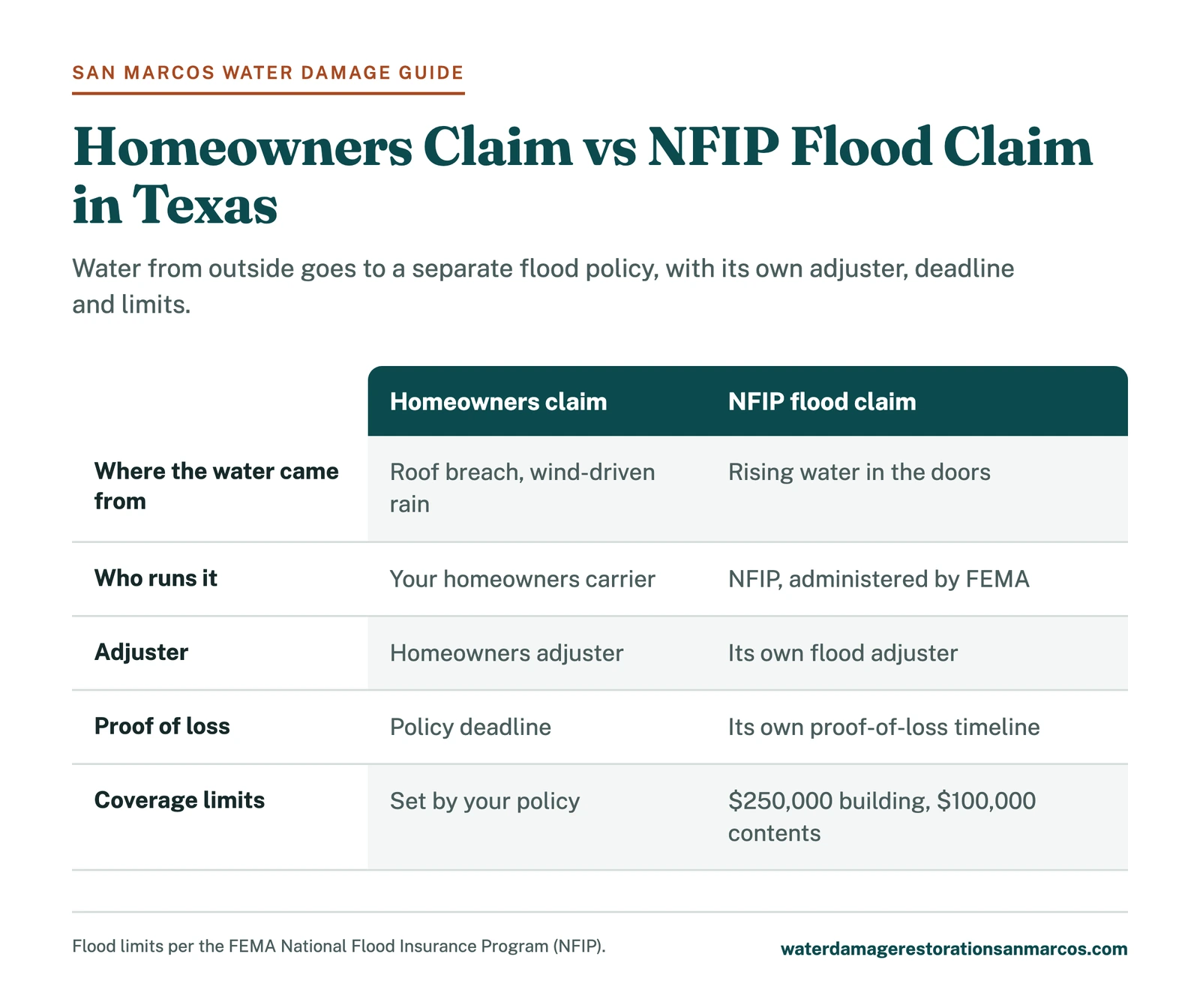
Text version of this infographic
Homeowners Claim vs NFIP Flood Claim in Texas. Water from outside goes to a separate flood policy, with its own adjuster, deadline and limits.
| Item | Homeowners claim | NFIP flood claim |
|---|---|---|
| Where the water came from | Roof breach, wind-driven rain | Rising water in the doors |
| Who runs it | Your homeowners carrier | NFIP, administered by FEMA |
| Adjuster | Homeowners adjuster | Its own flood adjuster |
| Proof of loss | Policy deadline | Its own proof-of-loss timeline |
| Coverage limits | Set by your policy | $250,000 building, $100,000 contents |
Flood limits per the FEMA National Flood Insurance Program (NFIP).
What If My Claim Is Denied?
A denial is not final. It's a sentence, and you get to respond to it. Request the written reason and the policy provision cited, gather documentation the adjuster didn't have, then ask for a reinspection or file a formal appeal. See what to do when a claim is denied.
First, get the denial reason in writing. Carriers have to tell you why, and the "why" is your roadmap. The common denial reasons in Texas run like this. The insurer says the damage was gradual rather than sudden, the loss falls under an exclusion like flooding or wear and tear, or the claim was filed too late. Read your policy language against the stated reason, then gather documentation that counters it directly. If they're calling a burst pipe "gradual," your timestamped photos and the failed coupling are the rebuttal. Push back with proof.
From there you have moves. You can request a re-inspection, formally appeal, or bring in a licensed public adjuster who represents you rather than the carrier. A lot of denials trace back to thin documentation, the exact gap this guide is built to close, and a gap you can sometimes still fill after the fact. We don't fight insurers or promise reversals; that's not our lane. But the cleaner the original paper trail, the fewer denials happen in the first place. Good records win. The full playbook is in what to do if your claim is denied.
Written by the Water Damage Restoration San Marcos team
Local water-damage restoration in San Marcos, TX and Hays County. Our guidance follows the ANSI/IICRC S500 and S520 reference standards the industry plans around. Questions about your situation? Call (512) 778-8417, we answer 24/7.