San Marcos water damage guide
How to Avoid Getting Overcharged for Water Damage Work
To avoid getting overcharged for water damage work, get the scope in writing, demand an itemized estimate that lists equipment by the day, ask for daily moisture readings, and get a second opinion before you sign. The stories that scare San Marcos homeowners are real ones, the $15,000 bill against a $5,000 approved scope, the $900 line for caulk. They are real. They happen when nobody itemizes and nobody checks. This guide shows you exactly how padding works and how to catch it, even if you never hire us.
Published · Updated
How Do You Avoid Getting Overcharged for Water Damage Work?
To avoid getting overcharged for water damage work, get the scope of work in writing, insist on an itemized estimate that lists equipment by the day, ask for daily moisture readings, and get a second opinion before signing. A fair restoration bill ties every line to a documented drying plan, not a flat lump sum.
That is the whole defense in one paragraph. The rest of this guide is just the detail behind each piece, so you can read your own quote like an adjuster would.
Why does this market need a guide at all? Because the trust here is already thin. Talk to enough San Marcos homeowners and you hear the same refrain about restoration billing. The number on the invoice and the number the insurer approved never seemed to line up, and nobody could explain the gap. That "we'll just bill your insurance" shrug is exactly the attitude that lets padding slide. The defense is not suspicion of everyone. It is paperwork. A documented scope and a moisture log turn a fuzzy lump sum into something you, or your adjuster, can check line by line.
Red Flags of a Padded Restoration Invoice
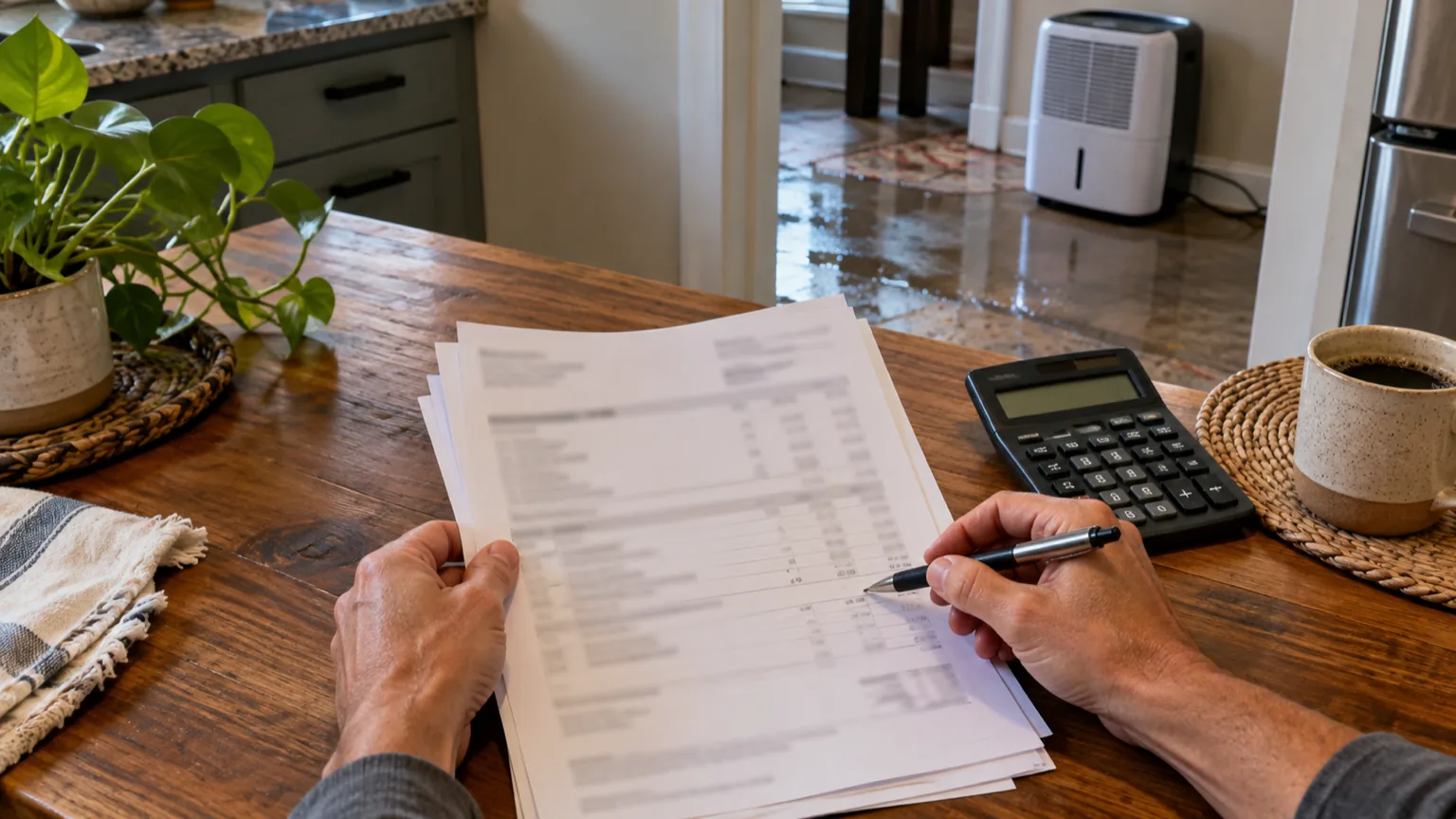
Most padding hides in plain sight. The common ones are a lump-sum drying charge with no equipment or day count, equipment left running past the point the meters read dry, rooms billed that were never wet, and a scope that grew after the adjuster approved it. Watch for these.
- A lump-sum price with no line items, just one big number and a signature line.
- No water category or class written on the estimate.
- Drying equipment left running, and billed, past the point the material reads dry.
- The phrase "we'll just bill insurance, don't worry about the cost."
- Pressure to sign before anyone took a single moisture reading.
- No daily drying log offered or kept.
- A flat refusal to put the scope in writing when you ask.
Any one of these deserves a question, because each one quietly removes a piece of paper you would otherwise use to check the bill against what actually got wet in your house. Two or three together, and you should call someone else for a second look. No exceptions. The honest operators in this trade do not flinch when you ask for the breakdown, because the breakdown is the exact same document they used to scope, price, and schedule the job in the first place.
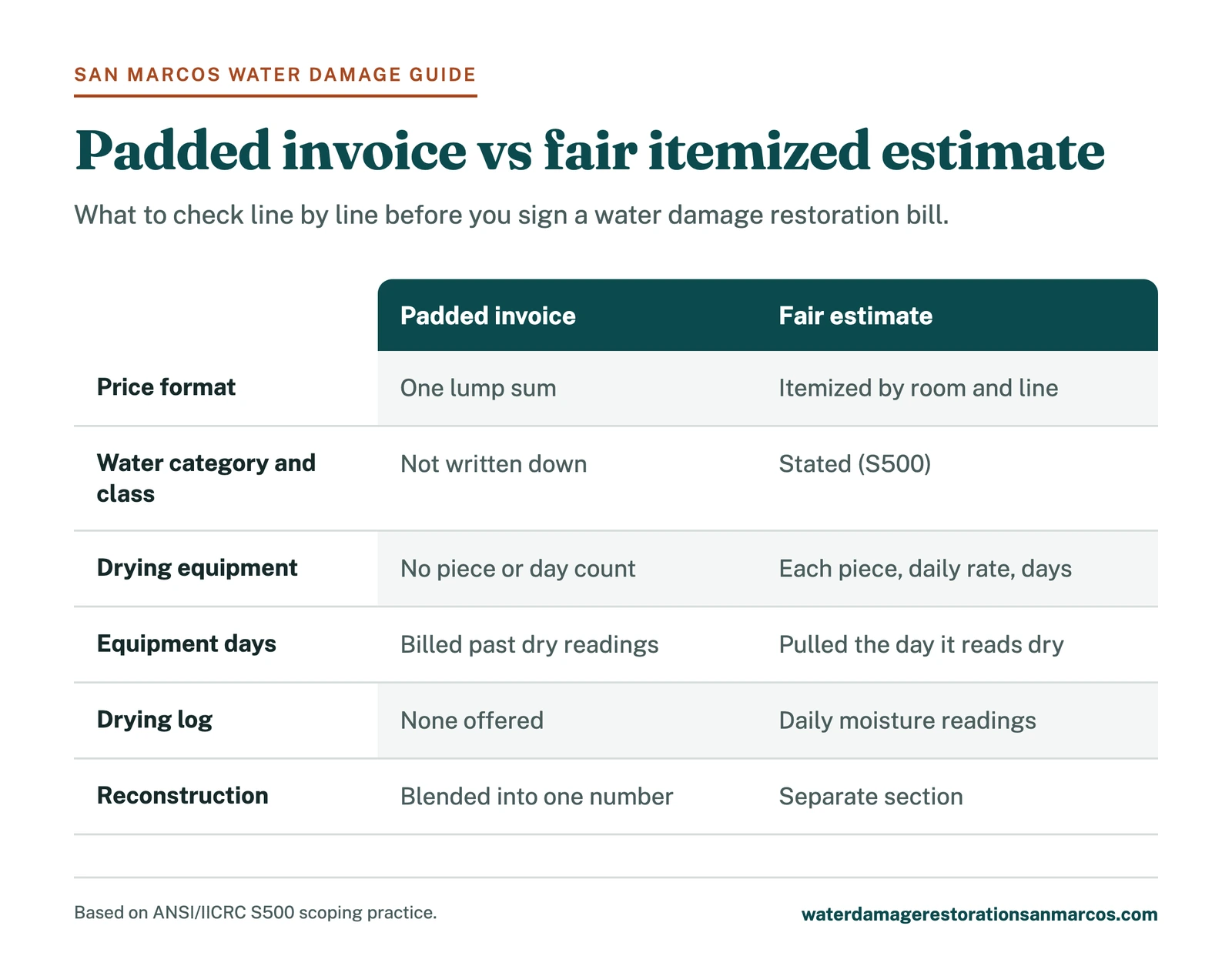
Text version of this infographic
Padded invoice vs fair itemized estimate. What to check line by line before you sign a water damage restoration bill.
| Item | Padded invoice | Fair estimate |
|---|---|---|
| Price format | One lump sum | Itemized by room and line |
| Water category and class | Not written down | Stated (S500) |
| Drying equipment | No piece or day count | Each piece, daily rate, days |
| Equipment days | Billed past dry readings | Pulled the day it reads dry |
| Drying log | None offered | Daily moisture readings |
| Reconstruction | Blended into one number | Separate section |
Based on ANSI/IICRC S500 scoping practice.
What a Fair, Itemized Estimate Looks Like
A real estimate reads like a plan, because that is what it is built from. It names each affected room, lists the equipment by type and the days each ran, gives material quantities, and separates mitigation from reconstruction so you can see two scopes rather than one number.
It starts with the water category and class, the S500 classification that decides how aggressive the drying has to be. That is the anchor. From there it lists the affected areas and the equipment assigned to each. The short version is so many air movers, so many dehumidifiers, each with a daily rate and an expected number of days. Antimicrobial appears only where the category warrants it, not as a reflex charge on a clean-water job. Each line earns its place. Disposal shows up only if contaminated material actually came out. And reconstruction, the drywall and paint and flooring, sits in its own section, priced separately, because rebuilding is a different job from drying.
The class part is worth a second. S500 sorts losses into classes by how much material is wet and how hard it will be to dry. A Class 1 loss is a small area with low-porosity materials and dries quickly. A Class 4 loss involves deeply saturated materials like hardwood, plaster, or concrete that hold water and need specialty drying. Big difference. The class is the honest reason an estimate runs higher, and it is a reason you can verify by looking at what actually got wet. A quote that skips category and class entirely has skipped the math, which means the number came from somewhere other than the conditions in your house. Do the comparison. When you can see typical water damage restoration cost in San Marcos next to your line items, you can tell at a glance whether the math is sane. In Hays County, a lot of insurance-driven work gets scoped in Xactimate, the same estimating software adjusters use, so a homeowner who knows the line items can compare a quote directly to what the carrier approves. That comparison is where you get your footing back.
Why Equipment Days Are the Most Common Padding
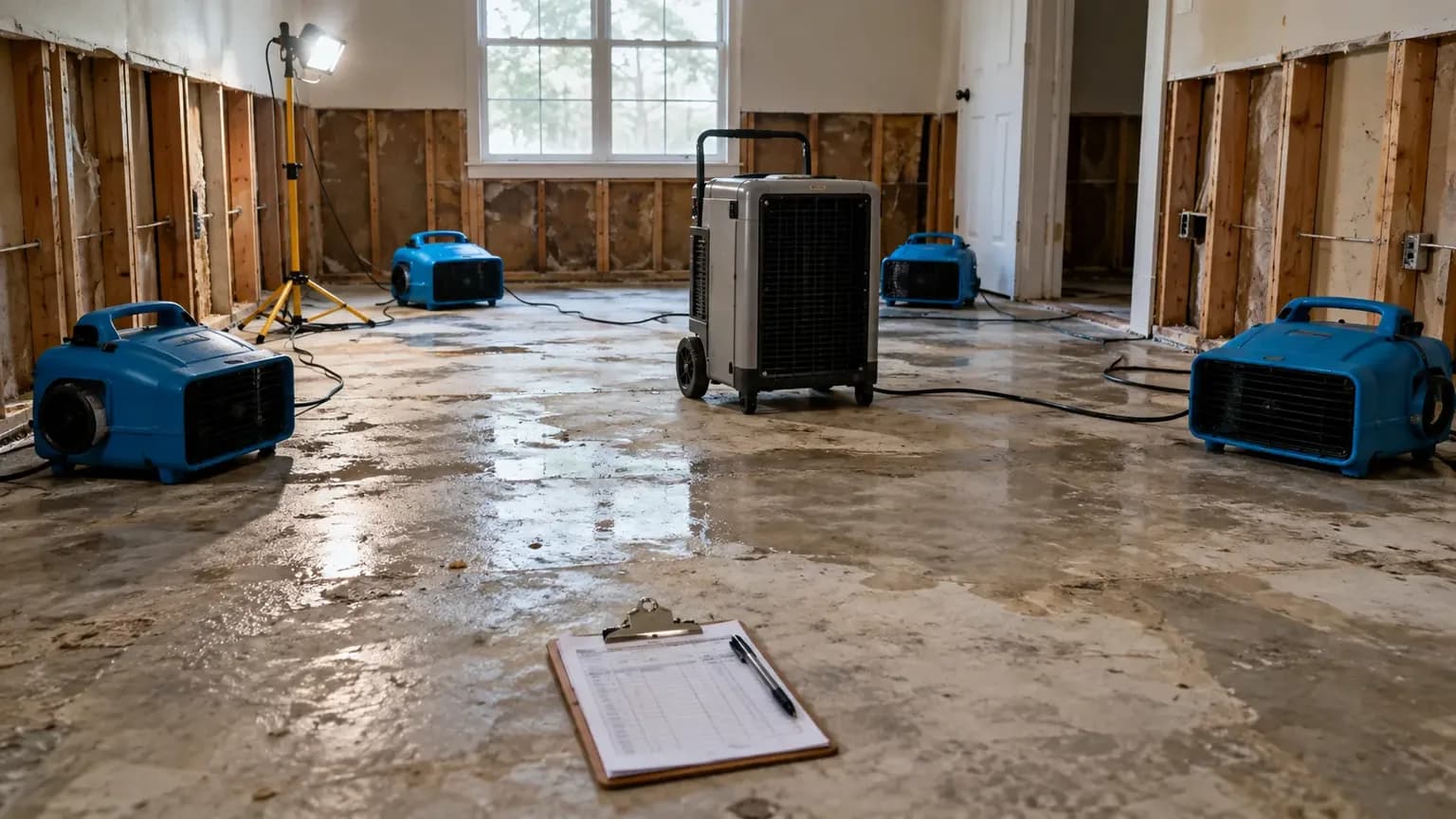
Here is the trick almost nobody explains. Drying gear is billed per piece, per day. Leave it running an extra three days and the invoice grows quietly, with no dramatic line item to flag. Daily moisture readings are the defense. They show the date the materials actually hit dry standard.
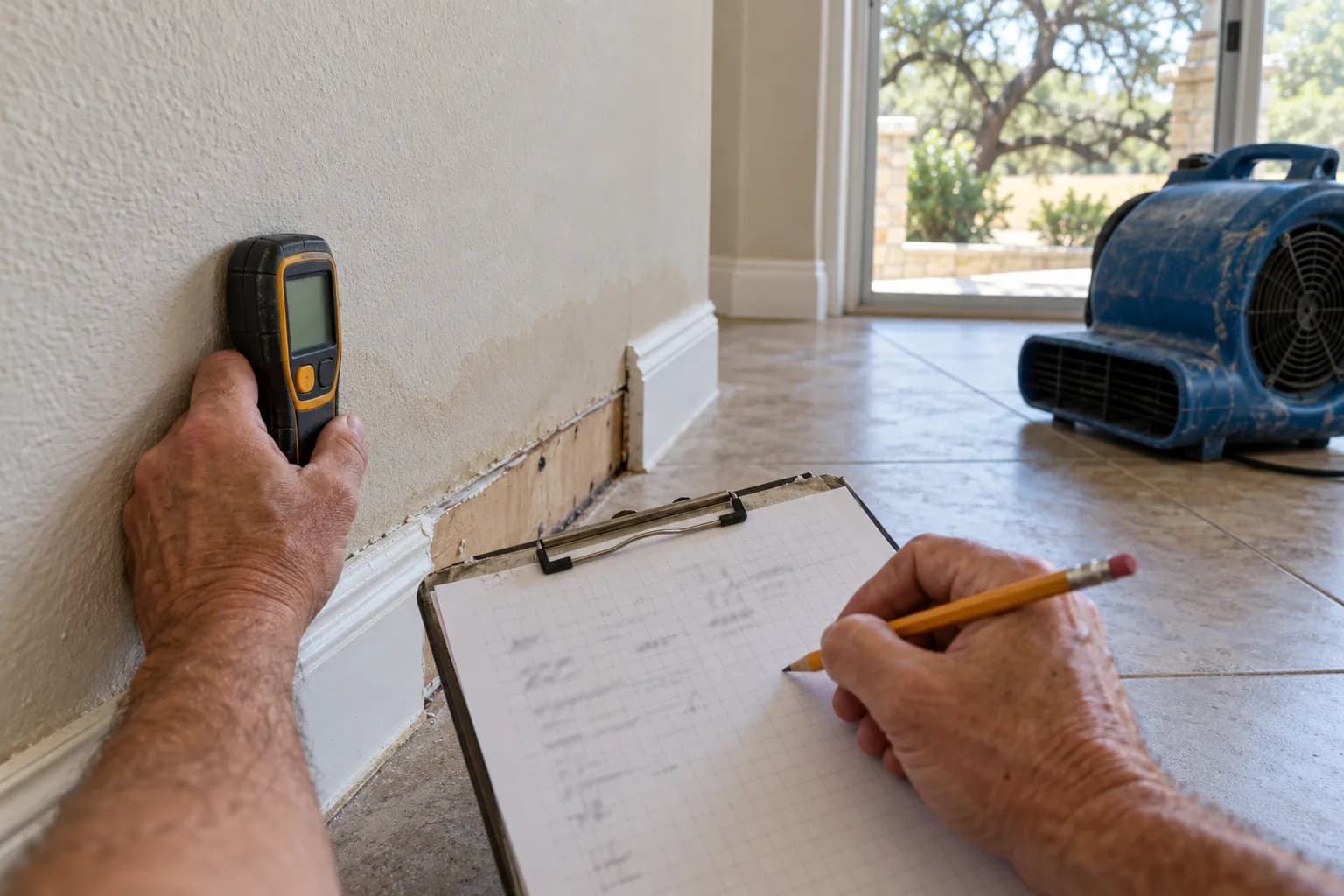
The fix is a number, not a vibe. Legitimate crews take daily moisture-meter readings and pull each piece of equipment on the exact day that material hits its dry-to-standard target, rather than leaving it running until whenever the truck happens to be back in the neighborhood again. The proof of that is the drying log. That means a sheet showing the moisture content of each material, day by day, dropping toward target. If the equipment count on the invoice matches the days the log says the material was still wet, the charge is honest. If the gear billed for six days but the log shows the drywall hit target on day three, you have found the padding right there. Ask for the log. A company that documents structural drying to standard hands it over without blinking, because the readings are how they decide when the job is actually done. The ones that just eyeballed the job tend to suddenly not have a log.
Should You Get a Second Opinion?
Yes. When the number feels high, or the estimate feels vague, a second opinion is the fastest, cheapest protection you have. Ask a second firm to price the same documented scope rather than re-inspect from scratch, so you are comparing like for like instead of two different jobs.
Get a written scope from each company and lay them side by side. Compare the category they assigned, the equipment counts, the drying days, and what material each says has to come out. Honest estimates will land close. A wild outlier usually means someone misclassified the water or stacked on equipment that the moisture readings will not support. Outliers tell on themselves. This matters more after area-wide events. When a 2015-style flood or a hard-freeze pipe burst hits Central Texas all at once, out-of-town storm chasers roll in with inflated quotes and a hurry-up pitch, then leave. A genuinely local outfit is still here next month if something is not right. We tell people plainly. Here that means get the second opinion, and if you are weighing companies, how to choose a restoration company walks through the rest of the criteria. We welcome the comparison and we itemize everything, because we would rather earn the job than win it on a number you cannot read.
Written by the Water Damage Restoration San Marcos team
Local water-damage restoration in San Marcos, TX and Hays County. Our guidance follows the ANSI/IICRC S500 and S520 reference standards the industry plans around. Questions about your situation? Call (512) 778-8417, we answer 24/7.