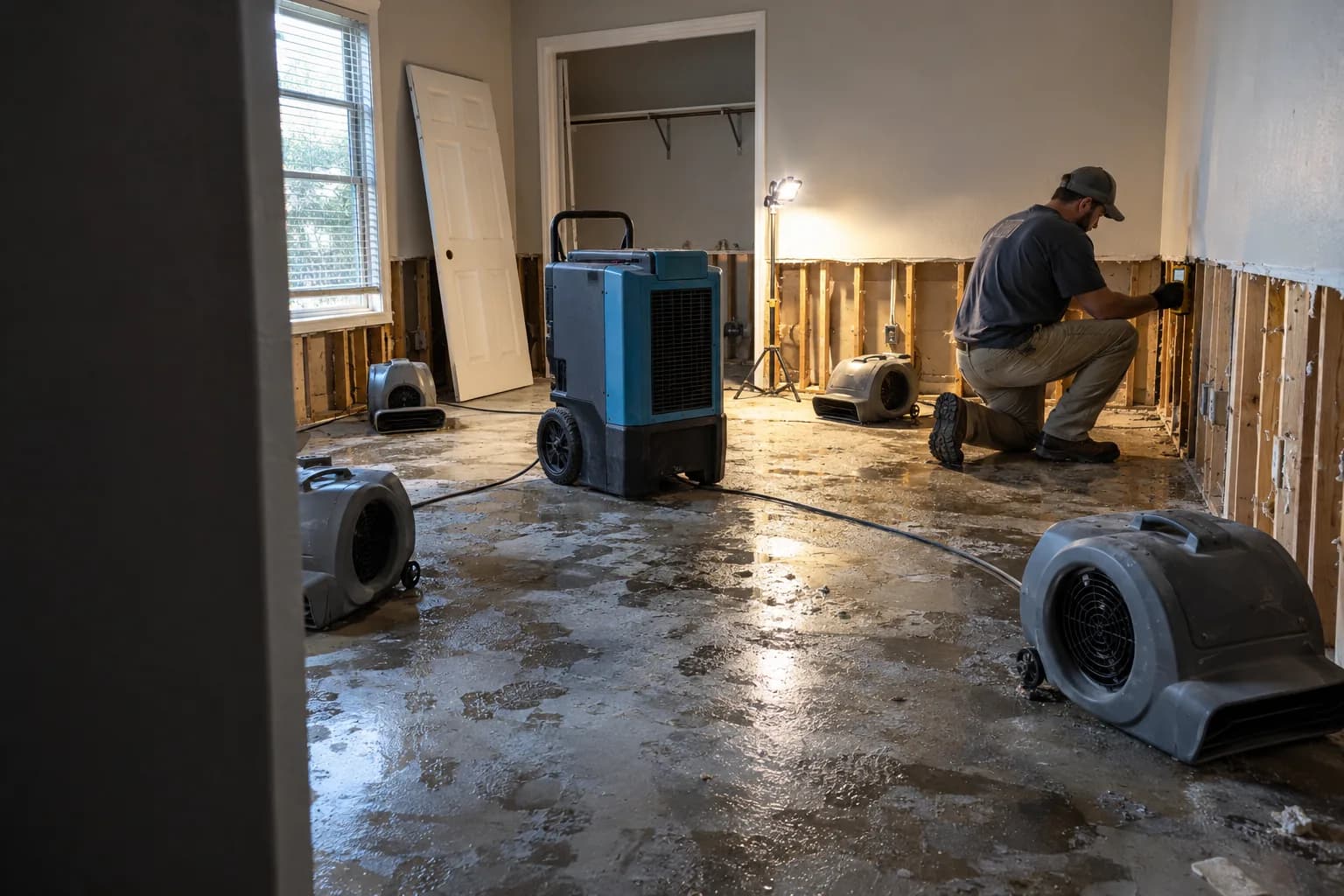
Structural Drying & Dehumidification
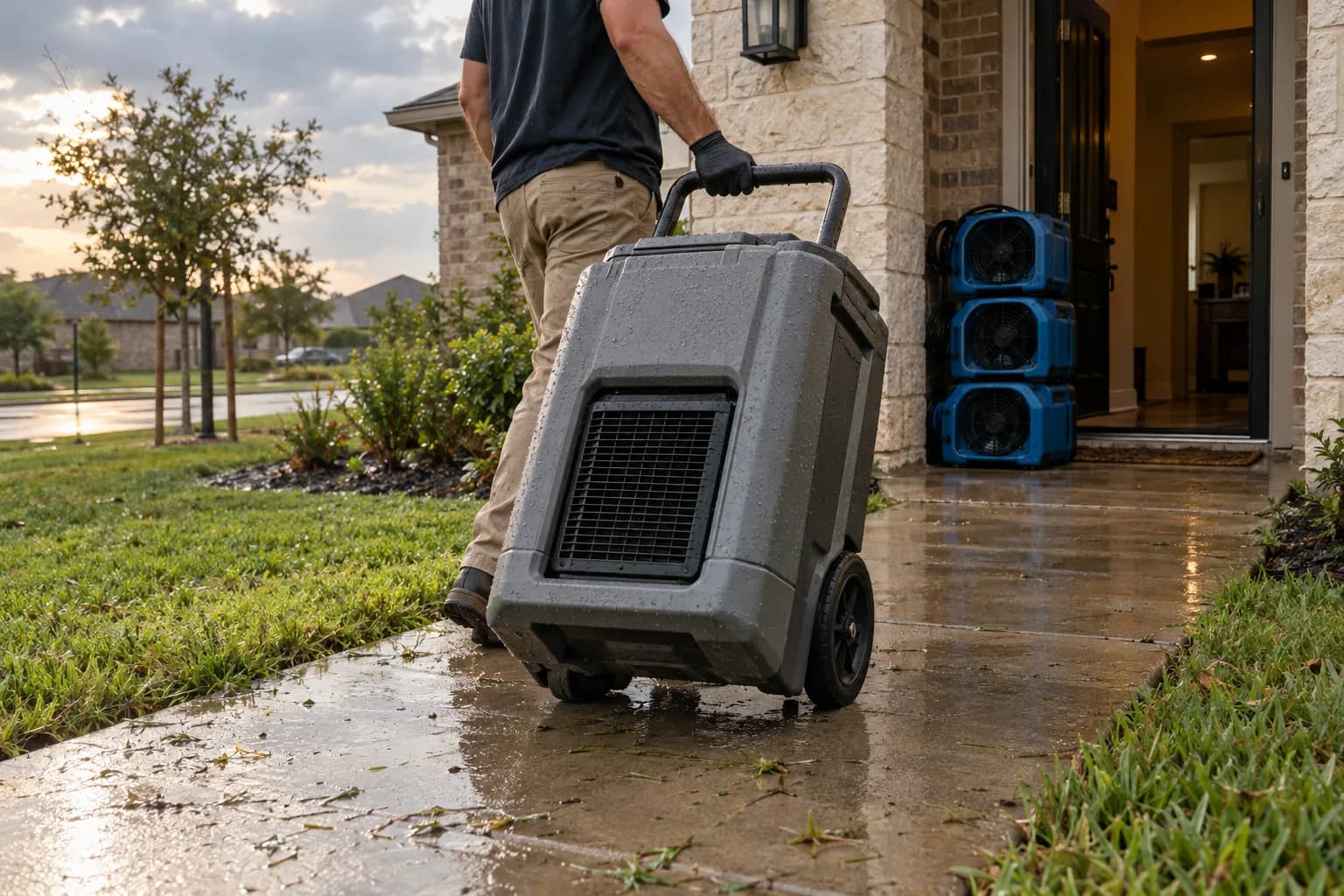
Air movers and LGR dehumidifiers with daily moisture readings, dried to a documented standard.
See structural drying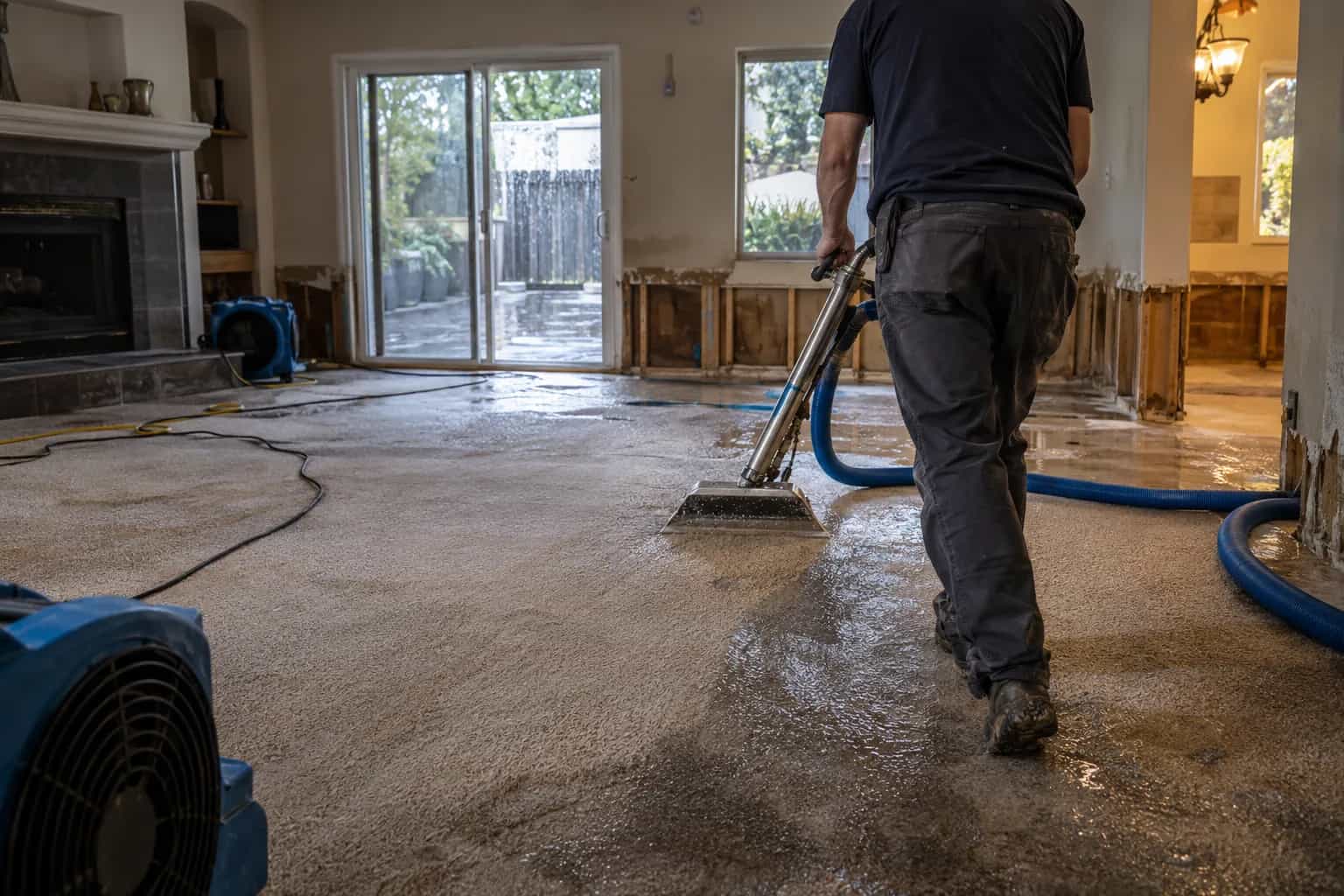
San Marcos, TX & Hays County · 24/7 response
Standing water comes out first, with truck-mounted and portable pumps, before it wicks into subfloor and wall plates. We answer 24/7 across San Marcos and Hays County.
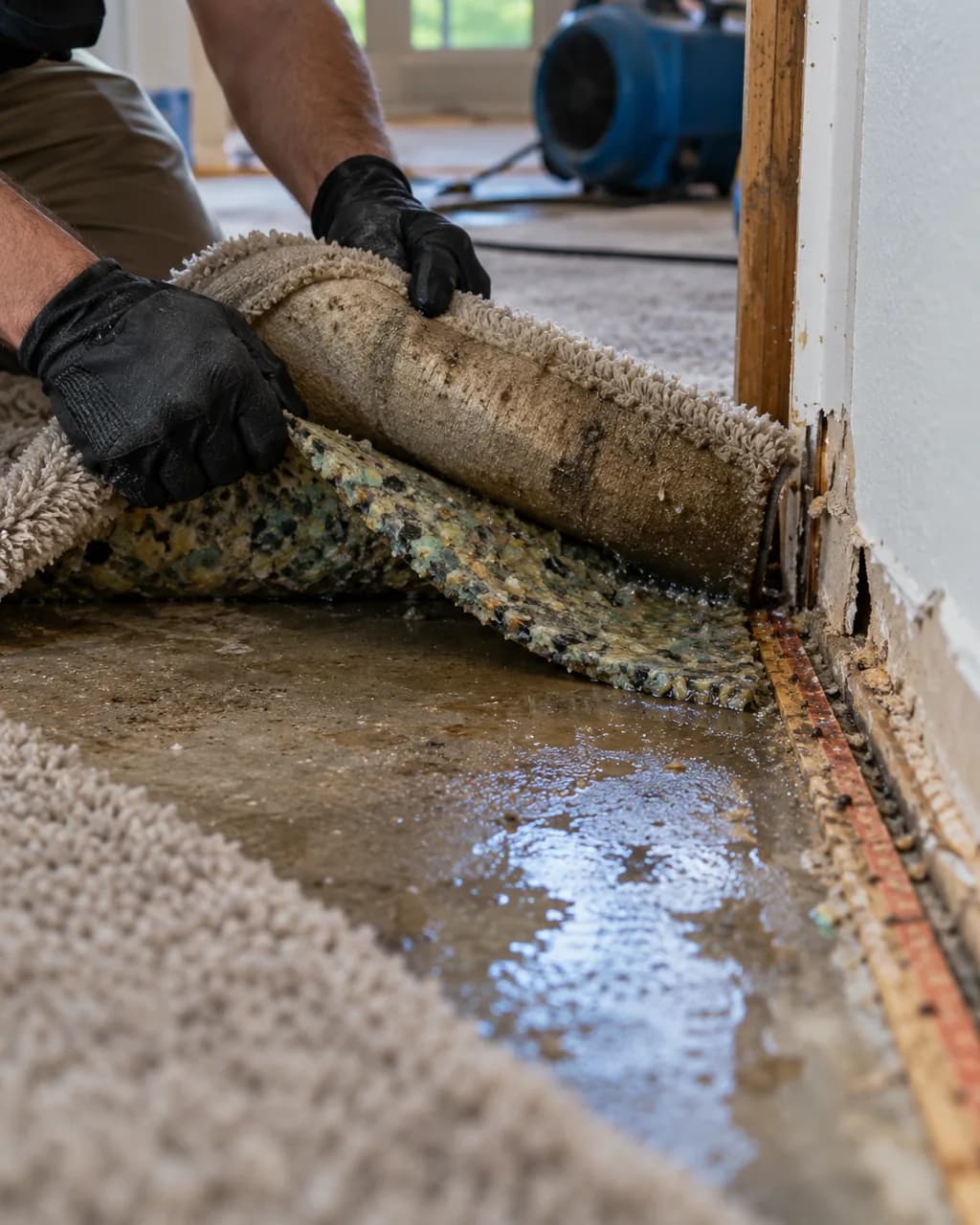
Emergency water extraction is the first stage of water damage restoration in San Marcos: pulling standing water out with truck-mounted and portable units so structural drying can begin. ANSI/IICRC S500 puts the critical window at 24 to 48 hours, because clean Category 1 water degrades to Category 2 as it sits.
If you're standing in water right now, here is the first move. Shut off the water source if you can reach it safely, keep clear of any outlet or panel the water has touched, and call us. We can talk you through the next few minutes on the phone while a crew heads your way.
Standing water? We're on the way. Tap to call now.
Water Damage Restoration San Marcos handles emergency water extraction across San Marcos and the wider Hays County area, with round-the-clock dispatch. The reason speed matters this much is simple. The water on your floor is already moving into places you can't see.
Extraction is the bulk-removal phase that comes before any drying. Get it right and most of your home is salvageable. Get it slow, and the repair bill climbs.
Standing water should be extracted as soon as possible, ideally within the first 24 to 48 hours. That window matters because water keeps wicking into drywall, subfloor, and carpet pad, and after roughly two days secondary damage like swelling, delamination, and mold growth becomes far harder and costlier to reverse.
That timeline isn't a sales tactic. It's the working window the industry plans around under ANSI/IICRC S500, the standard our process follows for water removal. In San Marcos's humid Central Texas air, the clock runs a little faster. Moisture that lingers feeds mold, and mold turns a drying job into a remediation job.
Sooner is cheaper. The longer water sits, the more material has to come out instead of being dried in place.
The sequence holds. We make the area safe, stop the source, classify the water category, extract standing water with truck-mounted and portable units, then move straight into drying before materials wick moisture further. Here is how a typical San Marcos extraction runs.
Category changes everything. ANSI/IICRC S500 grades water in three categories by contamination level, and that grade decides whether a wet material gets cleaned and dried in place or cut out and disposed of. It also decides what protective equipment the crew wears.
Category 1 is clean water from a supply line or a water heater. Category 2, sometimes called gray water, carries some contamination, think a washing machine overflow. Then it gets worse. Category 3 is black water. The short version is sewage backup, or river floodwater that has picked up ground contaminants, the kind of loss where more material has to come out and sanitizing becomes part of the job rather than an afterthought.
This is why a crew can't just start pulling up water. What the water is determines what's safe to keep.
Some of these are obvious. Some are not. Standing water anywhere on a floor needs extraction, but so does carpet that squelches underfoot, a baseboard that has darkened, a musty smell in a closed room, or a water bill that jumped without explanation. Any of these means water is sitting somewhere.
If you're seeing the last one, water has likely been moving under your flooring for a while. Call before it surfaces.
San Marcos sits in Flash Flood Alley, right along the San Marcos River, so standing water here comes from two very different directions. On one end, a burst supply line in a Blanco Vista new-build. On the other, river water pushed into a Blanco Gardens home during a flood event. Same wet floor, very different cleanup.
Slab-on-grade construction is common across San Marcos subdivisions. That matters because a slab leak or supply-line failure can pool water under the flooring before anything shows on top. By the time you notice, it's been spreading.
And the climate works against you. Hays County's humid air means water left standing accelerates mold growth, which is exactly why the first 24 to 48 hours carry so much weight here. We're locally based and San Marcos-fast for that reason.
Central Texas mitigation runs about $3.00 to $7.50 per square foot, and the water category decides where inside that band you land. Roughly $3.00 to $4.00 for clean Category 1, $4.00 to $6.50 for grey Category 2, and $7.00 to $7.50 for black Category 3 water (industry cost data, scoped under ANSI/IICRC S500). Extraction is the first line on that scope, not all of it.
Those rates are far more useful multiplied out. Applied to an affected floor area, the published Central Texas band works out like this.
| Affected floor area | Category 1, clean supply water | Category 2, grey water | Category 3, black water |
|---|---|---|---|
| 150 sq ft, one bathroom | $450 to $600 | $600 to $975 | $1,050 to $1,125 |
| 300 sq ft, bedroom and closet | $900 to $1,200 | $1,200 to $1,950 | $2,100 to $2,250 |
| 600 sq ft, two rooms and a hallway | $1,800 to $2,400 | $2,400 to $3,900 | $4,200 to $4,500 |
| 1,200 sq ft, most of a ground floor | $3,600 to $4,800 | $4,800 to $7,800 | $8,400 to $9,000 |
Read that as market arithmetic rather than a quote from us. It is the published Central Texas rate band applied to a floor area, and two things bend it in practice. Small jobs rarely price at the raw multiplication, because a callout, an equipment set and return monitoring visits all have a floor, so a genuinely tiny loss lands nearer the $1,200 bottom of the whole-job range than the $450 the maths suggests. And the category is not a negotiating position. It is a classification under S500 decided by what the water is, so a sewage loss cannot be billed as clean water however clear it looks.
On coverage, a sudden discharge is usually the covered scenario and slow seepage usually is not. See whether homeowners insurance covers water damage in Texas and how filing a water damage insurance claim in Texas actually runs.
Written scope before any work starts. Tap to call.
A shop vac picks water up off a floor and stops there. It cannot pull water back out of carpet pad, and it does nothing about water already inside the pad, the subfloor or the bottom plates. Restoration extraction combines vacuum lift with weight to squeeze water out of the material itself, which is a different job from collecting what is sitting on top.
| Shop vac | Portable extractor | Truck mount | |
|---|---|---|---|
| Removes surface water | Yes | Yes | Yes |
| Pulls water back out of carpet pad | No | Partly | Yes |
| Vacuum lift | Low | Moderate | Highest, driven from the vehicle |
| Weighted extraction head | No | Optional | Standard |
| Practical volume | A few gallons, then you empty it | Tens of gallons | Continuous, discharged to the truck |
| Where it earns its place | A spilled bucket | Upstairs rooms and long hose runs | The bulk volume on any real loss |
The honest version. For a spill you caught within ten minutes, a shop vac and a box fan genuinely are enough. Past that, what a shop vac lifts is a small fraction of what is in the room, and the fraction it leaves behind is the part that grows mold.
Every gallon pulled out mechanically is a gallon a dehumidifier does not have to remove from the air, and mechanical extraction is dramatically faster and cheaper than evaporation. That is the whole reason a crew spends two hours extracting before setting a single air mover.
| Approach | What happens to the water | Practical effect on the job |
|---|---|---|
| Extract first, then dry | Most of the water leaves as liquid, in minutes | Fewer equipment days, smaller dehumidification load, lower bill |
| Fans straight onto standing water | Water leaves as vapour, into the room air | Longer drying, higher humidity, more secondary damage risk |
| Fans with no dehumidification | Vapour moves around and re-condenses on cool surfaces | Damage spreads to rooms that were dry |
This is also the quickest way to judge a crew. If somebody sets fans while there is still water on the floor, they are converting a cheap mechanical problem into an expensive atmospheric one.
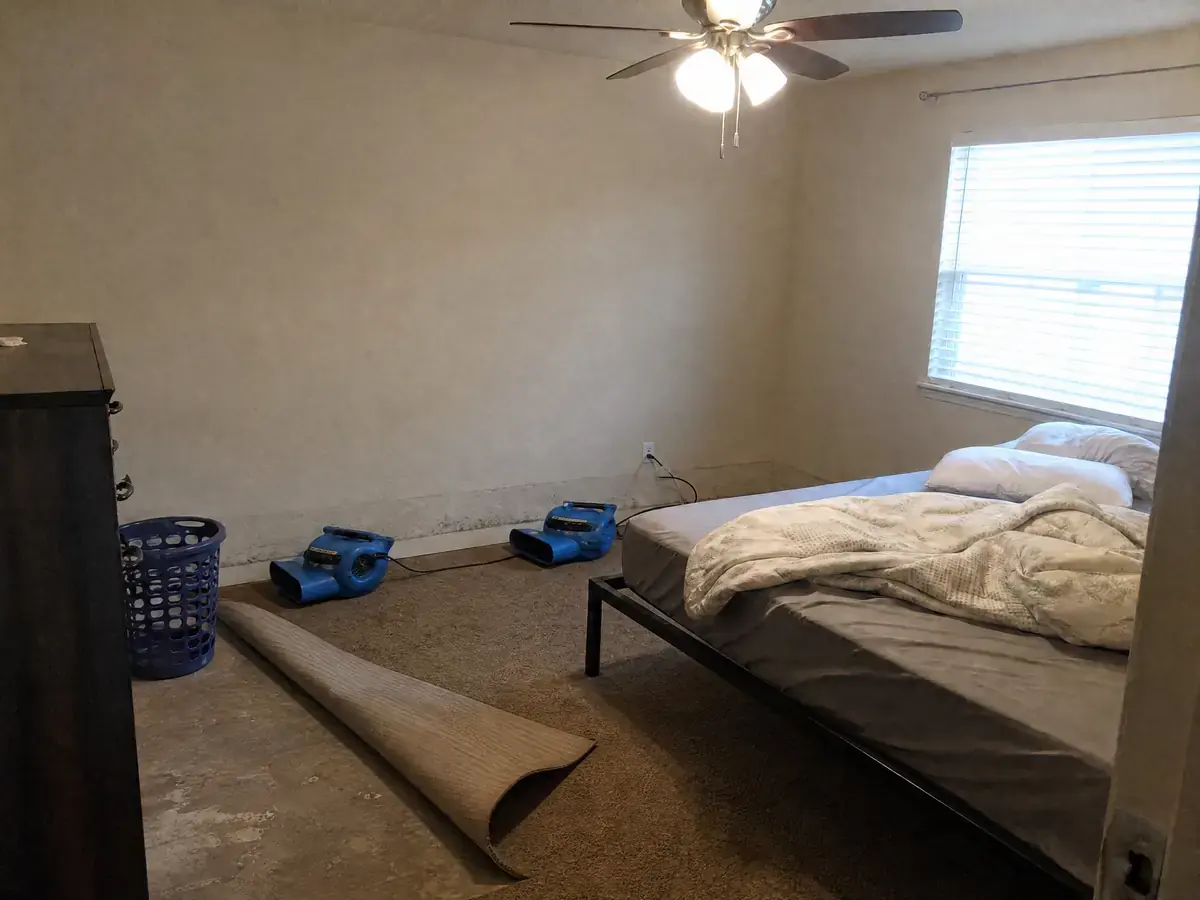
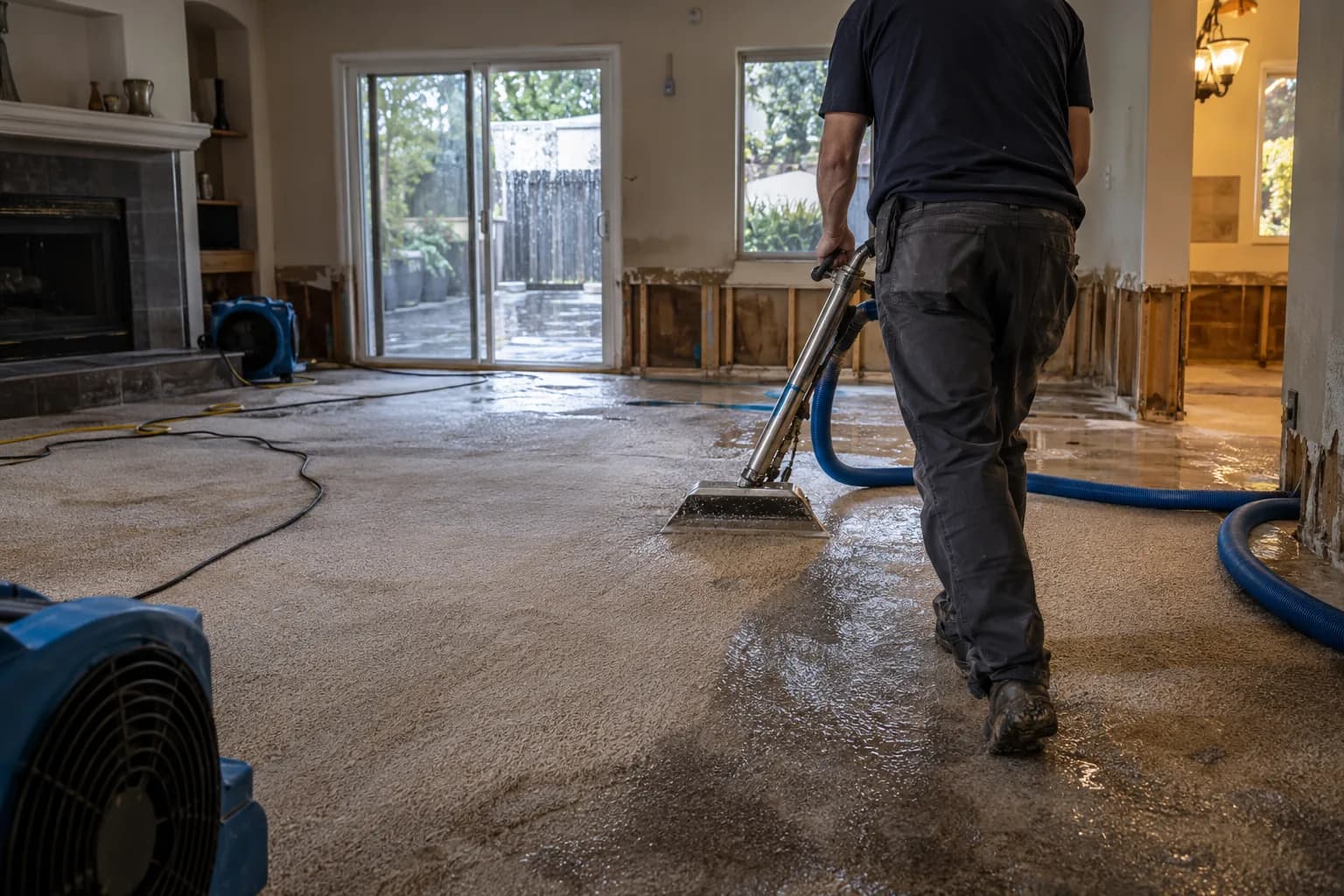
Before and after
Extraction is not mopping. A truck mount pulls the free water, then a weighted extraction head presses water out of carpet and pad that a wet vac leaves behind. The wall cavity is still wet when the floor looks dry, which is why the readings matter more than the look.
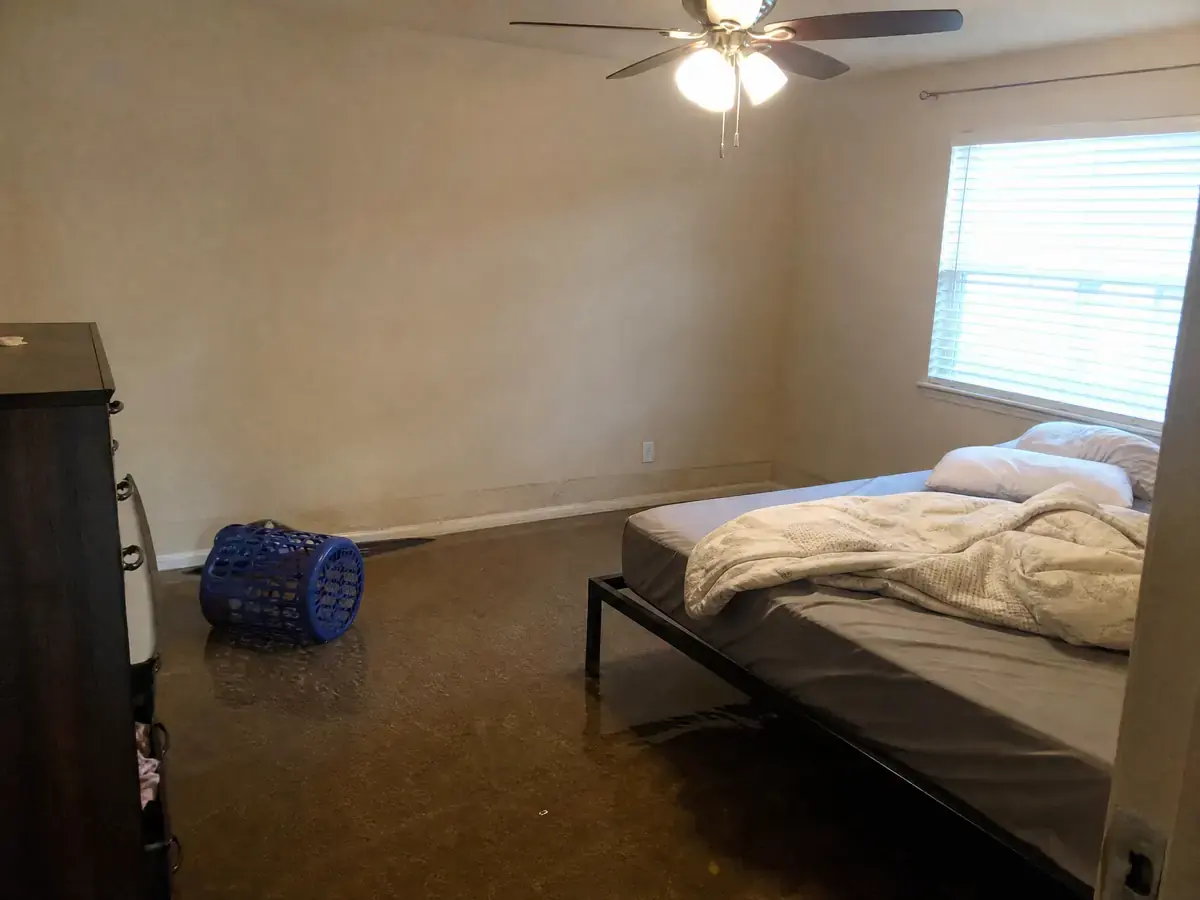 Hour 0, on arrival
Two inches of standing water across the room, carpet pad fully saturated, water already wicking up the bottom 14 inches of drywall.
 Hour 2, after extraction
Free water gone, pad removed and bagged, air movers set on the wet wall line before drying begins. The drywall is still wet, and we say so.
Standing water? Call now, we answer 24/7.
A real local person picks up, then a crew heads your way.
Who we are
We put the things most companies keep vague in writing: real price ranges for this market, the standards we work to, and a moisture log your adjuster can read.
24/7
A real local person answers, day or night
24-48 hrs
The critical window to limit secondary damage
~25 mi
Served from our San Marcos hub across Hays, Comal & Caldwell
S500
The ANSI/IICRC drying standard our process follows
One local team handles every stage, so you are not juggling separate vendors.
Air movers and LGR dehumidifiers with daily moisture readings, dried to a documented standard.
See structural drying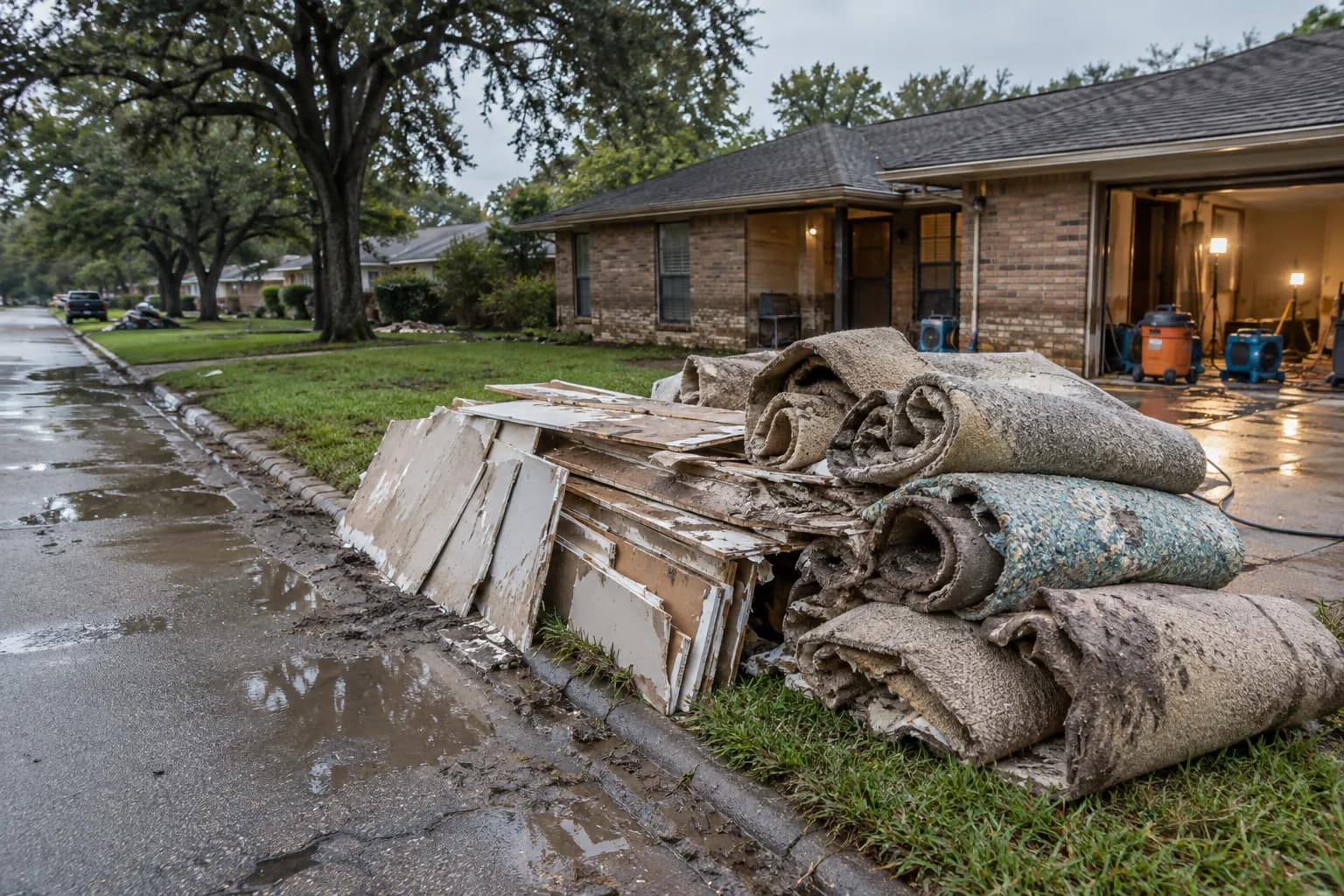
Muck-out and restoration after river flooding and flash floods along the San Marcos and Blanco Rivers.
See flood damage cleanup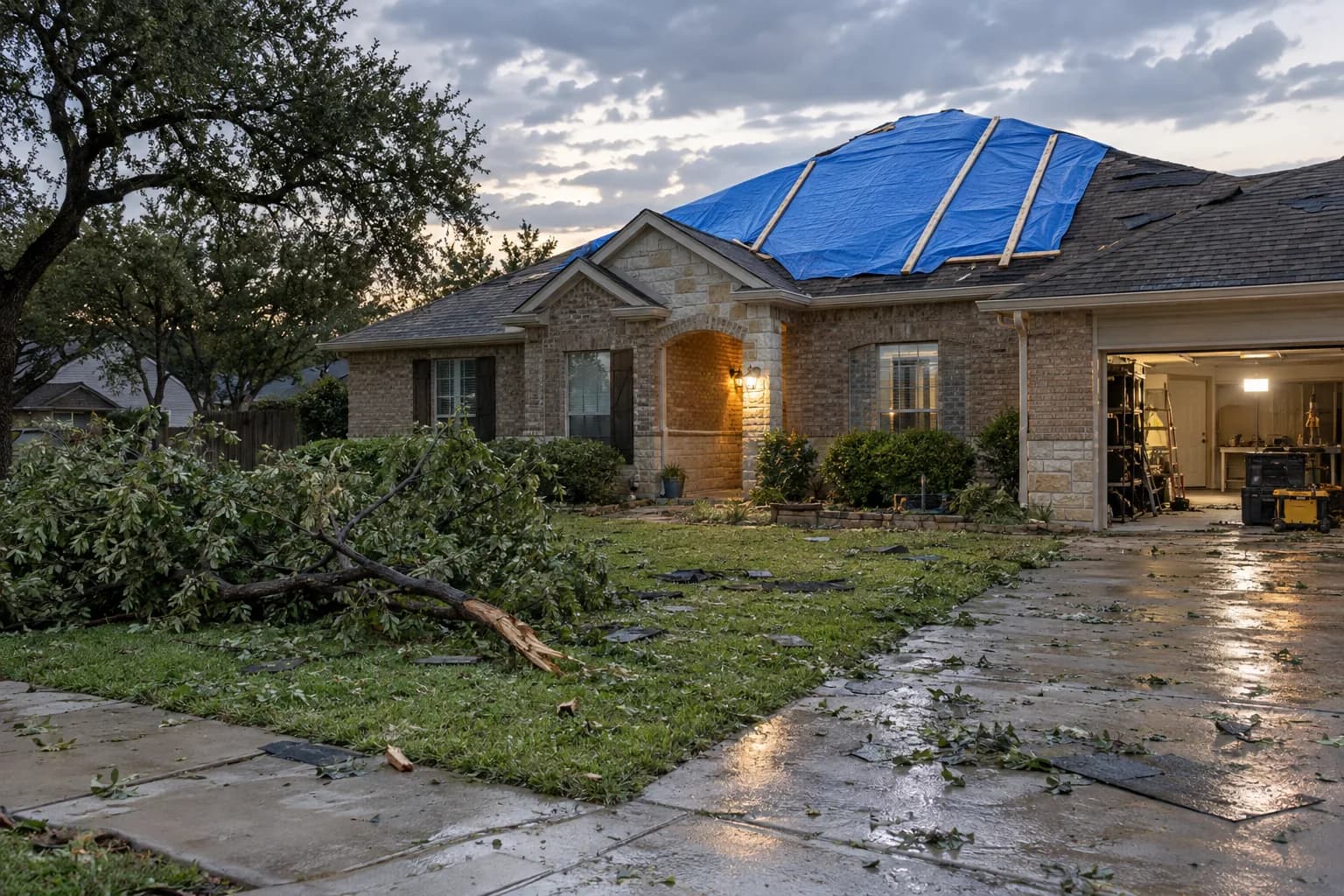
Water-intrusion repair after Central Texas thunderstorms, hail, and wind-driven rain.
See storm damage restorationFAQ
Straight answers to what San Marcos homeowners ask most, on cost, insurance, mold timelines, and what to do first.
24/7
A real local team across Hays, Comal & Caldwell counties. Every job dried to a documented standard.
Have a question on your mind?
Get a quoteAs fast as possible, and ideally inside the first 24 to 48 hours. Water keeps moving into carpet pad, drywall, and subfloor the whole time it sits, so early extraction is what limits secondary damage like swelling, warping, and mold. The clock is real. In San Marcos's humid climate that window is even tighter. Calling for round-the-clock dispatch sooner rather than later usually means less material has to be removed.
You can remove a small amount of surface water with a wet vac, and doing so while you wait for help is better than nothing. But a shop vac only pulls water off the top; it won't reach what has soaked into the pad, subfloor, or wall cavities, which is where most damage develops. Surface only. Professional truck-mounted and portable units extract far more volume and let crews evaluate the carpet and pad properly. That's the difference. For anything beyond a small, clean spill, it's safer to call.
Yes. Drying equipment pulls moisture out of materials and air, but it can't do its job while bulk water is still pooled on the floor. Extraction removes the standing water first; only then do air movers and dehumidifiers bring the structure down to a dry standard. Skipping straight to fans over standing water wastes time and lets damage spread.
Cost depends on how much water there is, the water category, the materials affected, and how far it has traveled, so there's no single flat figure. We assess it on site so you get a clear scope before any work begins, and we can coordinate directly with your insurer where coverage applies. For a full breakdown of what drives the price, see our San Marcos water damage restoration cost guide.
Tell us straight what is happening and we will tell you the next step. We pick up, then we are on the way.
A real local person answers, 24/7. Tell us what is happening and we are on the way.