 Start here
Emergency Water Extraction
Fast removal of standing water with truck-mounted and portable units before it soaks into more material.
See emergency water extraction
Water damage restoration
Water damage restoration in Wimberley, TX is about the Blanco River. Muck-out, sanitizing, and documented drying after a rise, not a wipe-down. Crews dispatch from San Marcos, 24/7.

Wimberley sits on the Blanco River in Texas Flash Flood Alley, where rain falling over steep limestone runs straight into the channel. The 2015 Memorial Day flood crested the Blanco at a record 40.21 feet and destroyed more than 2,000 Hays County homes. River water is contaminated, so cleanup starts with a muck-out.
If you live along the Blanco River, you already know the feeling when the rain won't stop and the river starts to climb. Wimberley earned that awareness the hard way. The river decides. Water damage restoration in Wimberley, TX is not really about pipe leaks here; it's about the river. On Memorial Day weekend in 2015 the Blanco crested near a record 40 feet, and that event reshaped how this community thinks about flood risk. You need a crew that takes the river as seriously as you do, can respond even when the whole area floods at once, and knows river-flood cleanup means a muck-out and documented drying, not a wipe-down.
Water damage restoration in Wimberley, TX centers on Blanco River flooding. Wimberley sits in Flash Flood Alley, where spring-fed rivers over limestone rise fast, and the 2015 Memorial Day flood saw the Blanco crest near a record 40 feet. River-flood water is contaminated, so cleanup means muck-out, sanitizing, and documented drying, with help for flood-insurance claims.
Every stage of water-loss work, each linking to the full detail on its service page. One local crew handles extraction, drying, mold, and rebuild.
Start hereFast removal of standing water with truck-mounted and portable units before it soaks into more material.
See emergency water extraction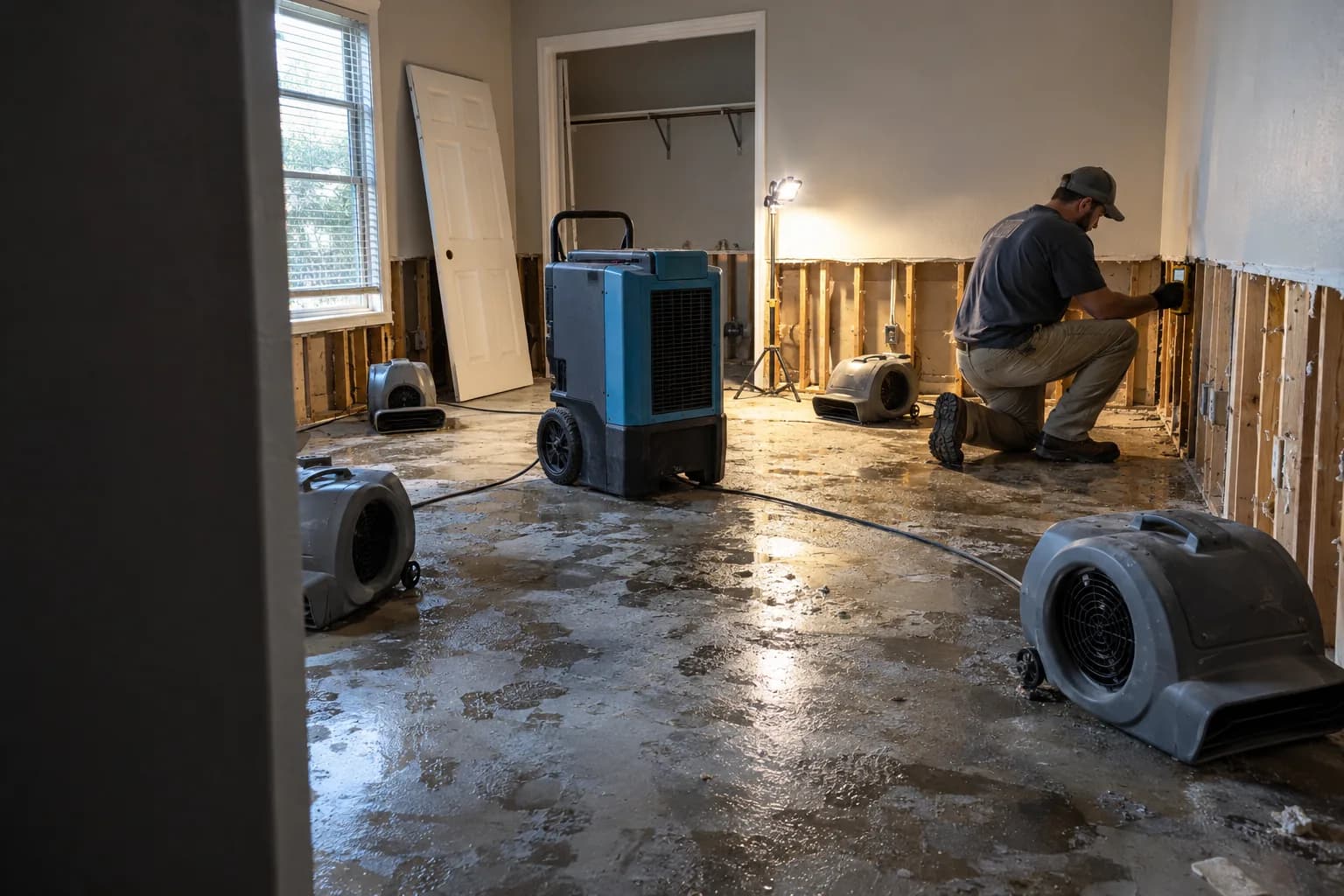
Air movers and LGR dehumidifiers with daily moisture readings, dried to a documented standard.
See structural drying
Muck-out and restoration after river flooding and flash floods along the San Marcos and Blanco Rivers.
See flood damage cleanup
Water-intrusion repair after Central Texas thunderstorms, hail, and wind-driven rain.
See storm damage restoration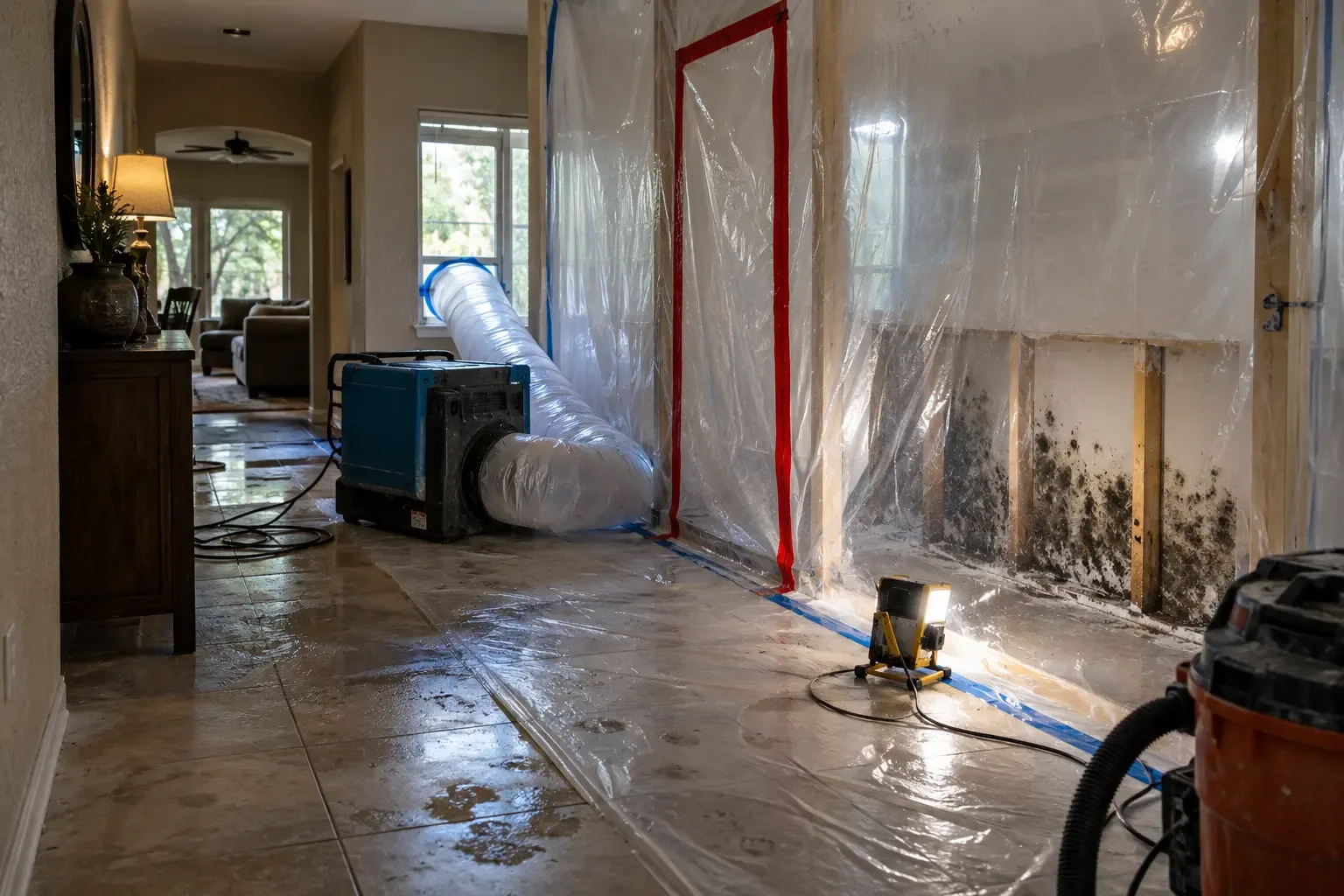
Containment, HEPA filtration, and antimicrobial treatment for the mold that follows untreated moisture.
See mold remediation
Safe handling of Category 3 black water with full sanitizing and disposal. Never a DIY job.
See sewage cleanupThe geography is the whole story. Wimberley sits on the Blanco River in Central Texas Flash Flood Alley, where spring-fed rivers run over steep limestone. Limestone doesn't absorb much, so a heavy rain band parked over the watershed upstream runs straight downhill into the river channel.
The rock sheds rain. The Blanco can go from a calm, clear stream to a dangerous wall of water within a few hours. Newcomers underestimate that speed; longtime residents never do.
The 2015 Memorial Day flood is the reference point. The Blanco crested at a record level near 40.21 feet, more than 2,000 homes were destroyed across Hays County, and at least a dozen lives were lost. We mention that not to alarm anyone but because it's the honest measure of what this river can do, and because that night taught the community how little warning the limestone watershed gives. An October flood that same year, the All Saints flood, showed it wasn't a one-time event. For the full picture, see the lessons from the 2015 San Marcos and Blanco River floods and why Central Texas floods so fast in Flash Flood Alley.
River-flood water is Category 3 black water, carrying sewage, silt, lawn chemicals, and bacteria. You cannot treat it like a clean spill, because most porous materials it soaks (carpet, pad, drywall, insulation) cannot simply be dried and saved. They have to come out.
Different animal entirely. The job is a muck-out, which means remove the contaminated materials and the silt, sanitize what stays, and only then dry the structure to a documented standard. We pair that with flood damage cleanup along the Blanco River and, when moisture lingered, mold remediation.
Here's the insider part. The damage that ruins a Wimberley home after a flood usually isn't the visible waterline on the wall. It's the silt and moisture trapped inside the wall cavities and under the flooring, where it keeps wicking and breeds mold for weeks if no one opens those assemblies up, sanitizes them, and dries them properly. A flood that looks like it stopped at knee height can quietly rot a wall from the inside, which is why moisture mapping and the 24-to-48-hour window after the water recedes decide how much gets saved instead of written off.
The hard, honest part is deciding what to remove versus what can be saved. That call matters. Over-removing to pad an invoice is exactly the abuse this market has every reason to fear. We'd rather show you the moisture readings and explain why a stud bay has to open than tear out a whole room because it's easier to bill.
Get a Blanco River Flood Cleanup Response
When the Blanco floods, it doesn't flood one house, it floods a corridor, and the honest worry is that no one will show up because everyone needs help at once. Crews dispatch from the San Marcos hub and prioritize reaching flooded homes inside the critical first 24 to 48 hours.
This is the fear we hear most. We run 24/7 emergency response as positioning, day or night, and we'd rather tell you straight that we're committed to getting there fast than promise a minute count no one can hold in a flood.
Why the rush. Waiting days is what lets mold take hold in those wet wall cavities, and the longer silt and contaminated water sit, the more of the home crosses from salvageable into tear-out.
In Texas, standard homeowners insurance generally does not cover rising flood water from a river. That is what separate flood insurance through the NFIP, the National Flood Insurance Program, is for. A burst pipe inside the house is often covered; the Blanco coming over its banks usually is not.
One thing every river-corridor homeowner should know, ideally before the next storm. Learn it now. Check your policy rather than finding out during a claim.
When a flood does hit, documentation is what gets a claim paid. Evidence wins. We document moisture readings, the scope of removed materials, and photos to the standard insurers and FEMA expect for a flood loss, so your proof of loss is built on evidence rather than memory. The logs do the arguing. We don't file the claim for you or guarantee an outcome, but the moisture logs and photos we keep are exactly what an adjuster needs to see.
Wimberley's flood exposure is not theoretical, and the record is specific enough to plan around.
| Event | What happened | What it means for a cleanup here |
|---|---|---|
| May 2015, Memorial Day flood | The Blanco River crested at a record of about 40.21 feet, destroying more than 2,000 homes across Hays County with 12 or more deaths (NWS EWX, City of San Marcos) | The benchmark event, and the reason Wimberley homeowners take a river forecast seriously |
| October 2015, All Saints flood | San Marcos and the corridor flooded again in the same year (City of San Marcos, TXST research) | Two major floods in one year is the local reality, not a freak sequence |
| Flash Flood Alley generally | Central Texas sheds rainfall fast off thin soil onto limestone, so river rises arrive in hours | Cleanup planning has to assume you may get very little warning |
Every one of those is Category 3 water. River flood water carries soil, septic and agricultural runoff, and whatever it crossed on the way, which puts it at the top of the contamination scale regardless of how clear it looks when it reaches the house.
River-flood work is Category 3, which prices at the top of the Central Texas band, roughly $7.00 to $7.50 per square foot against $3.00 to $7.50 across all water losses (industry cost data, scoped under ANSI/IICRC S500).
| Typical Wimberley loss | Category | Affected area | Market range at published rates |
|---|---|---|---|
| Cypress Creek or Blanco River water into a riverside home | 3, black | 800 sq ft | $5,600 to $6,000 |
| Flood water in a detached guest house or studio | 3, black | 350 sq ft | $2,450 to $2,625 |
| Storm breach, wind-driven rain through the roof | 2, grey | 400 sq ft | $1,600 to $2,600 |
| Burst pipe in a hill-country property left unoccupied | 1 to 2, clean to grey | 600 sq ft | $1,800 to $3,900 |
That is the published Central Texas market band applied to a floor area, not a quote from us. Whole jobs here run from about $1,200 for a small clean-water loss to $8,500 or more for a large or contaminated one, with mid-range multi-room work near $2,500 to $5,000 (industry cost data). Small jobs land nearer that $1,200 floor than the raw multiplication suggests, because a callout and an equipment set carry a practical minimum.
Mitigation and rebuild are separate scopes, and none of the figures above include putting the house back.
Standard Texas homeowners policies exclude rising water, so a Blanco River loss needs a National Flood Insurance Program policy or a private flood policy, bought in advance. NFIP limits are $250,000 for the structure and $100,000 for contents (FEMA).
| Homeowners policy | NFIP flood policy | |
|---|---|---|
| Blanco River rising into the house | Excluded | Covered |
| Flash flood water across the ground | Excluded | Covered |
| Burst pipe inside the house | Usually covered | Not covered |
| Wind opens the roof, rain enters | Usually covered | Not covered |
| Building limit | Your dwelling limit | $250,000 |
| Contents limit | Your contents limit | $100,000 |
| Waiting period | None | Typically 30 days |
The waiting period is the line that matters most in Wimberley. A policy bought when the forecast turns will not be in force for the storm that prompted it, so that decision belongs in a dry month. If you live along the Blanco or Cypress Creek and you are not sure what you hold, the time to read the declarations page is now, not while you are watching a river gauge.
Our guide on flood insurance versus homeowners insurance in Texas covers the rest.
Before and after
River water climbs the drywall past the mark it leaves on the surface. Cutting at the mud line looks tidy and leaves wet, contaminated gypsum above it, which is the single most common reason a flood repair fails months later.
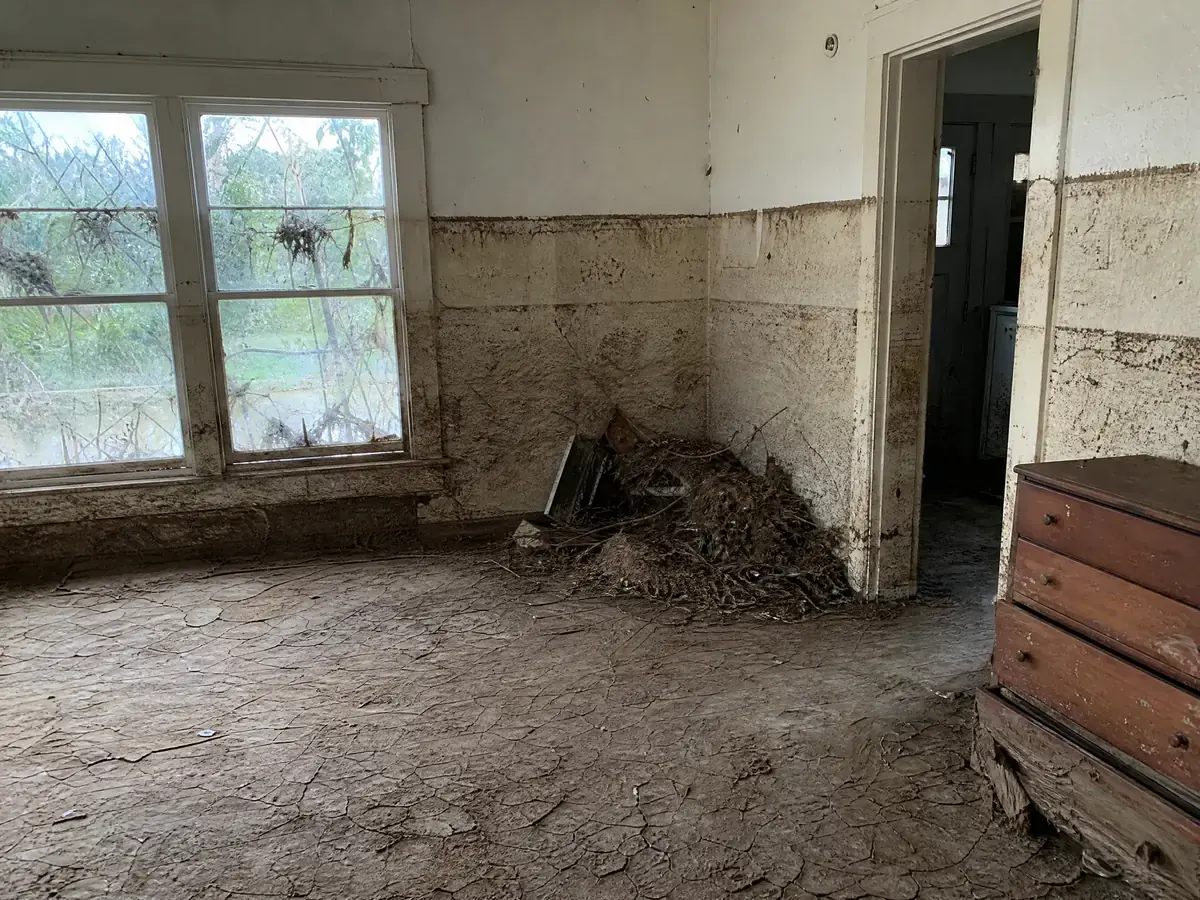 After the water drops
A visible flood line with silt behind it, saturated insulation in the cavity, and moisture wicked well above the mark the water left.
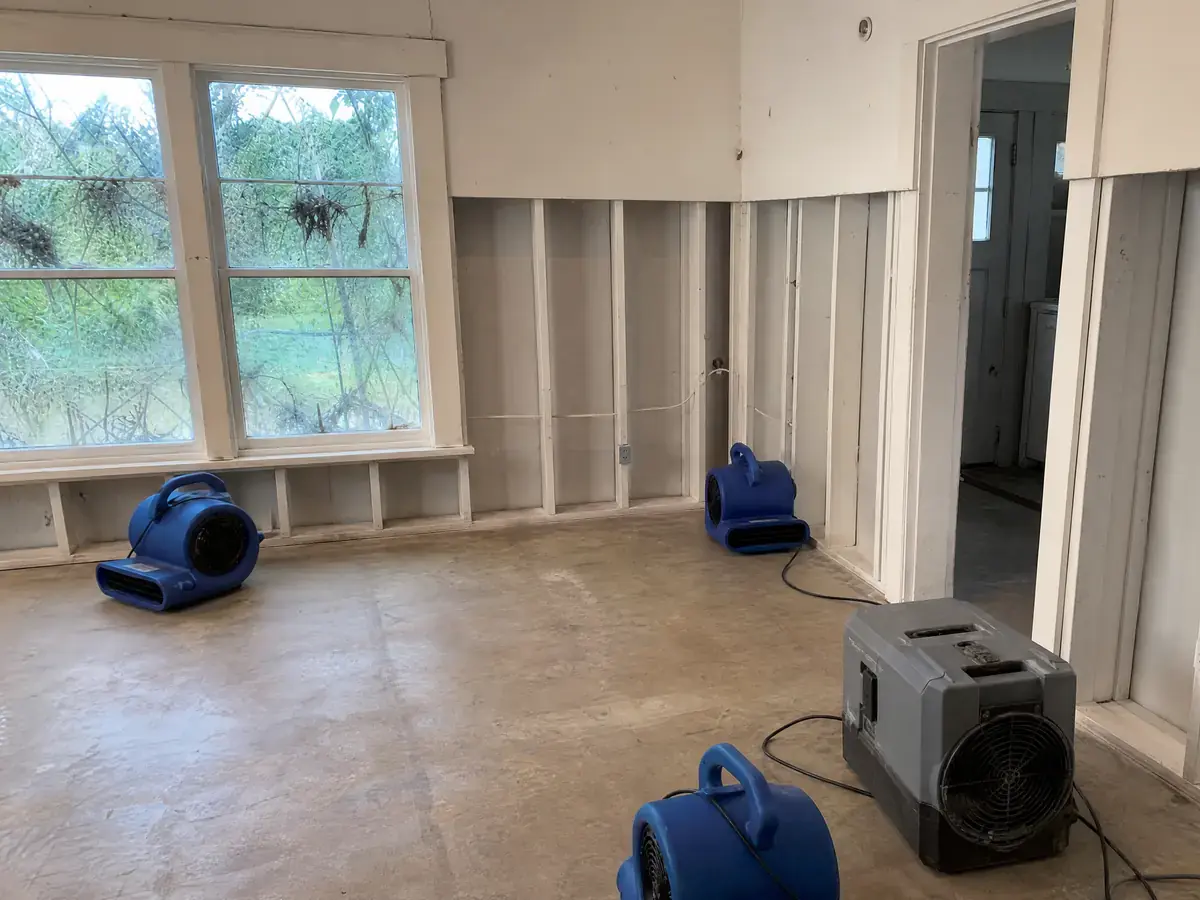 Cut above the wicked line, dried
Drywall removed above the meter-confirmed wick height, insulation and porous contents out, framing cleaned and dried to standard.

Who we are
We put the things most companies keep vague in writing: real price ranges for this market, the standards we work to, and a moisture log your adjuster can read.
24/7
A real local person answers, day or night
24-48 hrs
The critical window to limit secondary damage
~25 mi
Served from our San Marcos hub across Hays, Comal & Caldwell
S500
The ANSI/IICRC drying standard our process follows
We dispatch from our San Marcos hub across Hays County and the surrounding counties: San Marcos and a ~25-mile radius across Hays, Comal, and Caldwell counties.
Wimberley emergency? Call now.
We dispatch from San Marcos, TX and move as fast as conditions allow.
FAQ
Straight answers to what San Marcos homeowners ask most, on cost, insurance, mold timelines, and what to do first.
24/7
A real local team across Hays, Comal & Caldwell counties. Every job dried to a documented standard.
Have a question on your mind?
Get a quoteWimberley sits on the Blanco River in Central Texas "Flash Flood Alley," where spring-fed rivers run over steep limestone that sheds rain fast. The rock barely soaks. Water has little time to soak in, so the river can rise from calm to dangerous within hours. The 2015 Memorial Day flood, when the Blanco crested near a record 40 feet, showed how severe that rise can be.
No. River-flood water is Category 3 "black water," it carries sewage, silt, chemicals, and bacteria. Treat it as hazardous. It's a health hazard, and most soaked porous materials can't simply be dried; they have to be removed and the area sanitized. Safe cleanup means protective handling, muck-out, sanitizing, and documented drying, not wiping it down.
That is the goal. Crews dispatch from the San Marcos hub and prioritize reaching flooded Wimberley homes within the critical first 24 to 48 hours, when fast extraction limits how much can be saved. We come. During regional events the aim is to scale response across the river corridor, because waiting days is what lets mold take hold deep in the wall cavities where it is hardest to reach and most expensive to remove.
Usually not on its own. In Texas, standard homeowners policies generally exclude rising flood water from a river; that requires separate flood insurance through the NFIP. Read the fine print. Sudden interior failures like a burst pipe are different. We help document moisture readings, scope, and photos to the standard insurers and FEMA expect for a flood claim.
Tell us straight what is happening and we will tell you the next step. We pick up, then we are on the way.
A real local person answers, 24/7. Tell us what is happening and we are on the way.