San Marcos water damage guide
How to Choose a Water Damage Restoration Company
Choosing a water damage restoration company comes down to a short list of things you can actually check, which means trained technicians, around-the-clock availability, a real local presence, an itemized written estimate, and documented drying with daily moisture readings. The pressure is the hard part. You are usually picking in the middle of a crisis, with water on the floor and the first truck that answered the phone idling out front. This guide gives you the criteria and the exact questions to ask, so you can vet fast without getting taken.
Published · Updated
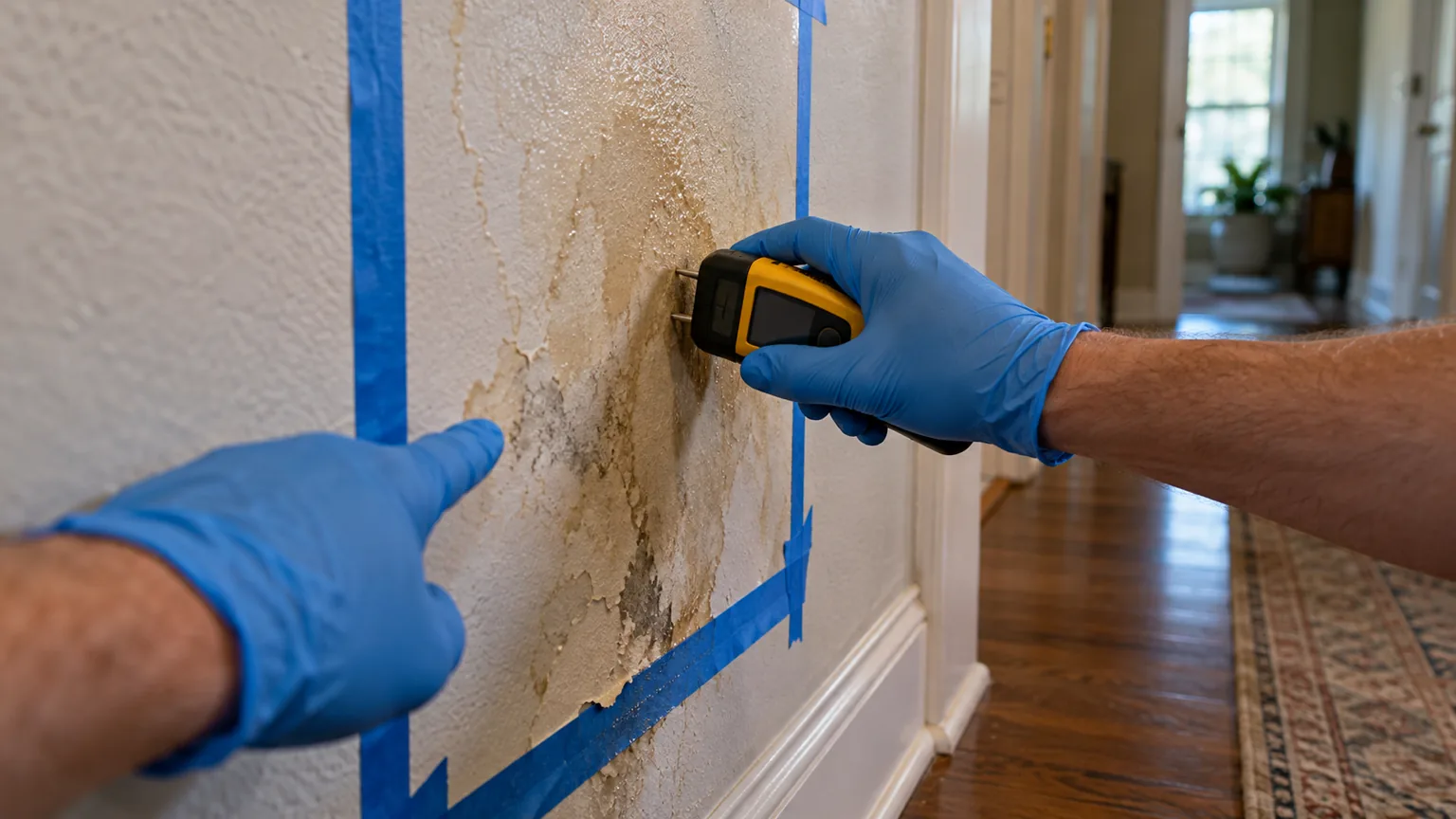
How Do You Choose a Water Damage Restoration Company?
To choose a water damage restoration company, look for technicians trained to recognized standards, 24/7 availability, genuine local presence, an itemized written estimate, and documented drying with daily moisture readings. Avoid lump-sum quotes, pressure to sign before any inspection, and out-of-town operators with no local number. A reputable company welcomes a second opinion.
Here is the full checklist, in the order most people should weigh it, written so you can run down it on the phone while the first truck is still idling out front.
- Technicians trained to recognized restoration standards.
- True 24/7 emergency availability, since water damage worsens by the hour.
- Genuine local presence. A local number, and a crew that knows the area.
- An itemized written estimate and a documented scope of work.
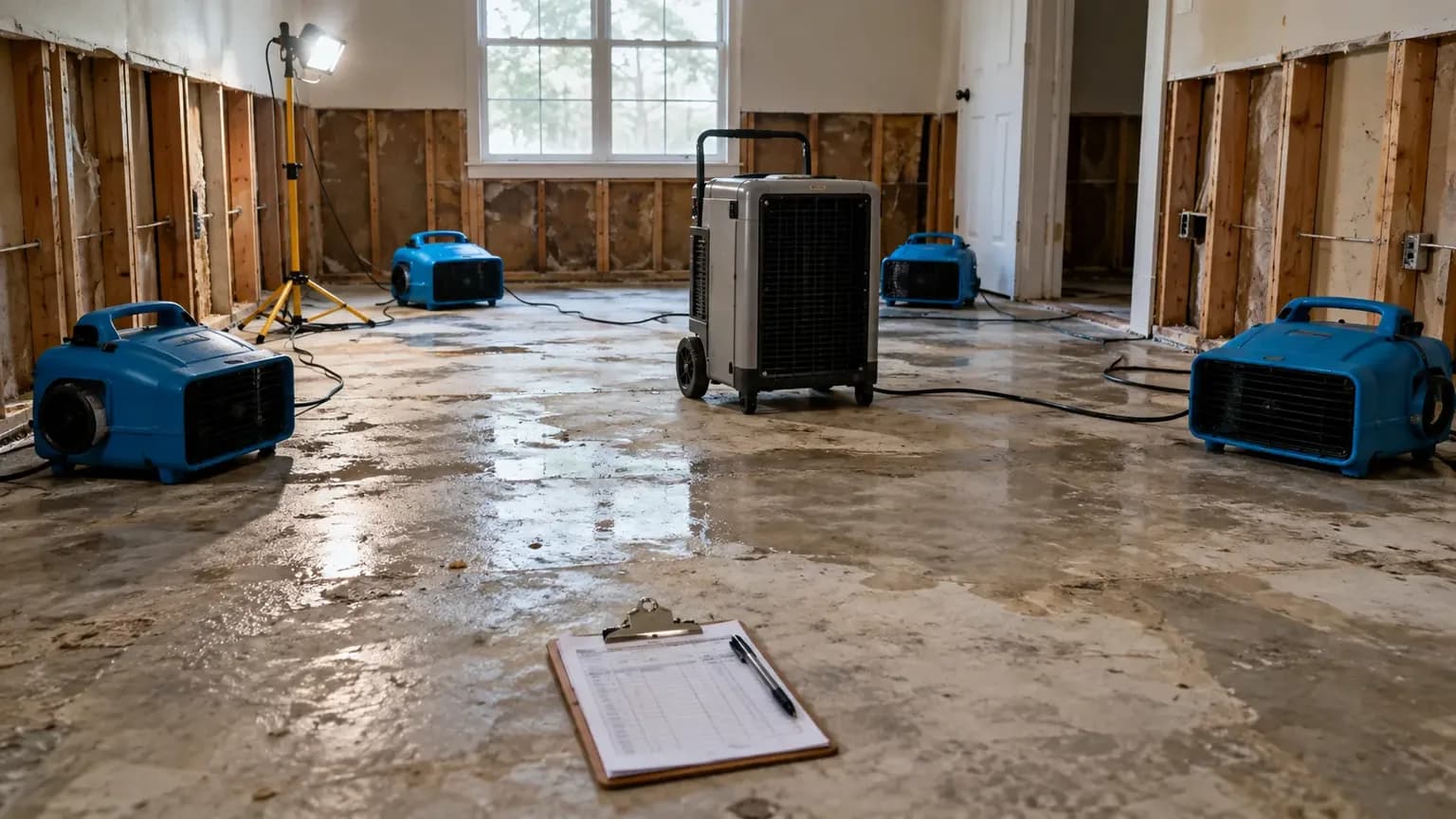
- Drying done to a documented standard, with daily moisture logs.
- Support with insurance documentation, including the photos, moisture readings, and written scope your adjuster will ask for before approving the claim and releasing payment.
- Real, recent reviews you can actually read.
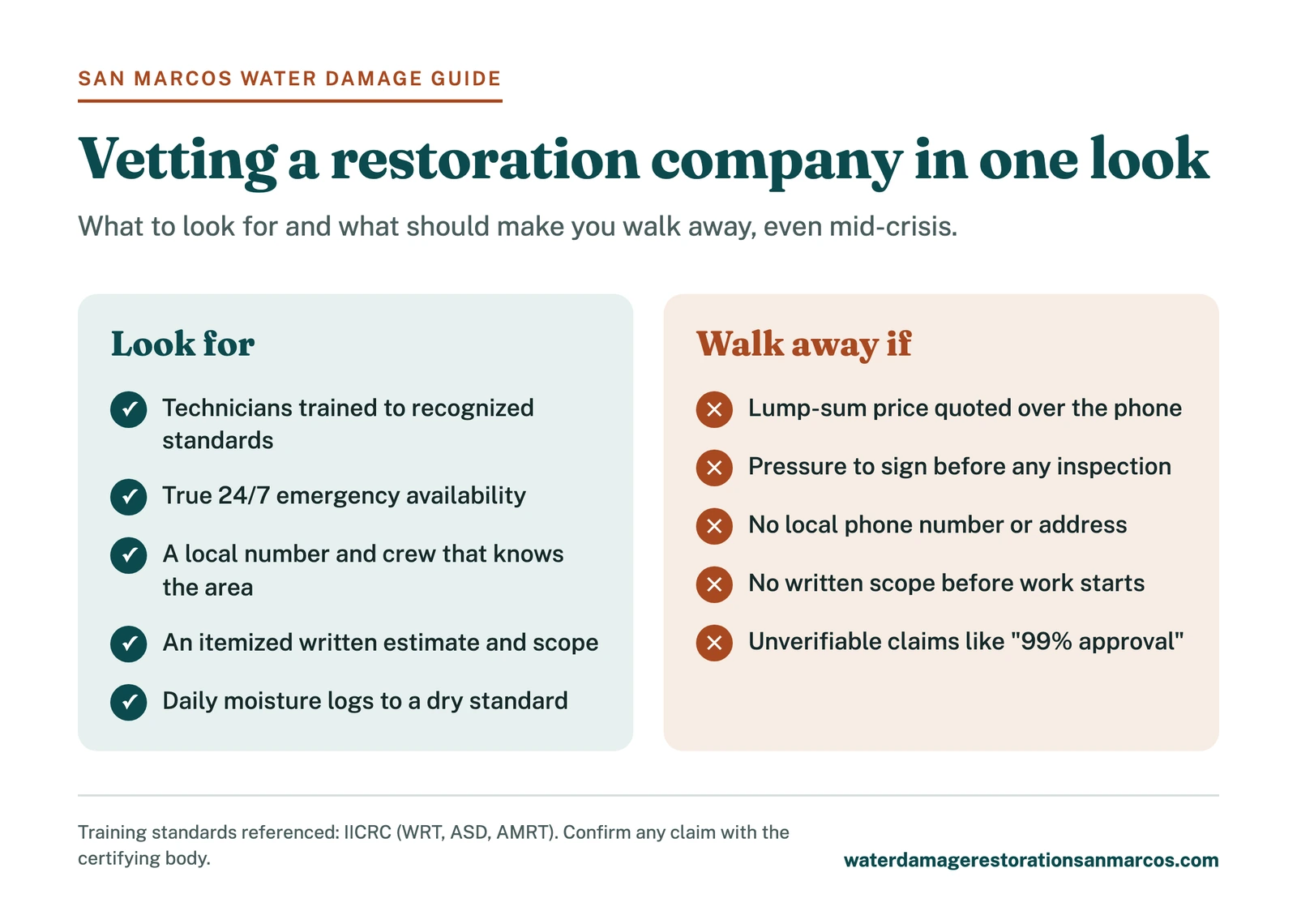
Text version of this infographic
Vetting a restoration company in one look. What to look for and what should make you walk away, even mid-crisis.
Look for
- Technicians trained to recognized standards
- True 24/7 emergency availability
- A local number and crew that knows the area
- An itemized written estimate and scope
- Daily moisture logs to a dry standard
Walk away if
- Lump-sum price quoted over the phone
- Pressure to sign before any inspection
- No local phone number or address
- No written scope before work starts
- Unverifiable claims like "99% approval"
Training standards referenced: IICRC (WRT, ASD, AMRT). Confirm any claim with the certifying body.
Red Flags to Avoid
The warning signs are usually obvious once you know to watch for them. That means no written scope before work starts, a lump-sum price quoted over the phone, pressure to sign an insurance assignment on the spot, a call center that cannot name your town, or no moisture readings offered.
A lump-sum quote with no line items tops the list, because you simply cannot audit a single number when there is nothing inside it to check against the equipment, the drying days, or the materials that actually got wet. Sign-now pressure is next. A legitimate crew stabilizes the loss and then writes the scope, rather than pushing a contract before anyone reads moisture. Watch for the absence of a real local phone number or address, and for inflated superlatives that no one can verify, the "99% claim approval" type of line. No log. No documentation offered, no written scope, means there is nothing to hold them to later. If you are also weighing the bill itself, how to avoid getting overcharged breaks down where padding hides. The pattern across all of these is simple. A company dodging documentation is a company that does not want its work measured.
Questions to Ask Before You Hire
You do not need to be an expert. You need five or six questions and a read on how easily they get answered. Here that means do you follow the IICRC S500 standard, will I get daily moisture readings, who does the rebuild, and what is in the written scope?
Ask what water category and class your loss is. Ask what the drying plan looks like and how many equipment days they expect. Ask whether they dry to a documented standard with daily moisture readings, and whether they will give you the log. Ask whether they provide a written scope and the documentation your insurance adjuster will want. Ask for references or recent local work. A trained restorer answers all of this without hesitation, because it is the same information they use to scope the loss, assign equipment, set drying targets, and price the job in the first place. Watch the reaction. Vague answers, a pivot to "trust us," or a sudden hard sell are the tells. The questions a good restorer fields easily, category, class, drying plan, equipment days, are precisely the ones a padding operator tries to skate past.
Pay attention to how the certification question lands, too. You are not checking a box; you are checking whether the crew was trained to classify water and build a drying plan the right way. The recognized standards in this trade come from the IICRC, with WRT covering water restoration, ASD covering applied structural drying, and AMRT covering mold. Names matter here. A company that holds those should say so plainly and let you verify it, rather than waving at "fully certified" without a single specific. Treat the cert question as the certification to look for, not a guarantee any one company has it, and make a point of confirming whatever they claim with the certifying body before the trucks ever unload at your house.
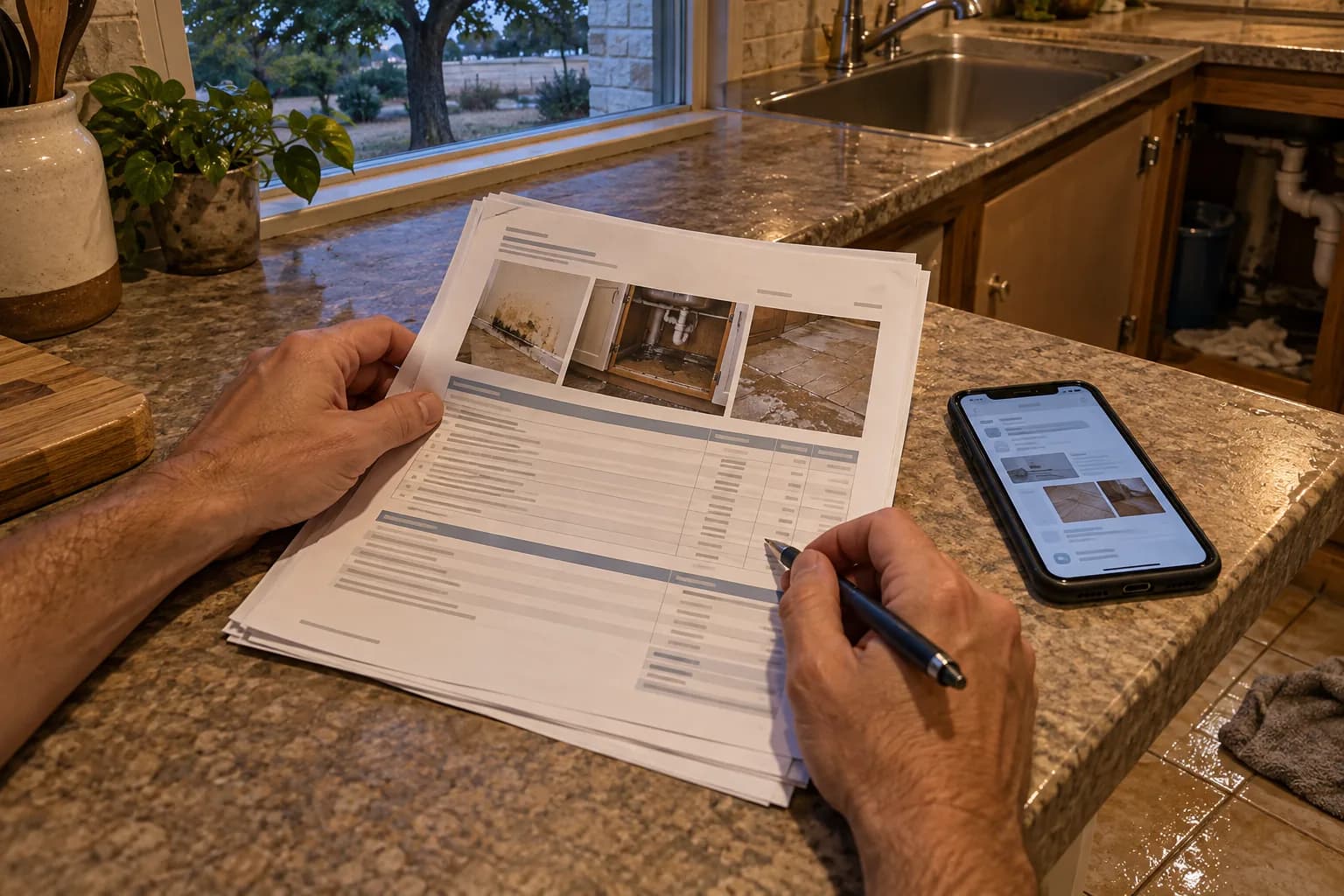
Why Local Presence Matters in San Marcos, TX
This one matters more here. It is worth being blunt about why, because the river-corridor flooding that drives most of the serious water losses in San Marcos also draws in the operators least likely to still be around when something goes wrong.
When a 2015-style flood or a hard-freeze pipe burst hits Central Texas, demand spikes overnight and out-of-town storm chasers appear. They run inflated quotes, push fast signatures, and are gone before anything goes wrong. A real local outfit is still answering the phone next month. So check for it. A "San Marcos, TX" company with a Utah area code on the call, or Austin ZIP codes scattered across a page that claims to serve San Marcos, is a tell worth catching before you sign. River-corridor knowledge is the other local test. A company that actually works here understands how fast the San Marcos and Blanco Rivers can rise, and why slab-on-grade homes in Blanco Gardens hold water in the subfloor differently than a pier-and-beam house does. That is the kind of competence that shows up in real local flood damage cleanup, not in a stock-photo website. If you want the longer version of how we work in this area, the about our San Marcos restoration approach page lays it out.
Are Water Damage Companies Worth It?
Honestly, not always. A small clean-water spill you catch and dry within a day or two is often a DIY job, and a good company will tell you that rather than upsell you. Where they earn their fee is hidden moisture, contaminated water, and documentation for a claim.
Where a pro earns the cost is hidden moisture, contaminated water, and anything bigger than a contained spill. Water travels into wall cavities, under flooring, and into slab subfloors where a shop vac and a box fan never reach, and that trapped moisture is what grows mold and rots framing weeks later. Professional extraction and dry-to-standard drying remove the moisture you cannot see and prove it with readings, which is the whole point. That is the difference. In humid Central Texas summers, that hidden moisture turns into mold fast, often inside a couple of days, which is why "it looks dry" is not the same as "it is dry." If you are genuinely on the fence about your situation, DIY vs professional water cleanup walks through where the line sits. The short version. The risk of moisture you cannot detect is what justifies the call.
One last filter before you sign anyone. Ask yourself whether the company has answered your questions or talked around them, whether the estimate you are holding has line items or just a total, and whether the people in front of you seem to know San Marcos or seem to have driven in from somewhere else. The right answers tend to cluster. A crew that documents, itemizes, and knows the rivers usually checks every box at once, while the out-of-town storm chaser circling after a flood usually misses several of them at the same time. Trust the pattern, not the pitch.
Written by the Water Damage Restoration San Marcos team
Local water-damage restoration in San Marcos, TX and Hays County. Our guidance follows the ANSI/IICRC S500 and S520 reference standards the industry plans around. Questions about your situation? Call (512) 778-8417, we answer 24/7.