San Marcos water damage guide
Flood Insurance vs Homeowners Insurance in Texas
The difference between flood insurance and homeowners insurance in Texas is the difference between water that starts inside your house and water that rises up from outside it. Homeowners insurance handles the burst pipe, the failed water heater, the overflowing appliance. It specifically excludes flooding. So when the San Marcos River or the Blanco jumps its banks and water comes in under the doors, your homeowners policy steps back and a separate flood policy steps in, if you have one. A lot of people along these rivers find out they don't, at the worst possible moment.
Published · Updated
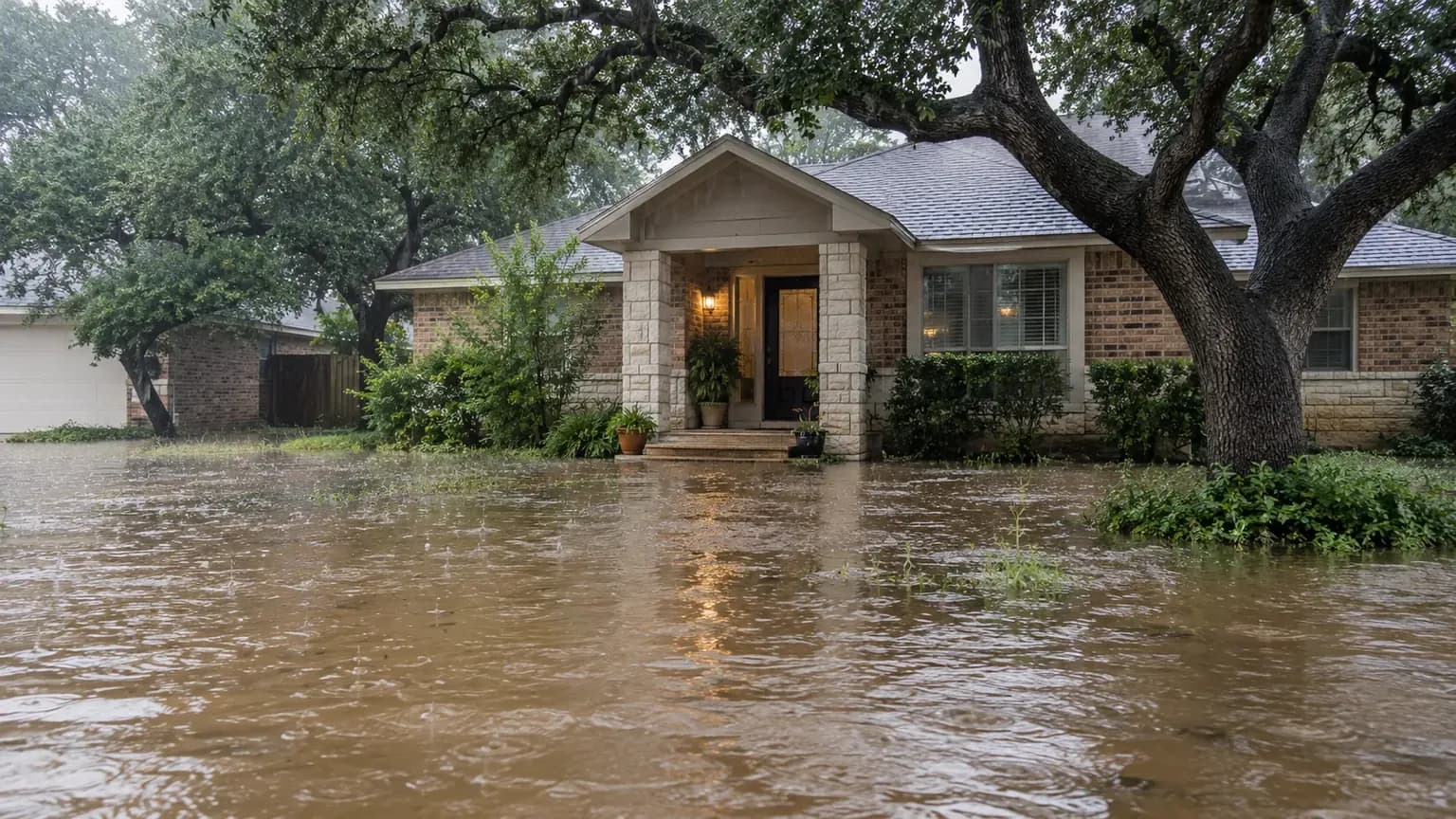
This isn't an abstract gap here. It's the lesson of 2015, and it's worth understanding before the next rain band parks over the Hill Country.
What's the Difference Between Flood Insurance and Homeowners Insurance in Texas?
Homeowners insurance covers sudden, accidental water damage from inside the home, like a burst pipe; it does not cover flooding. Flooding from rising rivers or flash floods is covered only by separate NFIP flood insurance, which carries a 30-day waiting period and limits of $250,000 building and $100,000 contents.
Most Texas homeowners need both.
The table makes the split easy to see at a glance.
| Homeowners Insurance | Flood Insurance (NFIP) | |
|---|---|---|
| Covers | Sudden indoor water (burst pipe, appliance) | Rising/surface water (river, flash flood) |
| Excludes | Flooding from outside | Indoor plumbing leaks |
| Limits | Per policy | $250k building / $100k contents |
| Waiting period | None (existing policy) | Typically 30 days |
| Required? | By most lenders | In high-risk flood zones |
Two policies. Two different kinds of water. Almost no overlap.
What Each Policy Actually Covers
The dividing line is simple once you see it. Did the water originate inside the structure, or did it come from outside and rise? Inside is the homeowners policy. Outside and rising is the flood policy. Nearly every coverage dispute traces back to that single question.
Homeowners covers the inside-out failures. A supply line lets go, a water heater ruptures, a dishwasher overflows. Sudden, accidental, indoors. Flood insurance covers the outside-in events. River water, flash-flood runoff, surface water that overwhelms a creek and sheets across your lot. That's it. Each policy guards its own narrow territory and flatly declines the other's, which is the whole reason so many homeowners discover the gap at the worst moment.
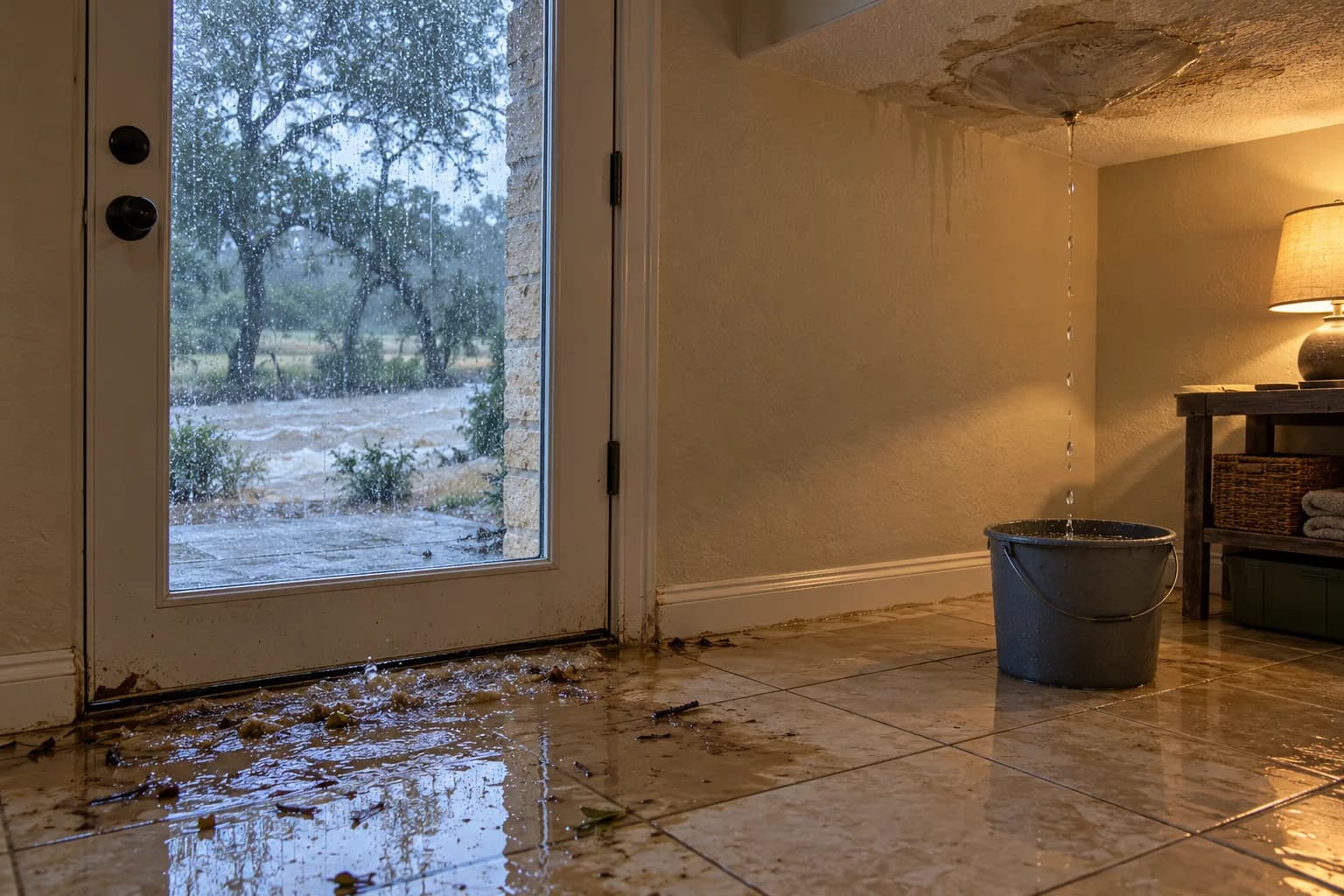
Now the part that surprises homeowners. One storm, two claims. One storm can produce two separate claims on the same house. Picture a Wimberley home during a heavy Hill Country downpour. Two things happen at once. Wind drives rain through a breach in the roof and soaks the ceiling. That's a sudden indoor cause, a homeowners claim. At the same time, the swollen river rises and pushes surface water in through the back doors. That's flooding, an NFIP claim. Same night, same house, two adjusters, two processes. Trace each source. Knowing which water came from where decides which policy pays for what, and getting that wrong slows everything down. When the rising-water side has already hit, our flood damage cleanup along the San Marcos and Blanco Rivers handles exactly that scenario.
Do I Need Flood Insurance in Texas?
You likely need flood insurance in Texas if your home is in or near a flood-prone area, and many homeowners outside mapped high-risk zones still benefit from it. In 2015, San Marcos-area homes outside designated flood zones still flooded, so "low risk" is not "no risk," especially along the rivers.
That last point deserves weight. People read their flood-zone designation, see something that isn't the high-risk category, and decide they're fine. Then it rains. The 2015 floods made a mockery of that logic. Plenty of homes that took on water that year sat outside the mapped high-risk zones, because flood maps describe probability, not promise. A map can't see a record crest coming.
If a lender holds your mortgage and your home sits in a designated high-risk zone, you're generally required to carry flood coverage anyway. Outside those zones it's your call, and it's a cheaper call than most people assume. For homes anywhere near the corridors, the honest move is to pull your actual flood-zone status, look at how close you are to the river, and decide with eyes open. For more on what the rivers taught the city, read the lessons from the 2015 San Marcos flood.
Flooded before? We know the rivers.
How NFIP Flood Insurance Works
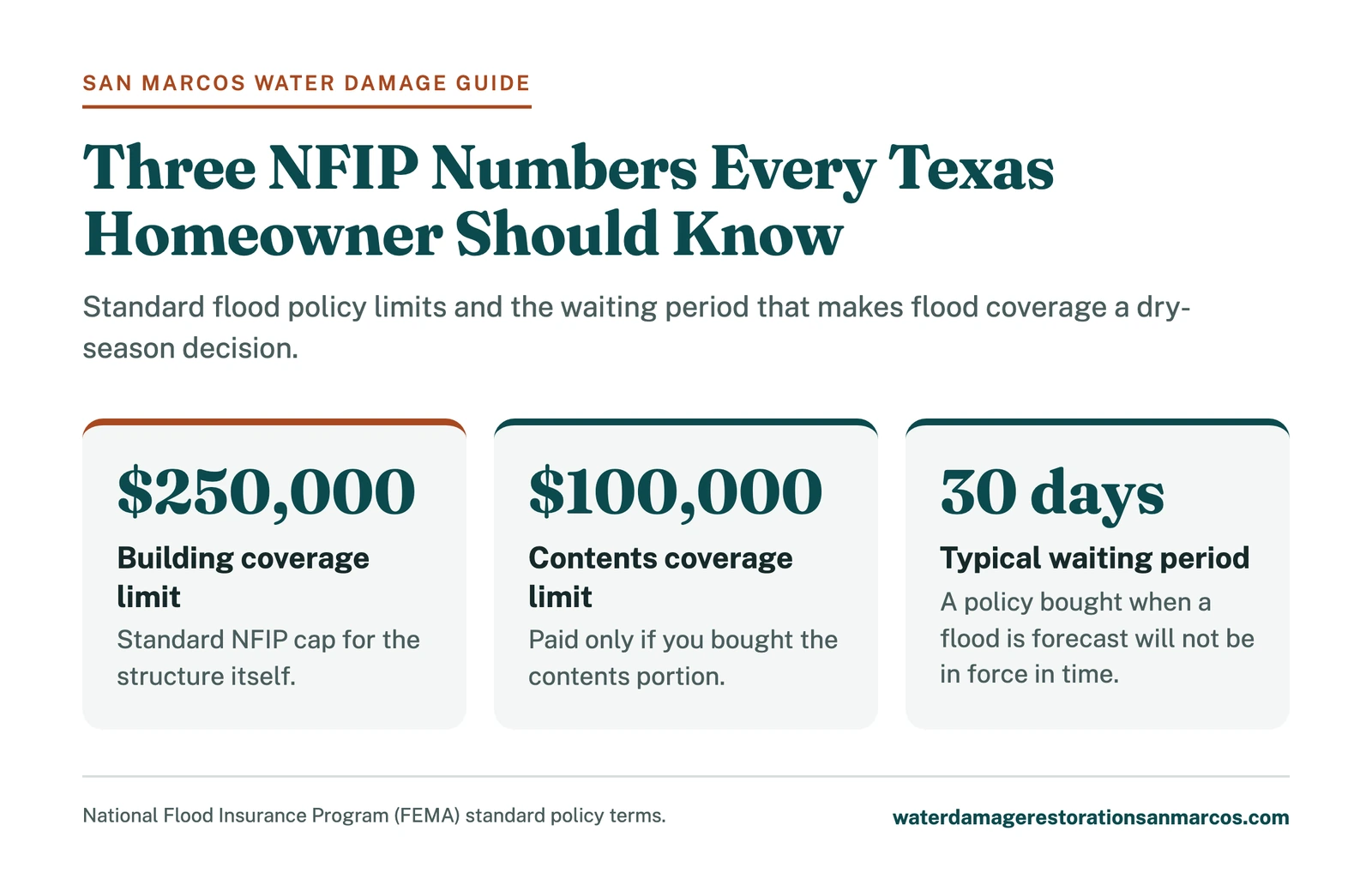
Flood insurance in this country mostly runs through one federal program, and its rules catch people off guard. The NFIP imposes a 30-day waiting period before a new policy takes effect, caps building coverage at $250,000 and contents at $100,000, and pays contents only if you bought that portion.
The National Flood Insurance Program is administered by FEMA. A standard policy covers up to $250,000 for the building structure and up to $100,000 for contents, which are real limits worth knowing if your home and belongings are worth more than that. The detail that bites hardest, though, is timing. There's typically a 30-day waiting period before a new policy takes effect. You cannot watch a flood warning roll in for the weekend and buy coverage Friday to protect yourself Saturday. It won't be in force.
That waiting period is the whole reason flood insurance is a dry-season decision, not a storm-season scramble. In Flash Flood Alley, where the Balcones Escarpment squeezes heavy rain off thin limestone soils and rivers can rise feet in minutes, you simply cannot buy your way in once the forecast turns. The coverage has to be sitting in place long before the clouds build. Buy it early.
Text version of this infographic
Three NFIP Numbers Every Texas Homeowner Should Know. Standard flood policy limits and the waiting period that makes flood coverage a dry-season decision.
- $250,000 Building coverage limit
- Standard NFIP cap for the structure itself.
- $100,000 Contents coverage limit
- Paid only if you bought the contents portion.
- 30 days Typical waiting period
- A policy bought when a flood is forecast will not be in force in time.
National Flood Insurance Program (FEMA) standard policy terms.
The San Marcos River-Corridor Reality
Why does any of this matter more here than in, say, the Panhandle? Geography. Properties along the San Marcos and Blanco Rivers sit in Flash Flood Alley, where a 30-day waiting period means buying coverage in May does nothing for a storm that arrives next week.
San Marcos sits in the heart of Flash Flood Alley, fed by the San Marcos and Blanco Rivers and a watershed of limestone that doesn't absorb much. Rain runs off fast, the rivers respond fast, and neighborhoods near the water carry exposure that a homeowners policy flatly will not cover. The 2015 Memorial Day flood is the unignorable case. The Blanco River crested at roughly 40.21 feet, a record, and more than two thousand homes across Hays County were destroyed. The water that did that damage was the excluded kind. Homeowners policies didn't pay for it. Flood policies did.
Downstream and along the tributaries, the pattern repeats. Wimberley sits right on the Blanco, Martindale sits downstream on the San Marcos, and both carry the kind of river exposure this gap was written for, which is why water damage restoration in Wimberley is so often a flood conversation first and a plumbing one second. None of this is meant to frighten anyone. It is just the rivers. It's the reality of the corridor, and the people who came through 2015 in the best shape were usually the ones who'd already sorted out which policy covered what.
Written by the Water Damage Restoration San Marcos team
Local water-damage restoration in San Marcos, TX and Hays County. Our guidance follows the ANSI/IICRC S500 and S520 reference standards the industry plans around. Questions about your situation? Call (512) 778-8417, we answer 24/7.