 Start here
Emergency Water Extraction
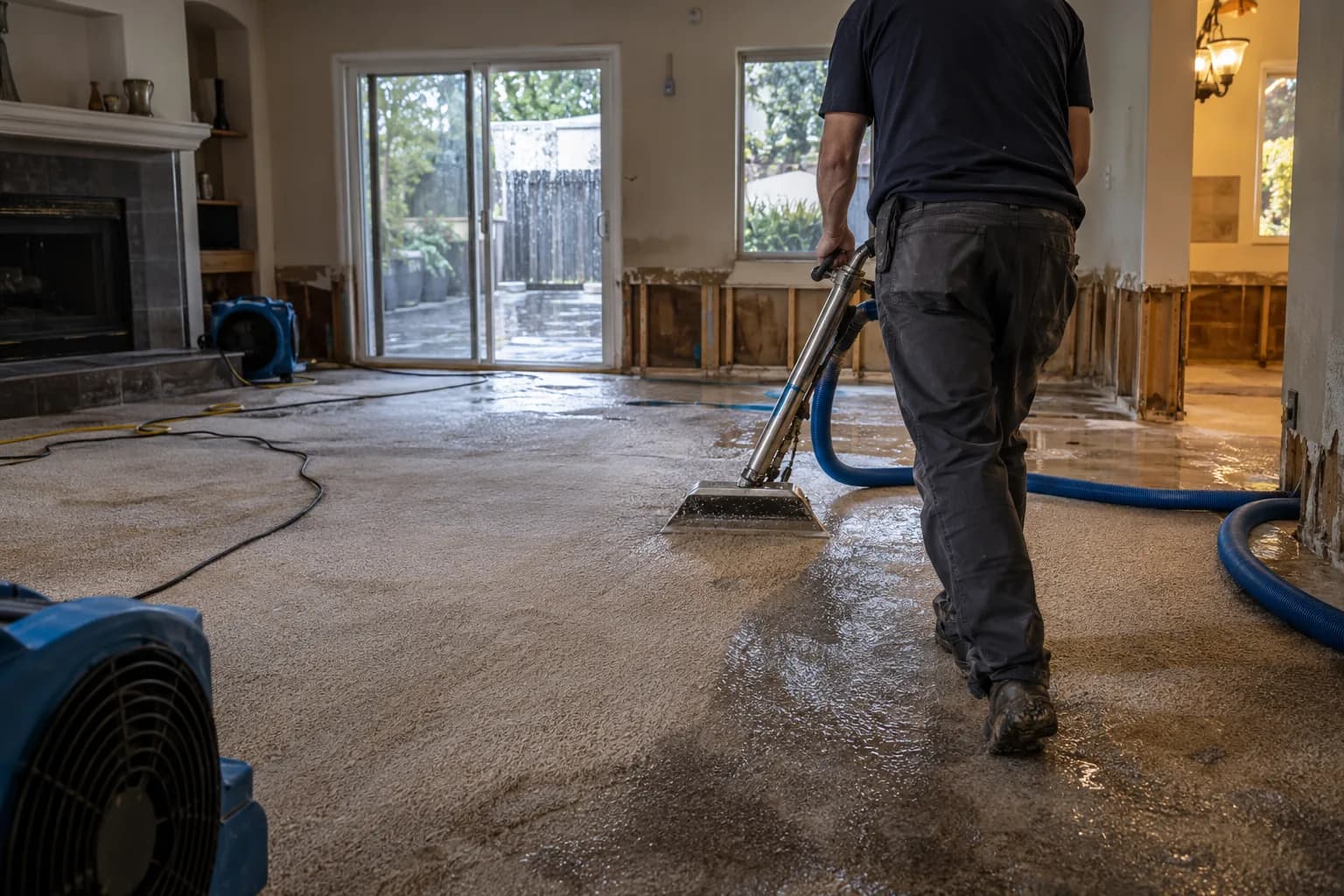
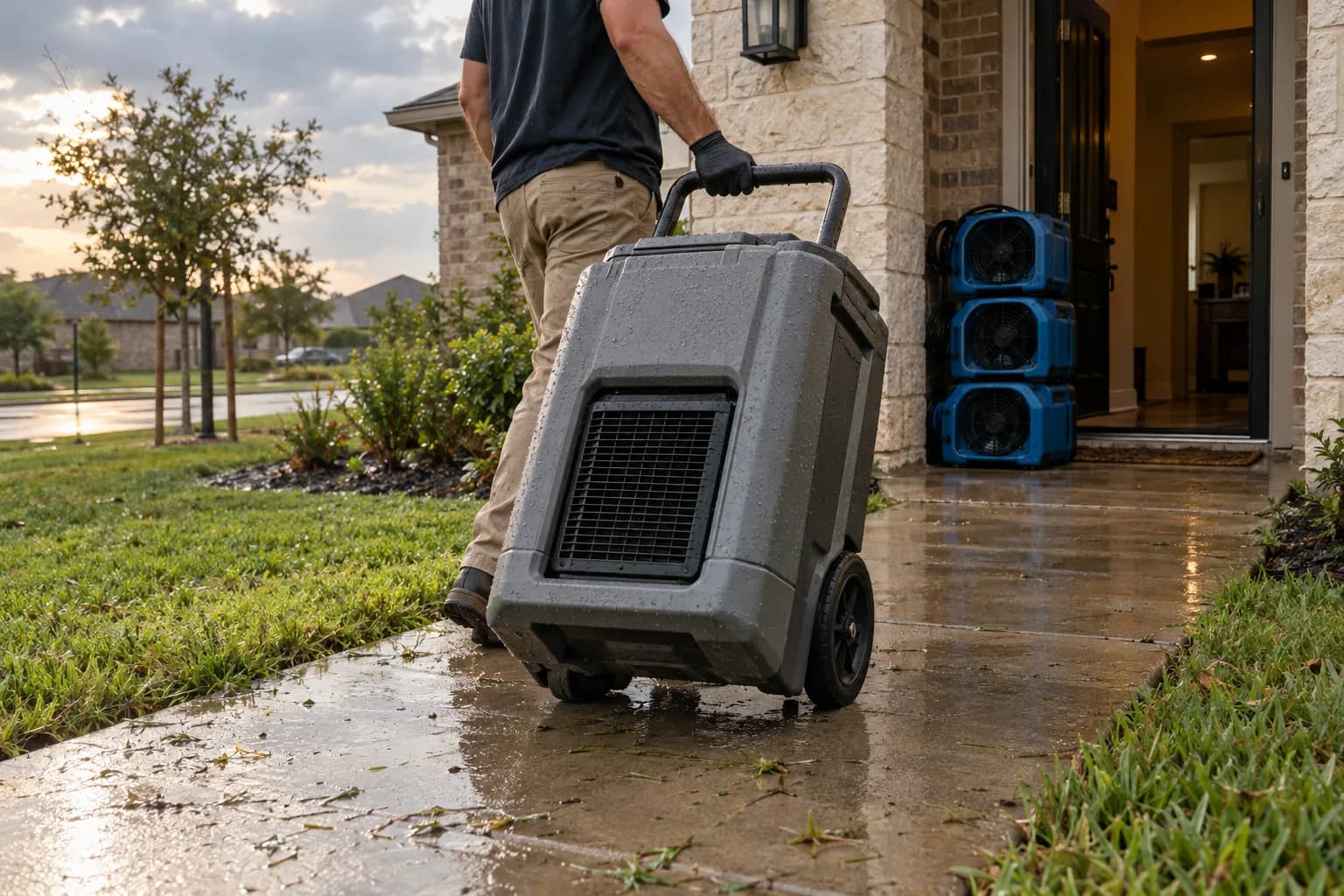
Fast removal of standing water with truck-mounted and portable units before it soaks into more material.
See emergency water extraction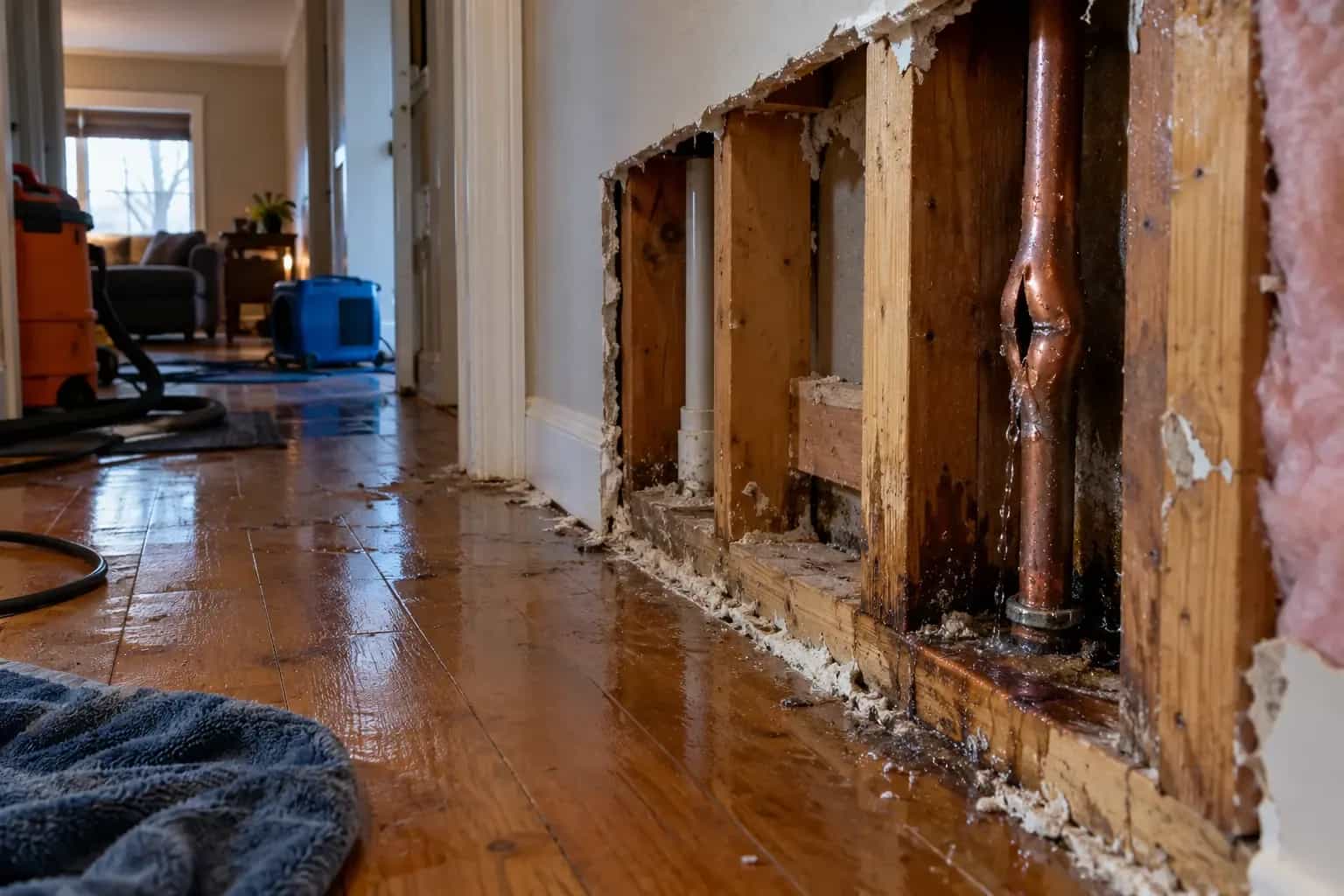
San Marcos, TX & Hays County · 24/7 response
A failed supply line or a winter freeze break floods a wall cavity long before anyone hears it. We extract, open what has to be opened, and dry in-cavity across San Marcos.
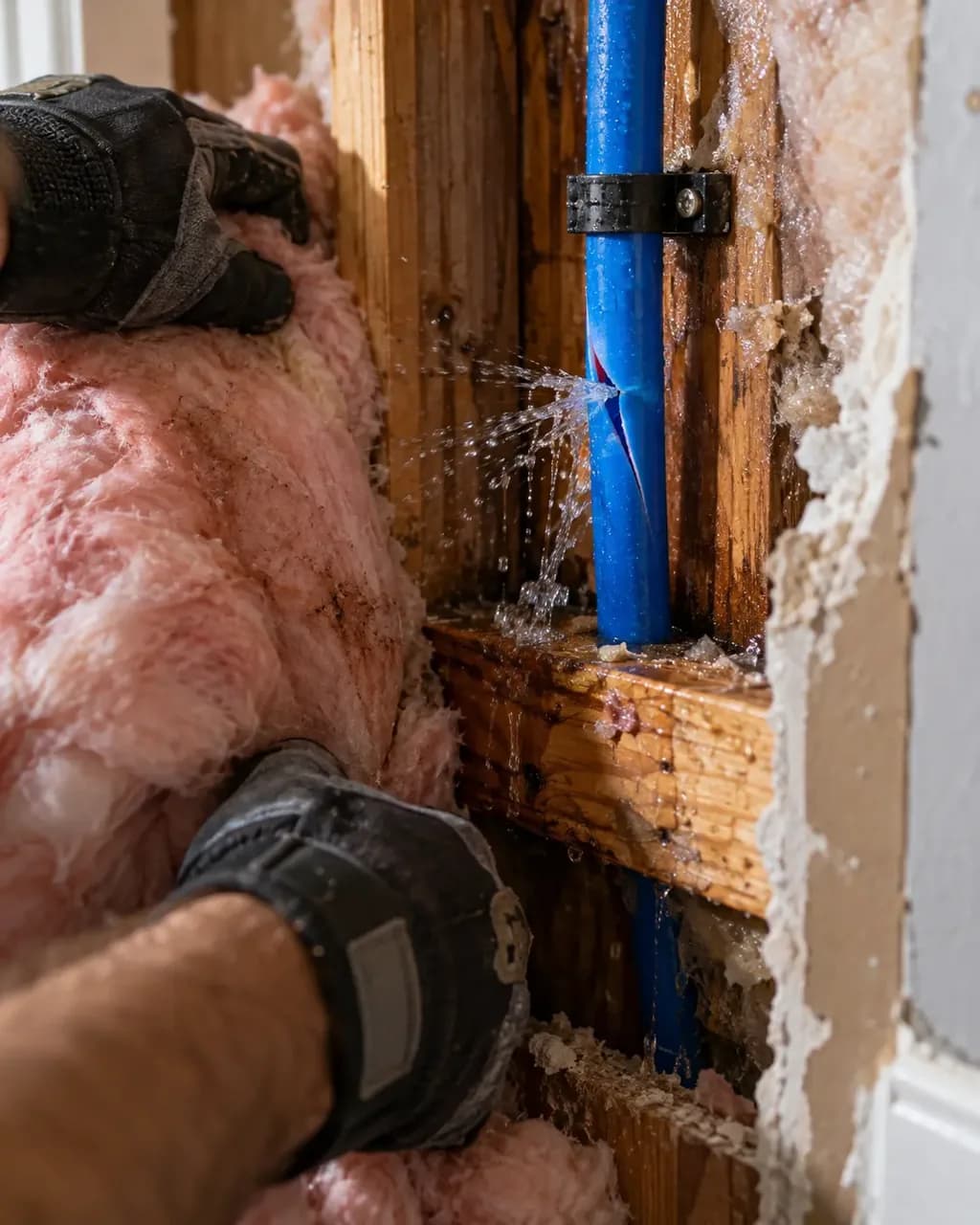
Burst pipe water damage comes from a failed supply line, a washing-machine hose, or a winter freeze break. Texas pipes start freezing around 20 degrees Fahrenheit, sooner in uninsulated attics and exterior walls. Water inside a cavity needs targeted in-cavity drying, not surface air movement, and the 24 to 48 hour clock starts immediately.
A pipe just let go and water is spreading across your floor in San Marcos, TX. Shut off your water main, then call. The first move matters more than the cleanup, because most of the damage happens in the hours before help arrives.
We're on the way. Tap to call now. Reach us around the clock for burst and frozen pipe water damage across San Marcos and Hays County.
When a pipe bursts, shut off your water main first to stop the flow, then cut power to any wet areas at the breaker before you step in. Move what you can. Call for water extraction right away, because the first 24 to 48 hours decide whether floors, walls, and cabinets can be saved or end up in the dumpster.
Stop the source before anything else. A burst supply line can push out gallons a minute, so toweling the floor while the water keeps coming gets you nowhere. Your main shut-off is usually where the line enters the house. That means a garage, a utility closet, near the water heater, or in a box near the curb. Turn a round valve clockwise or flip a lever a quarter turn until it stops.
Water and electricity together is the part people skip when they're rushing. If water has reached outlets, baseboards, or the panel itself, cut those circuits at the breaker before you walk through standing water and treat anything wet near a live circuit as dangerous until proven otherwise. When in doubt, stay out and wait, because no floor is worth a shock.
Once the water is off and the room is safe, call. The reason isn't the puddle you can see. It's the water that already ran into the wall cavity, under the cabinets, and down to the subfloor while you were finding the shut-off. That hidden water is the real problem. Get the visible water up with towels or a wet vac in the meantime, pull rugs and electronics clear of the wet zone, and lift anything off the floor that can still be moved by hand.
Plenty of failures get called burst pipes. The cause changes how the water behaves. A frozen pipe splits when the water inside expands in a hard freeze, then floods the second it thaws. A braided steel supply line fails at the fitting and sprays for hours before anyone notices.
That is especially true overnight or while the house is empty. A water heater can crack at the tank, and a copper or galvanized line inside a wall can give way at a joint with no warning.
Here's the part most homeowners get wrong. The puddle on the floor is usually the smallest part of the problem. In a new-build subdivision, the most common burst isn't a frozen main, it's a failed braided washing-machine or toilet supply line, a twelve-dollar part that quietly floods a downstairs ceiling overnight. Cheap part, expensive mess. The water inside the wall cavity and under the subfloor is what causes the mold call three weeks later.
Our crews follow ANSI/IICRC S500. We shut the water off at the source, extract standing water, open only what has to be opened to reach wet framing, then dry to a documented standard. Here is the sequence on a typical burst pipe call.
First we confirm the water main is shut and trace the failure back to the pipe that let go. On a freeze break that usually means an attic run, a garage line, or an exterior-facing wall cavity, the spots that freeze first in a Texas home. Thermal imaging shows where water tracked behind drywall and under flooring, and a moisture meter confirms how far and how deep it traveled before we mark it on a plan of the room.
Next we pull the standing water with truck-mounted or portable units. Speed matters here more than anywhere else in the job, because every hour that water sits, it migrates further into the structure and the salvageable list shrinks.
This is the step that separates real restoration from mopping. Water from a burst supply line hides in the wall, so we open the cavity where the pipe runs, drill weep holes at the base of the drywall, and inject dry air behind baseboards to move moisture out of the framing and insulation. Air movers and LGR dehumidifiers run alongside psychrometry, the science of measuring temperature and humidity, to dry the structure to a documented standard. A cavity takes days to dry, not a fan pointed at a damp spot, because the framing holds water long after the surface feels dry to the hand.
We do not seal a wall back up over a pipe that hasn't been proven. Once the plumbing source is repaired, the line gets pressure-tested to confirm it holds before drywall goes back, so you are not re-opening the same wall in a month. The first 24 to 48 hours are still the ones that decide whether framing dries or rots (ANSI/IICRC S500).
We take daily moisture readings and log them. Numbers, not guesswork. When materials hit the dry standard, we can document those readings and provide a completion summary for your insurer, so "dried to standard" is a number on paper, not a guess.
Once everything is dry, we rebuild. Here that means drywall, insulation, paint, and flooring back to pre-loss condition. One team handles mitigation through repair, so you aren't juggling separate vendors in the middle of a crisis you never asked for.
Not every burst floods. Some hide. Watch for a sudden drop in water pressure, a spike in the water bill, a damp or warm patch on a wall or floor, the sound of running water with every tap closed, or a musty smell near a supply line.
Any one is worth investigating. A line inside a wall can drip quietly for days, soaking insulation and framing the whole time, before it ever shows up as a stain on the ceiling below.
The window is short. Inside the first 48 hours, soaked drywall, flooring, and cabinets can often be dried and saved. Past it, materials swell, delaminate, and start to harbor mold, and our humid Central Texas air speeds that clock up considerably.
Move fast. What was a drying job on day one becomes a tear-out and rebuild by day four, which is the difference between a few hundred dollars in materials and a gutted room.
Freeze breaks are real here. Household pipes can begin to freeze when temperatures fall below about 20 degrees Fahrenheit, and sooner for the uninsulated attic and exterior-wall runs common in Texas homes. Hays County drops below freezing most winters, and those exposed pipes split when it does.
That threshold comes from NWS and building-science guidance. This is not a once-a-decade event. Winter Storm Uri in February 2021 burst pipes across San Marcos and the I-35 corridor when temperatures stayed below freezing for days.
The local risk splits two ways. Older neighborhoods like Hughson Heights carry aging galvanized and copper plumbing that fails at the joints. Newer subdivisions, Blanco Vista, Stonebridge, and La Cima, see factory-installed braided supply lines fail in the first few years. Both flood the same way. To get ahead of the next cold snap, our guide on how to prevent frozen pipes from bursting in a Texas freeze covers insulation and shut-off prep.
Standing water won't wait. Talk to a local tech.
A burst supply line is usually clean Category 1 water, which prices at the bottom of the Central Texas band, about $3.00 to $4.00 per square foot against a $3.00 to $7.50 range across all water losses (industry cost data, scoped under ANSI/IICRC S500). It climbs the moment the water sits long enough to turn grey, which in a Central Texas summer takes a day or two.
| Affected floor area | Caught fast, Category 1 | Sat overnight or longer, Category 2 |
|---|---|---|
| 200 sq ft, one room | $600 to $800 | $800 to $1,300 |
| 450 sq ft, room and hallway | $1,350 to $1,800 | $1,800 to $2,925 |
| 800 sq ft, several rooms on one level | $2,400 to $3,200 | $3,200 to $5,200 |
| 1,500 sq ft, water through a whole floor | $4,500 to $6,000 | $6,000 to $9,750 |
That is the published market rate band multiplied by floor area, not a quote from us. Whole San Marcos jobs range from about $1,200 for a small clean-water burst to $8,500 or more for one that ran through several rooms (industry cost data), and small jobs land near that $1,200 floor rather than the raw multiplication, because a callout and an equipment set have a practical minimum.
A burst pipe generates two separate scopes from two separate trades, and homeowners routinely expect one invoice.
| Plumber | Restoration crew | |
|---|---|---|
| What they fix | The failed pipe, fitting or valve | Everything the water touched |
| Typical timing | First, same day, before drying can finish | Extraction starts immediately, drying continues after the repair |
| Insurance treatment | The pipe repair itself is often excluded | The resulting water damage is typically the covered part |
| Who we are | Not us, we coordinate them | This is our scope |
That insurance split catches people out. A standard Texas homeowners policy generally pays for the damage the escaping water caused, not for replacing the component that failed. So the plumber's invoice frequently comes out of pocket while the drying and rebuild go on the claim. Ask your adjuster to confirm the split in writing before either trade starts.
On coverage generally, a sudden and accidental burst is one of the more commonly covered causes in Texas, while gradual or neglected leaks are often excluded. See does homeowners insurance cover water damage in Texas and filing a water damage insurance claim in Texas.
Household pipes can start to freeze once outdoor temperatures fall below about 20 degrees Fahrenheit, and sooner for uninsulated attic or exterior-wall runs, which are common in Texas homes built for heat rather than cold (NWS and building science guidance). The burst rarely happens during the freeze. It happens on the thaw, when the ice plug melts and pressure finds the split.
| Condition | What is at risk | What to do |
|---|---|---|
| Below 32F for a few hours | Exposed hose bibs and irrigation backflow preventers | Disconnect hoses, cover the bib, shut and drain irrigation |
| Below 28F overnight | Attic runs, garage walls, exterior-wall plumbing | Open cabinet doors, run a pencil-thin drip on the furthest fixture |
| Below 20F for several hours | Any uninsulated run, including under-slab manifolds in older homes | Drip several fixtures, keep the heat on, know where your shutoff is |
| Below 20F for a full day or more, the 2021 pattern | Whole-house risk, plus municipal supply pressure loss | Consider shutting the main and draining if the house will be empty |
Texas homes are the vulnerable ones here specifically because so much plumbing runs through unconditioned attic space. In a Northern build those lines sit inside the heated envelope. Here they sit above the insulation, where attic temperature tracks the outdoors within a few degrees. Our Texas freeze pipe burst prevention guide covers the prep list before the next front arrives.
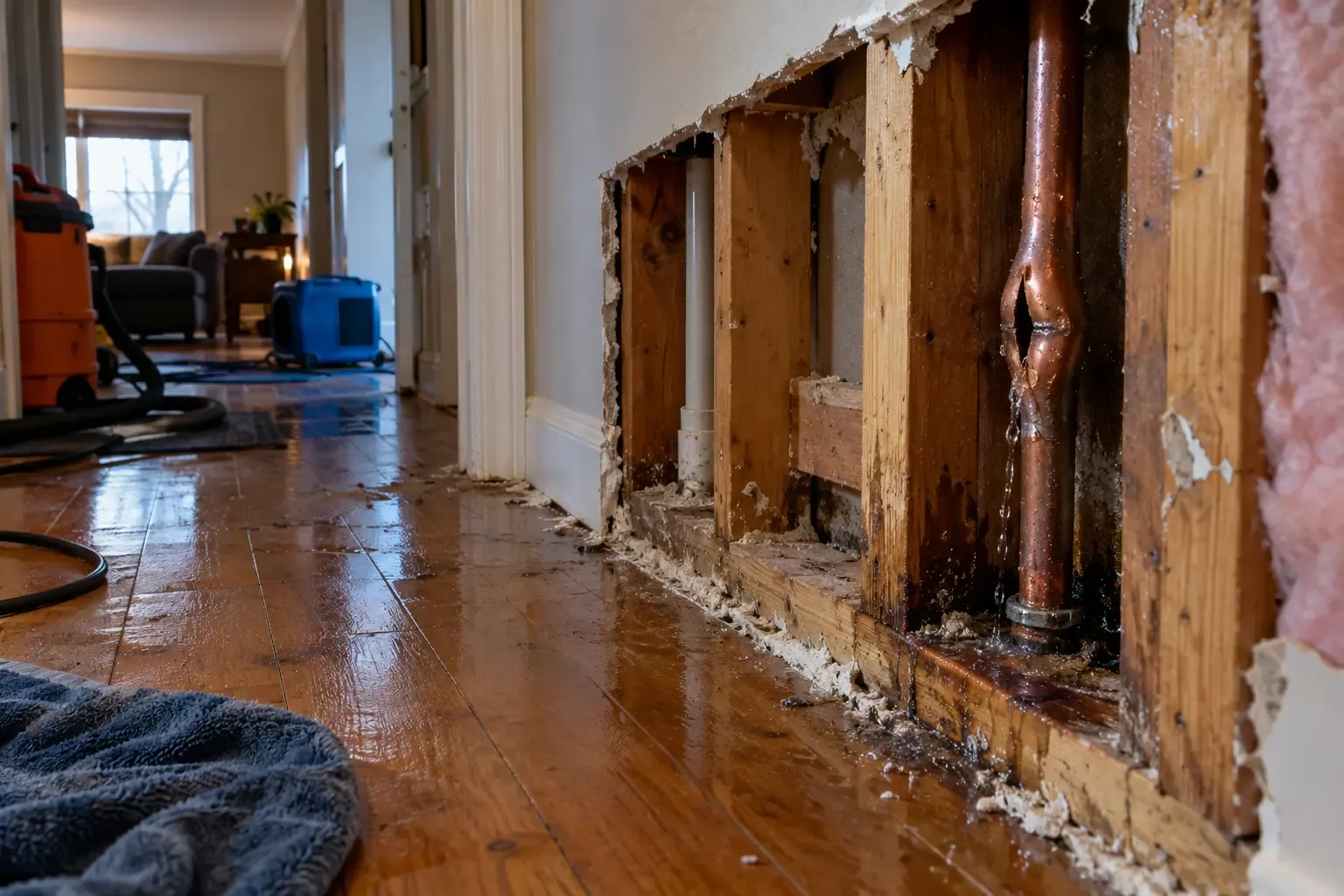
Pressurised water does not pool politely at the failure point. It follows framing, and it travels a long way sideways before it shows up on a ceiling or a baseboard, which is why the wet footprint is almost always larger than the stain.
| Path | Where it shows up | How long before you see it |
|---|---|---|
| Down the stud bay to the bottom plate | Baseboard darkening two rooms away | Hours, and often after the plumber has left |
| Along the top plate to an interior wall | A ceiling stain on the floor below | Hours to a day |
| Under a floating floor | Cupping planks, edges lifting | One to three days |
| Into fibreglass batt insulation | Nothing visible at all | It may never show, which is the problem |
| Onto a slab under tile | A cold patch underfoot, grout darkening | Days, sometimes weeks |
That fourth row is why a meter reading beats a visual check. Wet insulation holds water against framing without producing a single visible sign, and it is a common reason a repaired room comes back as a mold call three months later.
Before and after
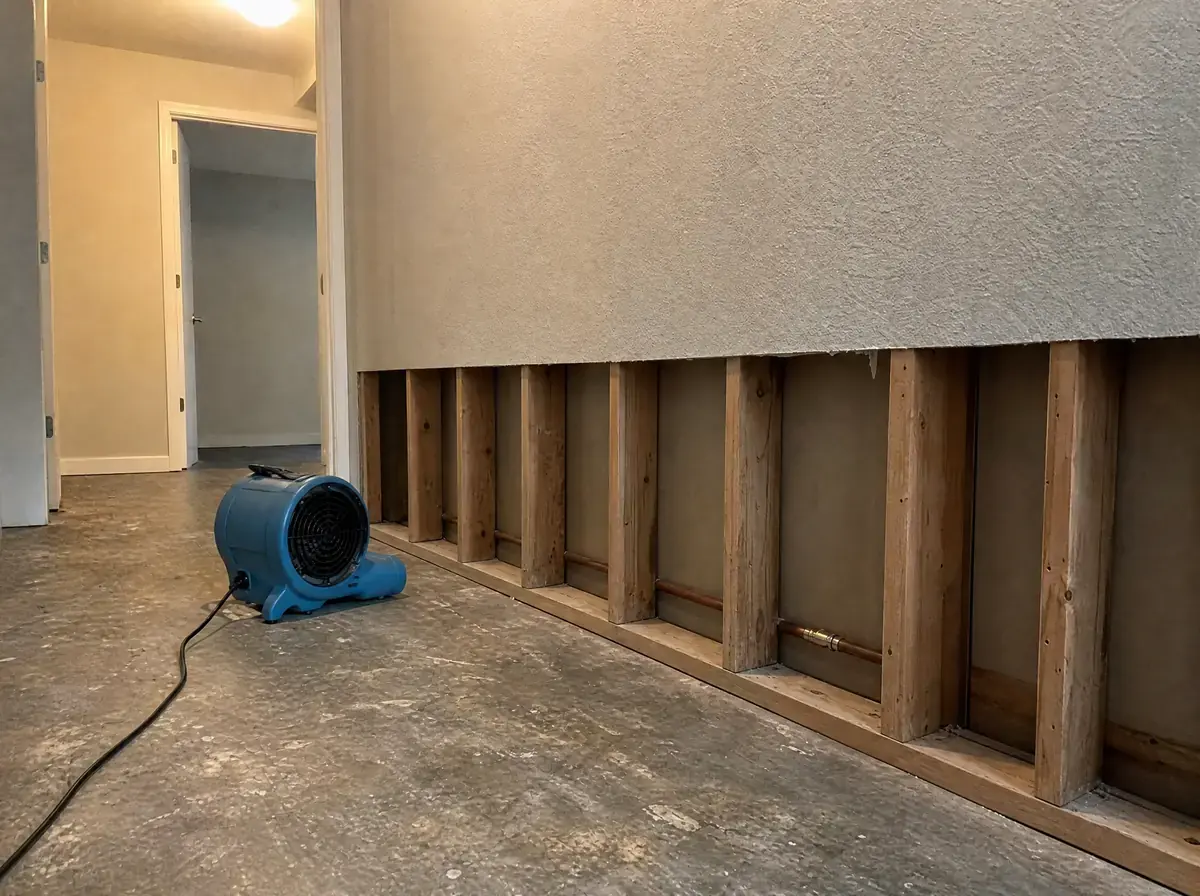
A half inch supply line pushes water continuously until someone finds the shutoff. The face of the wall shows a fraction of it. The cavity, the bottom plate and the subfloor hold the rest, and that is where the drying work happens.
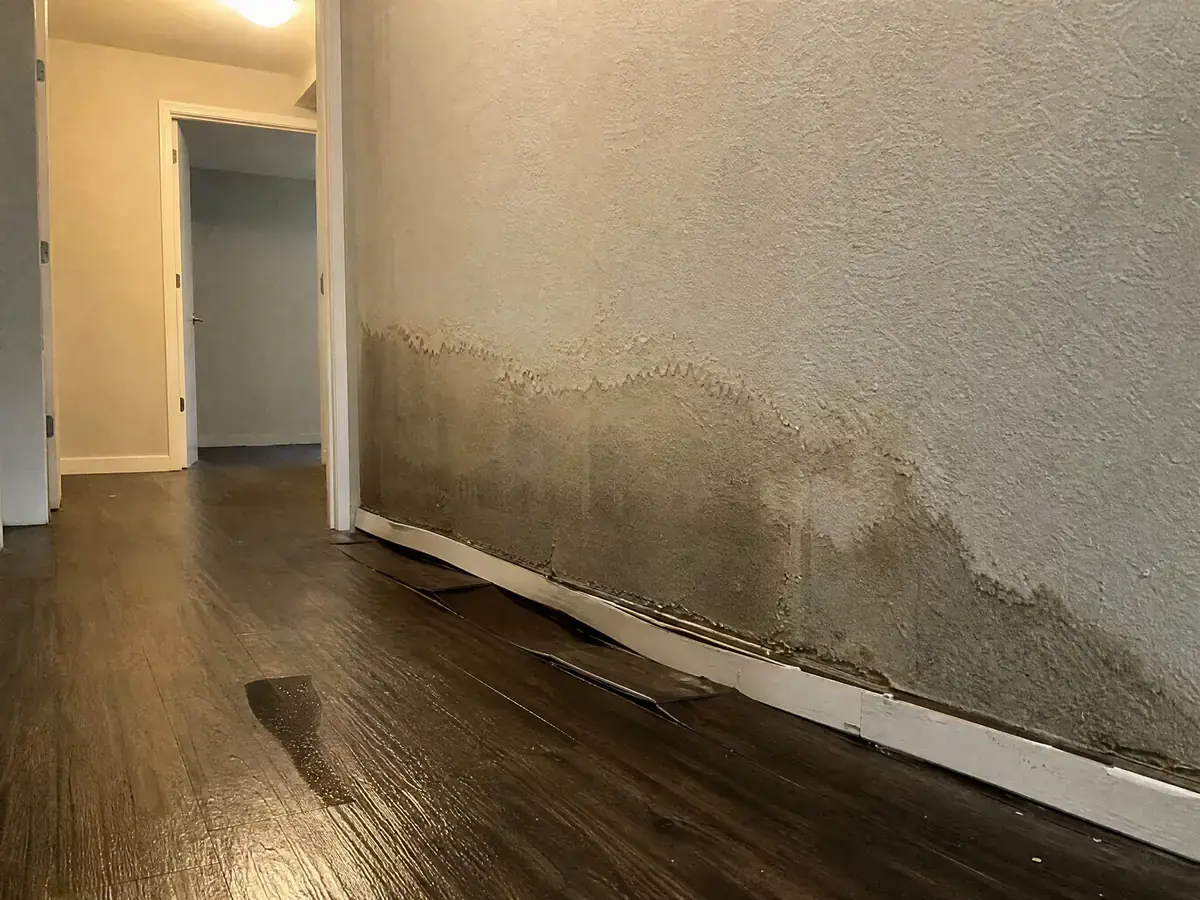 Before, cavity saturated
Water tracked down the stud bay and along the bottom plate, spreading further than the visible stain suggests. Insulation in the bay is holding water against the framing.
 After, opened, dried, verified
Cavity opened where it had to be, wet insulation out, targeted airflow into the bay, and daily readings until framing matches the unaffected reference.
Standing water? Call now, we answer 24/7.
A real local person picks up, then a crew heads your way.
Who we are
We put the things most companies keep vague in writing: real price ranges for this market, the standards we work to, and a moisture log your adjuster can read.
24/7
A real local person answers, day or night
24-48 hrs
The critical window to limit secondary damage
~25 mi
Served from our San Marcos hub across Hays, Comal & Caldwell
S500
The ANSI/IICRC drying standard our process follows
One local team handles every stage, so you are not juggling separate vendors.
Start hereFast removal of standing water with truck-mounted and portable units before it soaks into more material.
See emergency water extraction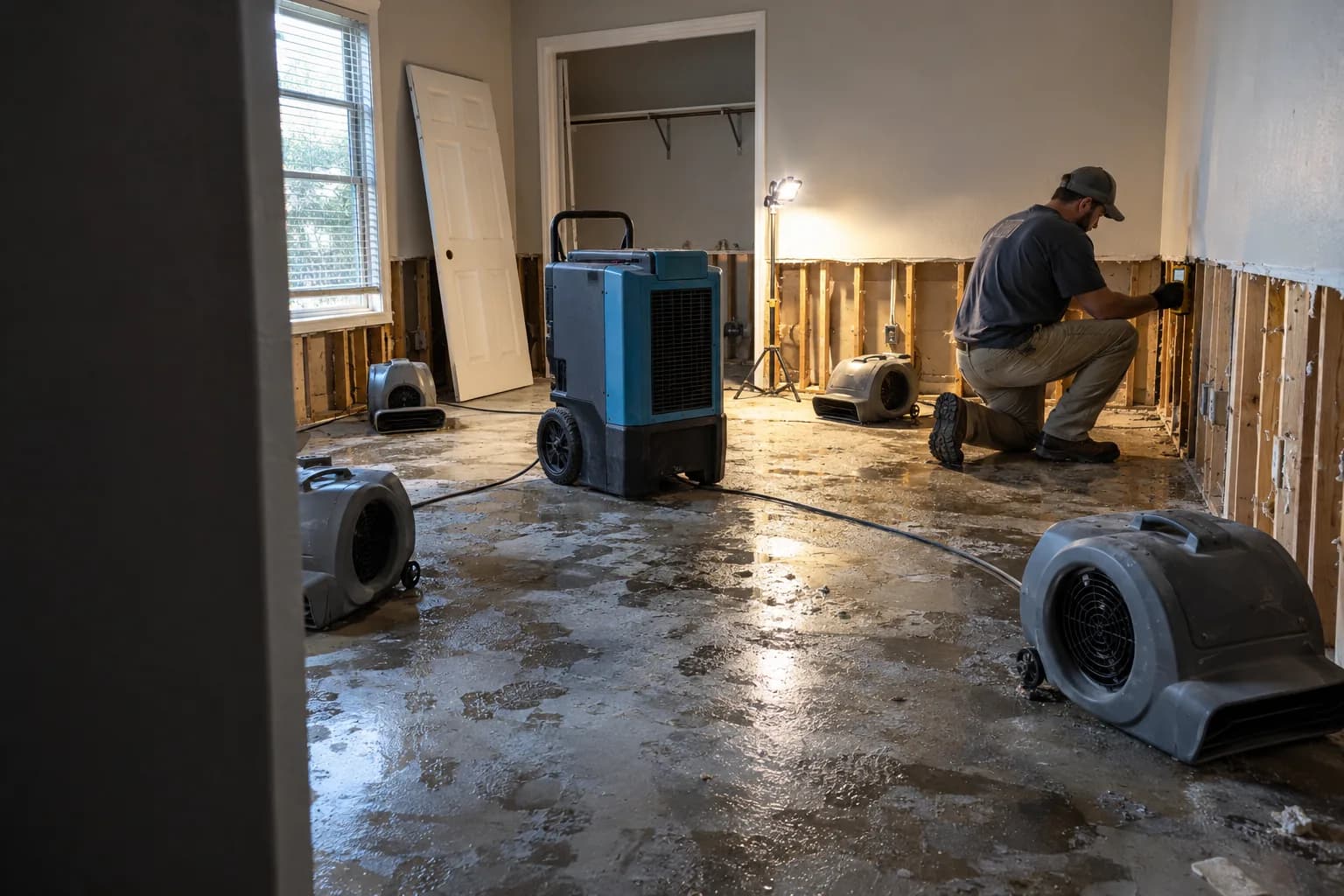
Air movers and LGR dehumidifiers with daily moisture readings, dried to a documented standard.
See structural drying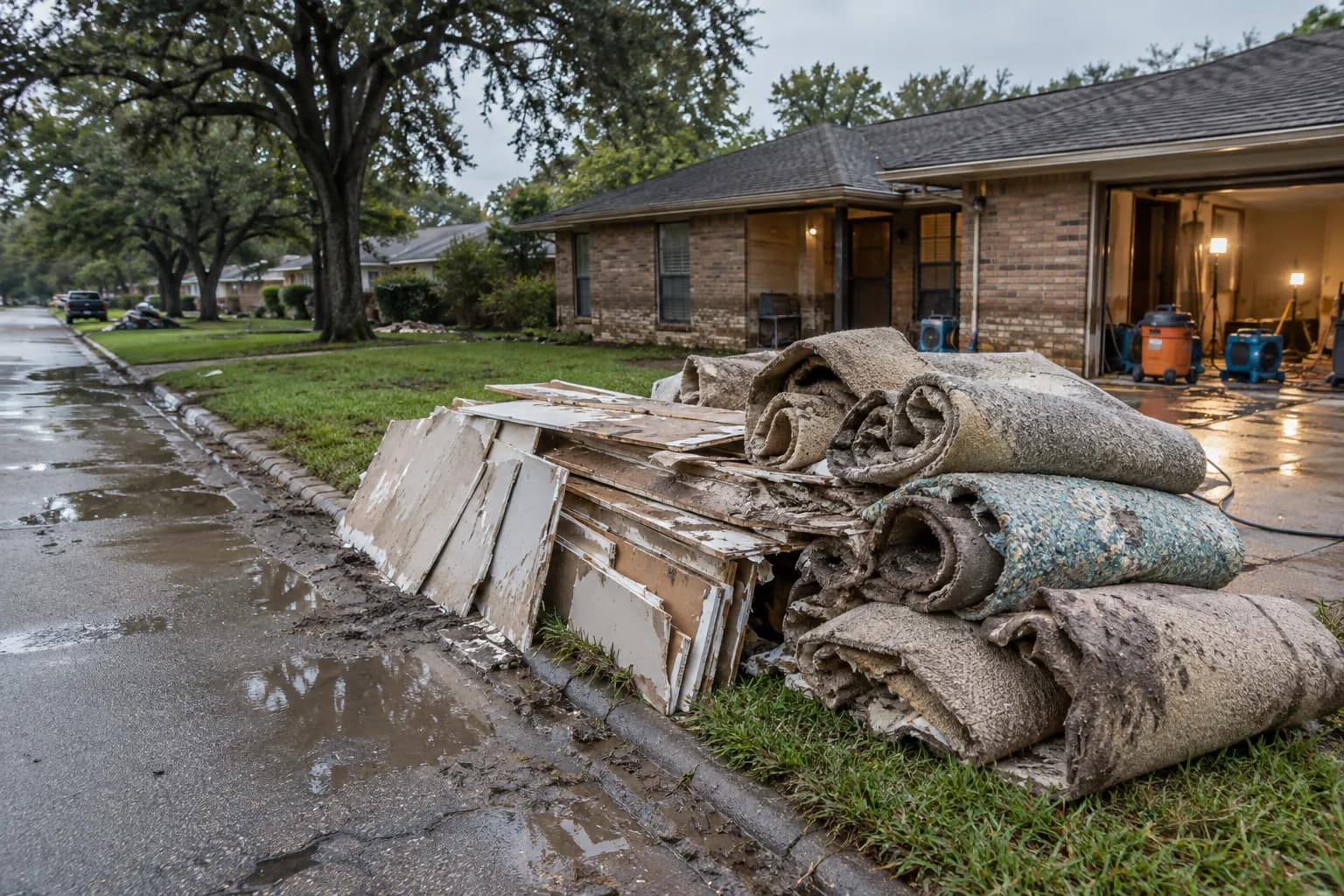
Muck-out and restoration after river flooding and flash floods along the San Marcos and Blanco Rivers.
See flood damage cleanupFAQ
Straight answers to what San Marcos homeowners ask most, on cost, insurance, mold timelines, and what to do first.
24/7
A real local team across Hays, Comal & Caldwell counties. Every job dried to a documented standard.
Have a question on your mind?
Get a quoteShut off your water main first. Then cut power to any flooded rooms at the breaker before you walk through standing water, move furniture and valuables out of the wet zone if you can do it safely, and start mopping or toweling visible water. After that, call for professional extraction, because the water you cannot see inside walls and under floors is what causes the lasting damage. Acting in the first 24 to 48 hours is what keeps floors, drywall, and cabinets salvageable.
Your main shut-off is usually where the water line enters the house, often in a garage, a utility closet, near the water heater, or in an exterior box near the street or sidewalk. To cut the flow, turn the valve clockwise if it is a round handle, or a quarter turn if it is a lever. Can't find it? Your water meter box near the curb has a street-side valve you can close in an emergency. It is worth locating yours before a freeze, while you have time, so you are not searching for the shut-off in the middle of a crisis with water already on the floor.
Yes. Freezes catch people out here, and Winter Storm Uri in February 2021 burst pipes across San Marcos and the I-35 corridor when temperatures stayed below freezing for days, the kind of multi-day hard freeze Hays County sees most winters. Uninsulated pipes in attics, garages, and exterior walls split first. The water inside expands, cracks the pipe, then floods the moment it thaws. Newer subdivisions and older neighborhoods are both at risk, so pipe insulation and a known shut-off location matter here far more than people expect.
In most cases, yes. A sudden and accidental pipe burst is one of the more commonly covered causes under a standard Texas homeowners policy, and coverage usually applies to the resulting damage to floors, walls, and belongings, though policies differ and gradual or neglected leaks may be excluded. Document it early. Photos and professional moisture readings, taken before any cleanup begins, strengthen the claim you hand your adjuster. See our guide on whether homeowners insurance covers water damage in Texas for what to expect before you file.
Tell us straight what is happening and we will tell you the next step. We pick up, then we are on the way.
A real local person answers, 24/7. Tell us what is happening and we are on the way.