San Marcos water damage guide
Texas Freeze Pipe-Burst Prevention: A Homeowner's Guide
Texas freeze pipe burst prevention comes down to a handful of steps you can do in an evening. The short version is let your faucets drip, open the cabinet doors under your sinks, insulate the pipes you can reach, disconnect your garden hoses, and keep the heat running. Here in San Marcos, TX, that matters more than most people think. The risk is real. Our houses were built to shed July heat, not to ride out a hard freeze, and the pipe running through your attic or an exterior wall has almost nothing protecting it when the temperature drops into the teens.
Published · Updated
Save our number before the freeze. Call now and keep it handy in case a pipe gives out.
How Do You Prevent Frozen Pipes From Bursting in a Texas Freeze?
To prevent frozen pipes from bursting in a Texas hard freeze, let faucets drip to relieve pressure, open cabinet doors to warm pipes on exterior walls, insulate exposed and attic pipes, disconnect and cover outdoor hose bibs, and keep the heat on. Know where your main water shut-off is, since most flooding happens when a cracked pipe thaws.
Here is the order I'd work through before a cold front lands, starting with the cheap moves that take minutes and ending with the ones you only need if a line actually gives out.
- Let vulnerable faucets drip. A slow, steady trickle relieves the pressure that builds between an ice plug and the faucet. That pressure, not the ice itself, is usually what splits the pipe. Pressure does the damage.
- Open the cabinet doors under kitchen and bathroom sinks on exterior walls. Warm air helps. It lets your indoor heat reach the pipes hiding behind the cabinet.
- Insulate the pipes you can get to. Foam sleeves on attic runs, garage lines, and anything along an outside wall. These are the spots that freeze first.
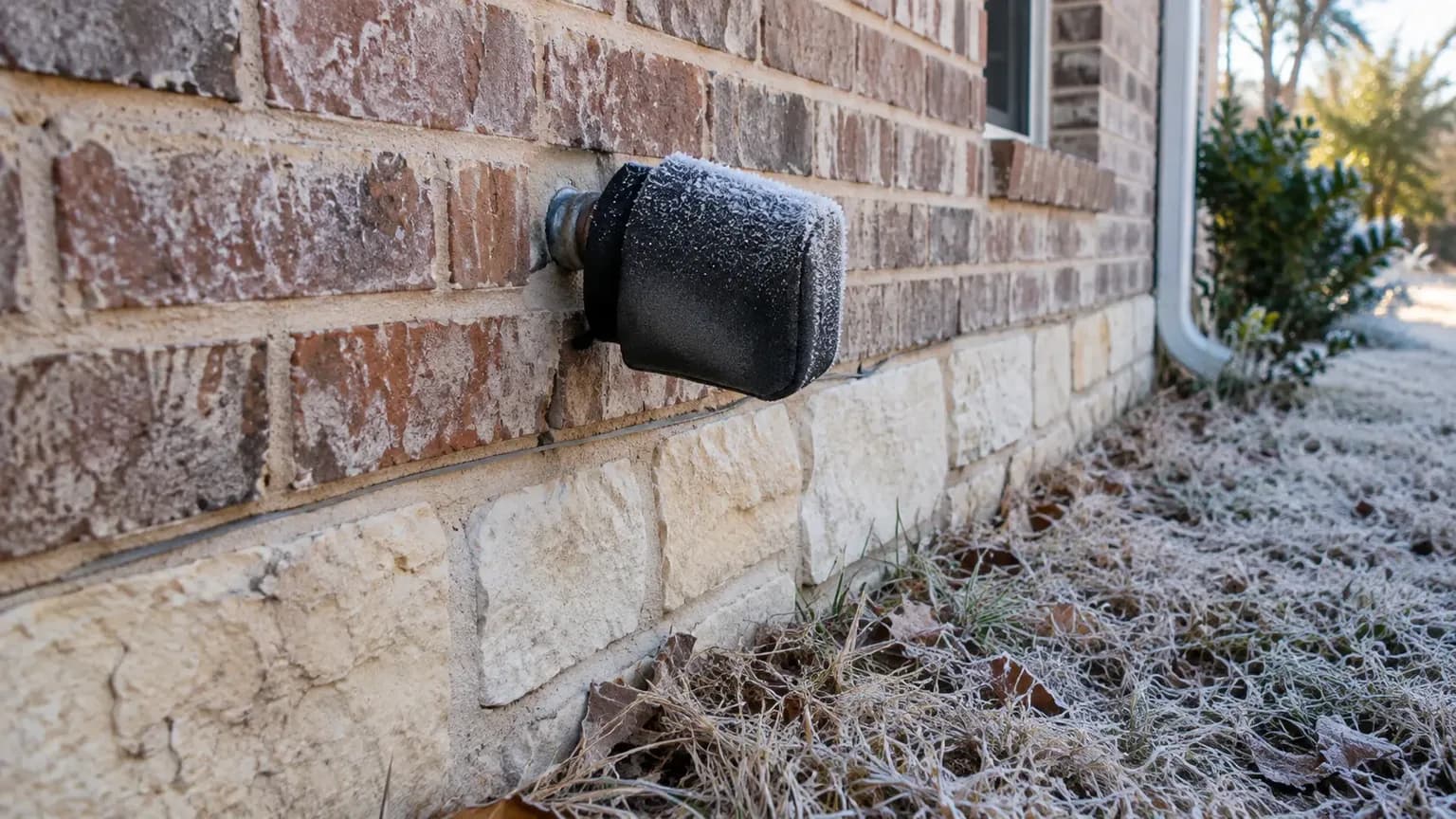
- Disconnect and drain garden hoses, then cover the hose bibs. A connected hose traps water at the spigot and the freeze backs up into the wall.
- Keep the heat on, even if you leave town. Set the thermostat no lower than 55°F and crack interior doors so warm air moves around.
- Find your main water shut-off now. It is usually at the meter near the street or where the line enters the house. Look while it is light out and dry.
- Know how to shut it off and drain the system if a line does break. One open faucet at the lowest point helps the water clear out faster, and getting the line empty before the next cold snap means a cracked pipe has nothing left to push through the wall when it thaws.
None of this is exotic. The trouble is that people read the list during the freeze instead of the day before, when the foam sleeves are still on the hardware store shelf.
Why Texas Pipes Burst (Built for Heat, Not Hard Freezes)
Worth saying plainly. A house in Minnesota buries its pipes deep and wraps the rest. A house here does the opposite, because for 360-some days a year the enemy is heat, not cold. Supply lines run through uninsulated attics and along exterior walls where a hard freeze reaches them.
Walk through a typical San Marcos build and you'll see why. The pipes sit exposed. Supply lines snake through an unconditioned attic, run down inside exterior walls with thin insulation, and feed hose bibs that stick out into open air. Slab-on-grade construction, which is everywhere from older neighborhoods to newer ones like Blanco Vista, puts plumbing close to outside temperatures with little buffer. Add a hard freeze that we get maybe once or twice a winter, and the weak points all line up at once.
Winter Storm Uri in February 2021 made that painfully clear across Central Texas. The cold held for days. Pipes burst by the thousands when temperatures sat below freezing for days and the power grid faltered, so even homes that kept the heat going lost it. The lesson from Uri wasn't that Texans did something wrong. It was that our homes carry a built-in vulnerability the rest of the year hides, and a long, deep freeze finds every exposed run, every uncovered hose bib, and every line in a wall that never needed insulating until that one week.
The Thaw Is When It Floods
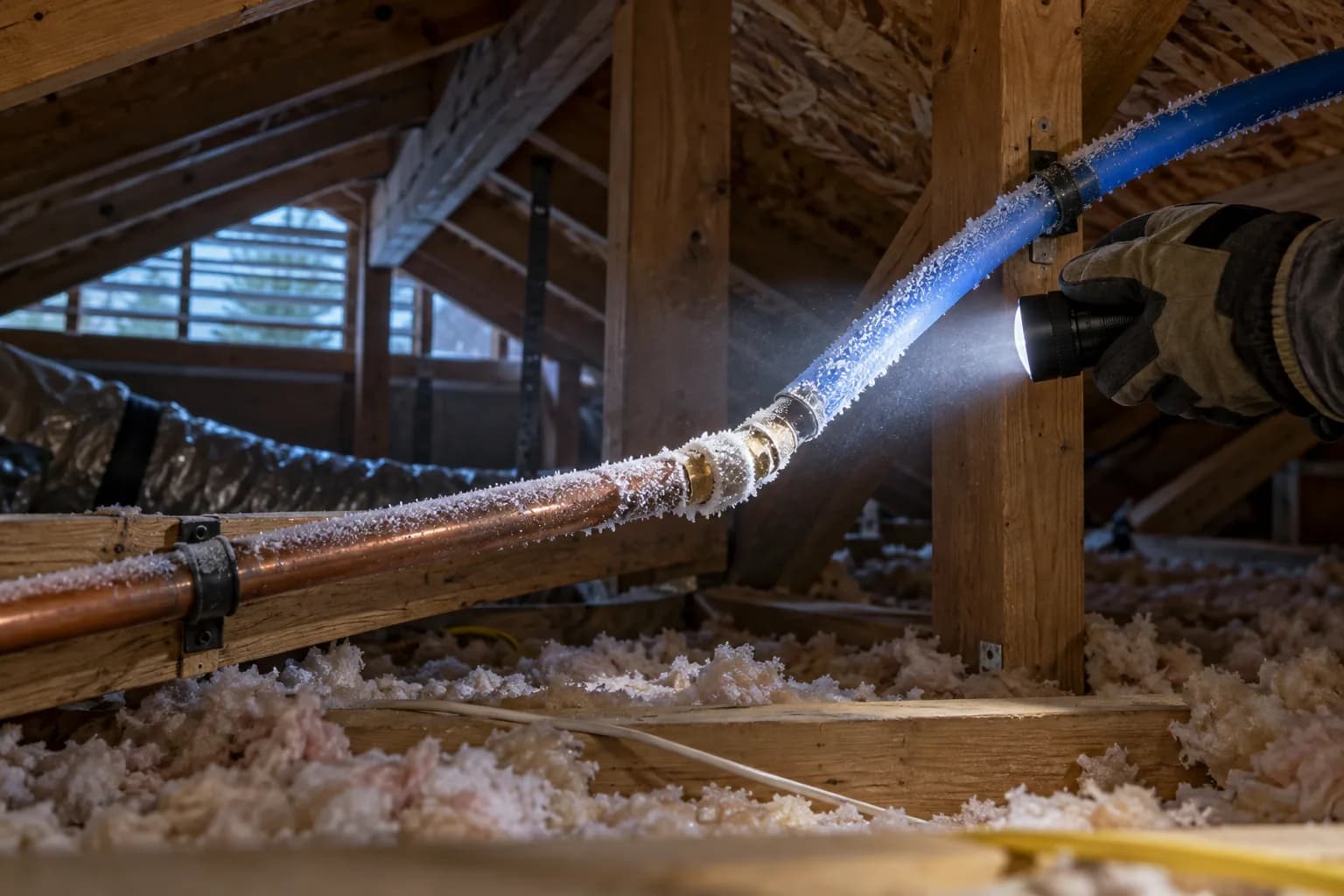
Here's the part most prevention guides skip. The pipe usually doesn't flood your house while it's frozen. It cracks while frozen, sure, but the ice is still plugging the hole. The water starts pouring the moment things warm up and flow returns to the line.
Not while frozen. That is the one that catches people off guard, because the danger window opens after the cold has passed.
So the highest-risk hours aren't the coldest ones. They're the morning the sun comes out, the temperature climbs back above freezing, and everyone relaxes because the freeze is "over." That's exactly when a hairline split in an attic line turns into water coming through the ceiling. If you suspect a pipe froze, leave the main shut-off closed until you've checked every fixture and you're confident nothing cracked. Stay alert. Watching for that thaw window, rather than only the freeze itself, is what separates a quick fix from a soaked subfloor. Mind the warm-up.
What to Do If a Pipe Bursts
Even a careful homeowner can lose a pipe in a freeze like Uri. Prevention lowers the odds, but it doesn't erase them, so it pays to know the moves before you need them, which means main shut-off, breaker, photos, then call. It happens.
- Shut off the main water valve. This is the single most important step, and it's why locating the valve early matters so much.
- Kill power to wet areas at the breaker. Water and electricity together are a real hazard, so cut the circuits feeding any flooded room.
- Open faucets to drain the line and relieve any remaining pressure.
- Photograph everything before you start mopping up. Shoot it first. Your insurer will want to see the damage as it happened.
- Call for extraction fast. The first 24 to 48 hours decide whether this stays a drying job or becomes a mold and rebuild job.
When you're ready for help, this is the moment for burst and frozen pipe water damage cleanup, and our walkthrough on what to do first when your house floods covers the safety steps in more detail. We respond around the clock during freeze events, though after a storm like Uri call volume runs high across the whole region.
Before the Next Freeze, A Quick Checklist
Quick recap. Run the list. Do these tonight if a cold front is on the forecast. That means cover exterior spigots, open cabinet doors under sinks on exterior walls, let a pencil-thin trickle run from the furthest tap, and know where your main shut-off is.
- Drip the faucets on lines that run through cold spaces.
- Open cabinet doors under sinks on exterior walls.
- Slide foam insulation onto exposed and attic pipes.
- Unhook the garden hoses and cap the outdoor spigots.
- Hold the thermostat at 55°F or higher, even when you're away.
- Confirm where your main shut-off is and that it actually turns.
Pair this with our broader guide on how to prevent water damage in your home for the year-round habits that stop the leaks freezes don't cause. Spend twenty minutes now, and you've handled the part of a Texas freeze that's actually in your control.
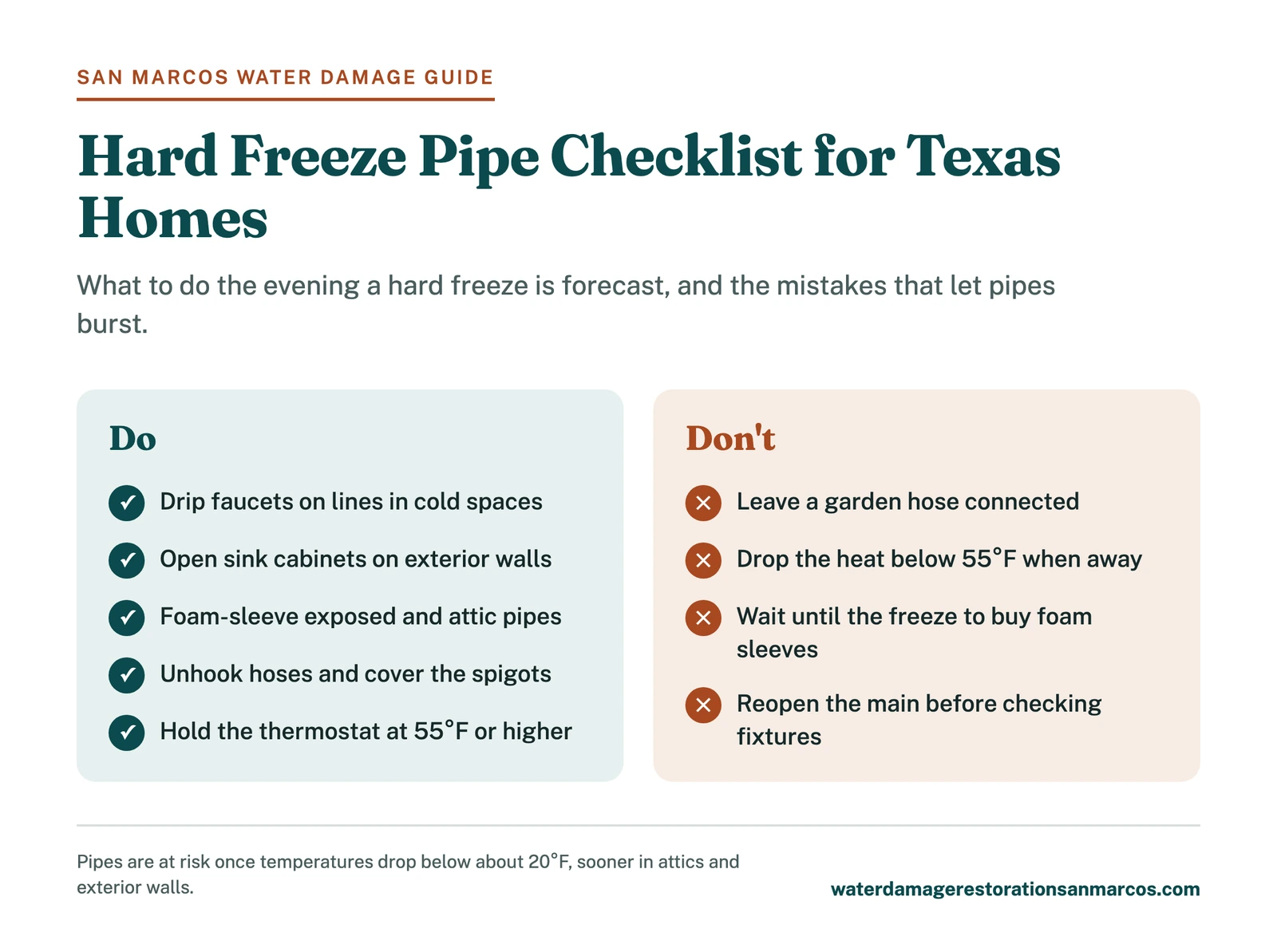
Text version of this infographic
Hard Freeze Pipe Checklist for Texas Homes. What to do the evening a hard freeze is forecast, and the mistakes that let pipes burst.
Do
- Drip faucets on lines in cold spaces
- Open sink cabinets on exterior walls
- Foam-sleeve exposed and attic pipes
- Unhook hoses and cover the spigots
- Hold the thermostat at 55°F or higher
Don't
- Leave a garden hose connected
- Drop the heat below 55°F when away
- Wait until the freeze to buy foam sleeves
- Reopen the main before checking fixtures
Pipes are at risk once temperatures drop below about 20°F, sooner in attics and exterior walls.
Written by the Water Damage Restoration San Marcos team
Local water-damage restoration in San Marcos, TX and Hays County. Our guidance follows the ANSI/IICRC S500 and S520 reference standards the industry plans around. Questions about your situation? Call (512) 778-8417, we answer 24/7.