 Start here
Emergency Water Extraction
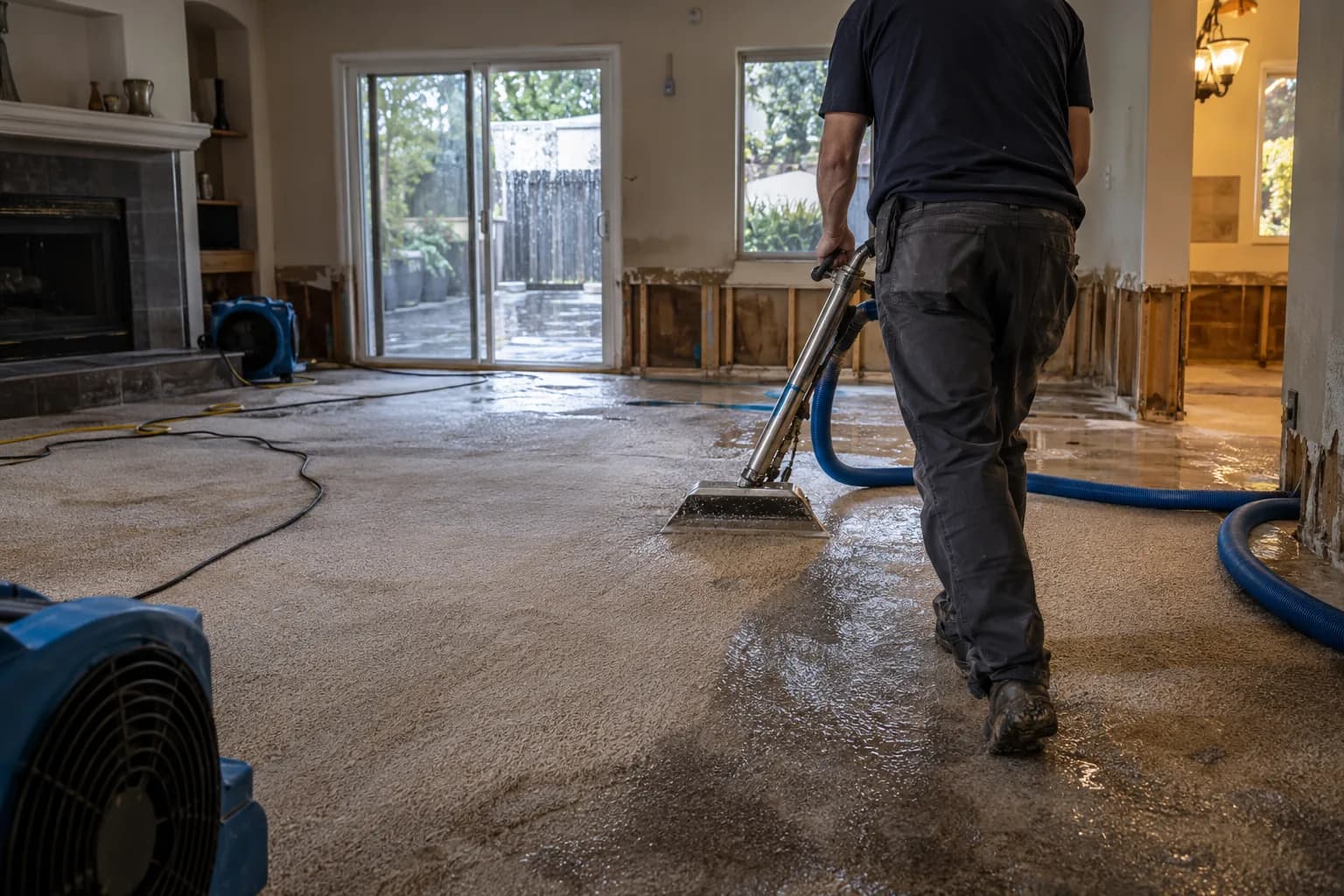
Fast removal of standing water with truck-mounted and portable units before it soaks into more material.
See emergency water extraction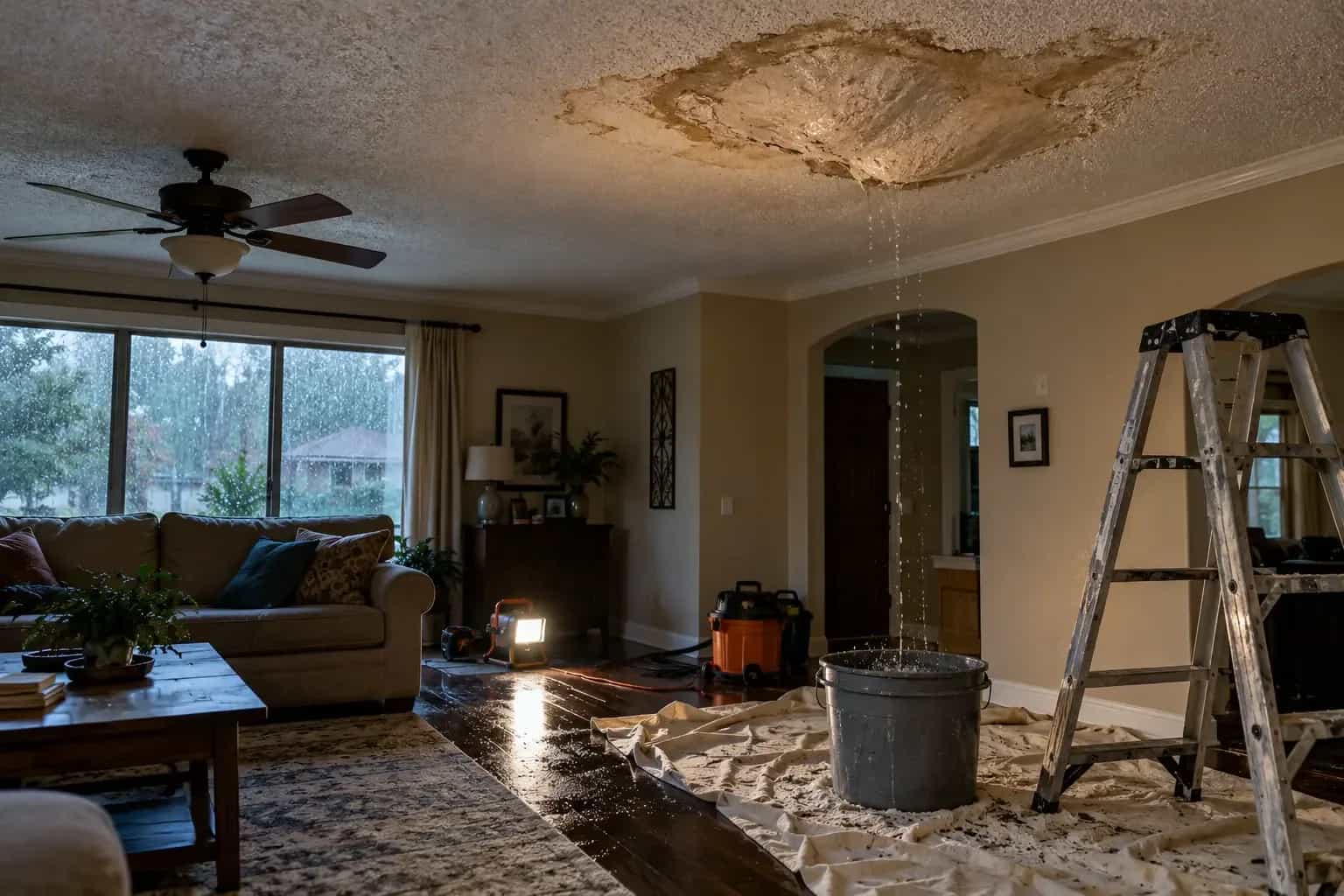
San Marcos, TX & Hays County · 24/7 response
A brown ring or a sagging ceiling means water has been sitting in the assembly for a while. We trace the source, dry the cavity, and repair, across San Marcos and Hays County.
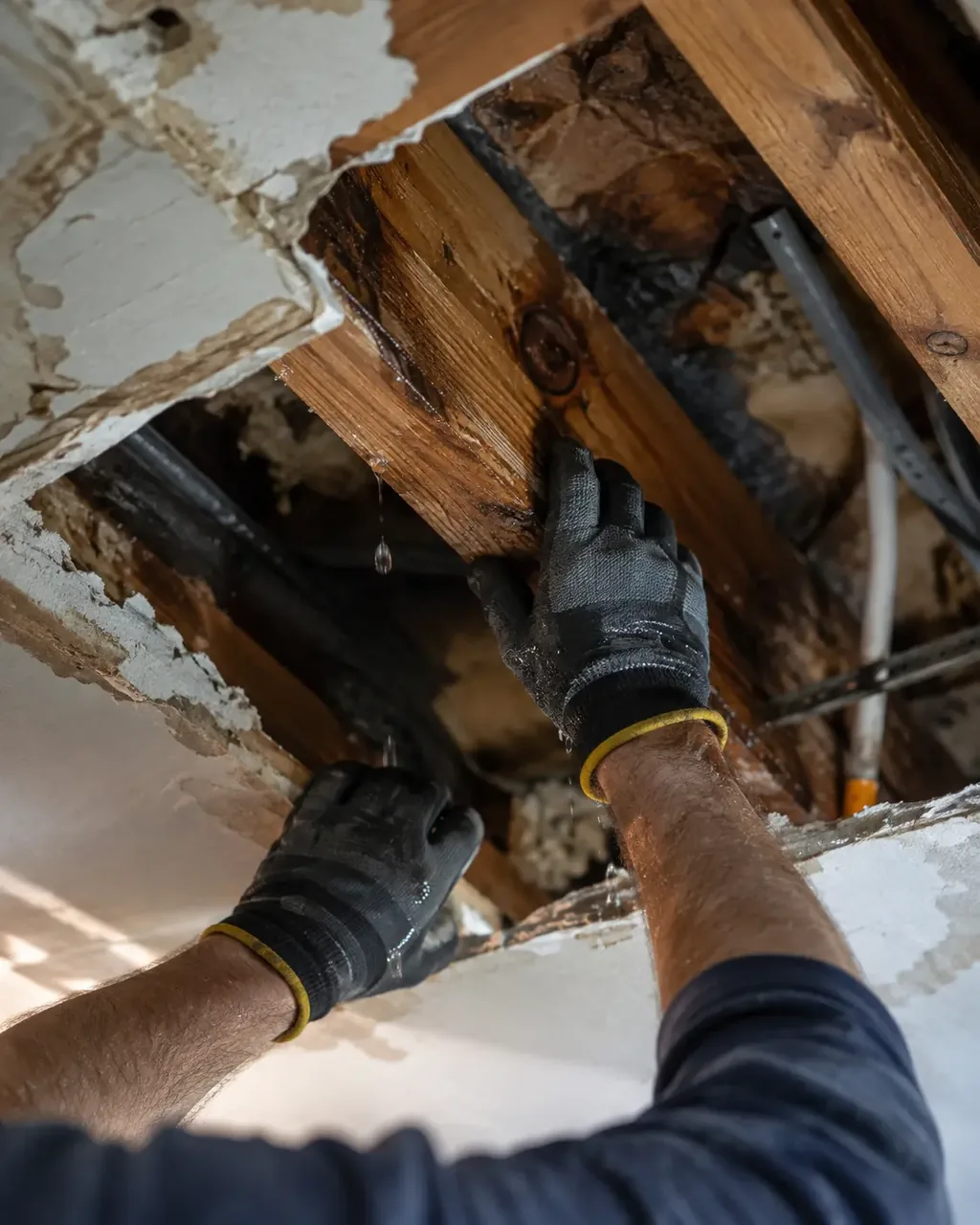
Ceiling and roof leak water damage is usually older than it looks, because the stain only appears after the insulation above it is already saturated. We trace the entry point with thermal imaging, dry the joist bay, then repair the drywall. Central Texas mitigation runs about $3 to $7.50 per square foot.
You looked up and there's a brown ring spreading across the ceiling, or a soft bulge that wasn't there yesterday. In a San Marcos home, that stain usually means a leak above, and where it shows is rarely where it started. Caught early, most of it dries and repairs cleanly. The part that costs money is waiting.
Seeing a stain or a sag? Tap to call now. Reach us around the clock for ceiling and roof leak water damage across San Marcos and Hays County.
A brown or yellow stain on your ceiling signals an active or past water leak above it, usually from plumbing, an upstairs bathroom, or a roof breach. The stain marks where water finally drips out, not where it started. A sagging or bulging ceiling is more urgent. It holds trapped water and is a safety risk that needs immediate attention.
The stain is a symptom, not the diagnosis. Finding the actual source is the whole game, and it's where guesswork costs people the most.
Four usual suspects. Four sources cover most of what we see in San Marcos, TX. Plumbing in the floor above is the big one, which means a supply line, a drain, or a shower pan leaking into the cavity. An upstairs bathroom is a frequent culprit, where a failed wax ring or a tub overflow soaks down. A roof breach lets storm water in. Damaged shingles or failed flashing open the path. And HVAC condensate, a clogged AC drain pan that backs up in the heat, drips through the ceiling all summer long until someone clears the line. Each stains the same way, which is exactly why the source has to be traced, not assumed.
Yes. A sag means trapped water, and water is heavy. Drywall was never built to carry it, so a bulging ceiling can let go all at once, taking insulation and debris down with it. Keep everyone out from directly under it, move valuables clear, and do not poke it to let it drain.
It adds up fast. Set a bucket below the lowest point. Relieving the water the wrong way can bring the whole section down on you. A ceiling that looked fine in the morning can be ready to fall by evening if the leak above it keeps running, so call and let us relieve the water and dry the cavity safely.
The timing tells you most of it. A stain that grows during or right after rain points at the roof or the envelope. A stain that grows on a dry day, or gets worse when somebody showers upstairs, points at plumbing. Getting this right first matters, because the two lead to completely different repairs.
| Clue | Points to a roof leak | Points to a plumbing leak |
|---|---|---|
| Timing | Appears or worsens during rain | Appears on dry days, or tracks bathroom use |
| Stain shape | Irregular, spreading, often with a ring | Rounder, tighter, sometimes directly under a fixture |
| Stain colour | Brown or tan, carries roofing and dust residue | Often lighter, cleaner water with less staining |
| Location | Below valleys, penetrations, chimneys, near exterior walls | Below bathrooms, kitchens, laundry, or an upstairs wet wall |
| Attic check | Wet sheathing or daylight at a penetration | Sheathing dry, insulation wet only in one spot near a pipe |
| Smell | Damp, earthy, outdoor | Often none at first, musty later |
| Behaviour after a dry week | Stops growing | Keeps growing |
Two honest caveats. Water travels along rafters and top plates before it drops, so the stain is often several feet from where the water actually enters, and the attic is where the answer lives. And a condensation problem on an HVAC line mimics both of these, which is common in Central Texas summers when a supply plenum sweats in a hot attic.
We trace the source before touching the ceiling, because patching a stain without finding the leak just buys a few months. Roof replacement itself is not our trade, so we tarp and mitigate and hand the permanent roof repair to a roofer, then dry and rebuild the interior.
Our crews follow the ANSI/IICRC S500 standard for drying ceiling and attic assemblies, so moisture doesn't get trapped behind the patch. We trace the true source, relieve trapped water safely, remove saturated insulation, then dry the cavity and framing until meters confirm a documented dry standard.
We trace, not guess. We map the wet area with thermal imaging and a moisture meter, tracing it up to the highest wet point to find the true source. That tells us whether you need a plumber, a roofer, or both.
Stop the bleed. If the source is an open roof breach, we tarp it to stop more water coming in while repairs get scheduled. Mitigation first.
We dry the ceiling cavity, the saturated insulation, and the attic to a documented standard with air movers and dehumidifiers. Wet blown-in insulation loses its R-value and holds moisture against the framing, so it often has to be removed and replaced rather than dried in place, a call we make once the moisture readings show what we're working with. Drying to standard before we close anything up is what keeps mold out of the repair.
Once it's dry, we cut out and replace what can't be saved, then patch, texture, and repaint so the ceiling matches. We can document the readings and provide a completion summary for your insurer.
Look and listen for these. That means a spreading brown ring on the ceiling, paint that bubbles or flakes, a sagging or soft patch, drips during or after rain, a musty smell in an upstairs hallway, or daylight visible through the attic roof deck.
A stain that grows on a sunny afternoon points to plumbing, not the roof, because a roof leak would have nothing to feed it on a dry day with no rain hitting the shingles. That single clue saves a lot of wrong repairs.
The first 24 to 48 hours are the window that decides whether materials dry or get torn out. Wet drywall and insulation can often be dried and saved if you catch them early, but mold can begin within that same window once materials stay saturated, and our humid Central Texas climate speeds that clock.
Move fast (ANSI/IICRC S500 and S520). A ceiling leak can't wait, because the cavity behind the stain holds moisture against the framing where you can't see it. Past that window, saturated drywall sags and loses strength, insulation has to come out, and a dry-and-repaint job turns into a cut-out-and-rebuild. The leak that seems minor today is the mold call next month if the cavity behind it never gets dried.
Most ceiling leaks we see here aren't the roof at all. It's the floor above. San Marcos has a lot of two-story homes and student rentals near TXST, where an upstairs bathroom or supply-line leak shows up as a ceiling stain on the floor below.
Tenants report a stain in the downstairs ceiling, and the real source is a shower pan or a toilet supply line one floor up.
Storms drive the rest. During Central Texas spring storm season, wind-driven rain and hail along the I-35 corridor breach roofs and wet attic insulation before a single stain appears. And in the older Historic District homes near The Square, aging plumbing in the walls drips slowly behind a second-floor bathroom, staining the ceiling below over weeks. To read your own stain first, our guide on what a brown stain on your ceiling really means goes deeper.
Find the real source. Talk to a local tech.
Lightly affected ceiling drywall caught early can often be dried in place, stain-blocked and repainted. Drywall that has sagged, bulged, crumbled at a fastener, or stayed wet long enough to lose strength gets cut out. The meter and the sag decide it, not the look of the stain.
| What we find | Outcome | Why |
|---|---|---|
| Light staining, drywall firm, dries quickly | Dry in place, seal, repaint | Gypsum keeps its strength if it dried before it slumped |
| Stain plus soft spot under light pressure | Cut out the affected section | Once the paper face separates from the core, strength is gone |
| Visible sag or bulge | Cut out, and treat it as urgent | A saturated ceiling can fail without much warning |
| Nail or screw pops along a joist line | Cut out that bay | Fasteners let go because the board swelled and shrank |
| Textured ceiling, small repair | Cut out, patch, then blend the texture | Matching a knockdown or popcorn texture is the fiddly part |
| Wet blown-in insulation above | Remove and replace the insulation regardless | Wet insulation loses most of its R-value and holds water against the drywall |
On price, Central Texas mitigation runs about $3.00 to $7.50 per square foot depending on the water category (industry cost data, scoped under ANSI/IICRC S500). Ceiling losses are measured by the affected ceiling area plus whatever the water reached below it.
| Affected ceiling area | Clean water, roof or supply line | Grey water, sat longer or came through insulation |
|---|---|---|
| 40 sq ft, one stain and the bay around it | $120 to $160 | $160 to $260 |
| 120 sq ft, a bedroom ceiling | $360 to $480 | $480 to $780 |
| 250 sq ft, a living room ceiling | $750 to $1,000 | $1,000 to $1,625 |
| 500 sq ft, ceilings across several rooms | $1,500 to $2,000 | $2,000 to $3,250 |
That is the published market rate applied to an area, not a quote from us, and it covers mitigation rather than the rebuild. Whole San Marcos jobs run roughly $1,200 to $8,500 or more (industry cost data), and a small ceiling repair lands near that lower figure in practice because a callout and equipment set carry a minimum.
A ceiling job also carries two extras on top of the drying line. Removing and replacing saturated insulation, and matching the ceiling texture on the rebuild. Texture matching is the item people underestimate. A patch that dries perfectly can still read as a patch across a whole ceiling under afternoon light, which is why a full-ceiling skim and repaint sometimes costs less in practice than three separate blended patches.
On coverage, a sudden roof or plumbing leak is often covered while a long-ignored drip usually is not. See does homeowners insurance cover water damage in Texas and filing a water damage insurance claim in Texas.
Only after the leak is fixed and the drywall reads dry, and even then plain paint will not hold the stain back. Water stains bleed through latex within weeks because the tannins are water soluble. A stain-blocking primer, shellac or oil based, is what actually seals it, and painting a still-wet ceiling traps moisture against gypsum and grows mold behind a fresh finish.
| Situation | Paint over it? | What to do instead |
|---|---|---|
| Leak fixed, drywall at dry standard, no sag | Yes, after stain-blocking primer | Two coats of primer, then colour |
| Leak fixed, drywall still reading wet | No | Dry to standard first, days not hours |
| Leak not yet found | No | Trace the source, or the stain returns in the same shape |
| Sagging or soft board | No | Cut out the section, this is a strength problem |
| Musty smell with the stain | No | Check above the board before closing anything |
The reason this question comes up so often is that painting works for a while. The stain vanishes, the ceiling looks fine, and three weeks later a brown ring comes back in exactly the same outline. That is the tannin bleeding through, and it is also a decent test. A stain that reappears through primer is usually telling you the leak never stopped.
Our guide on a brown stain on the ceiling covers how to read the stain before anyone gets a brush out.
Before and after
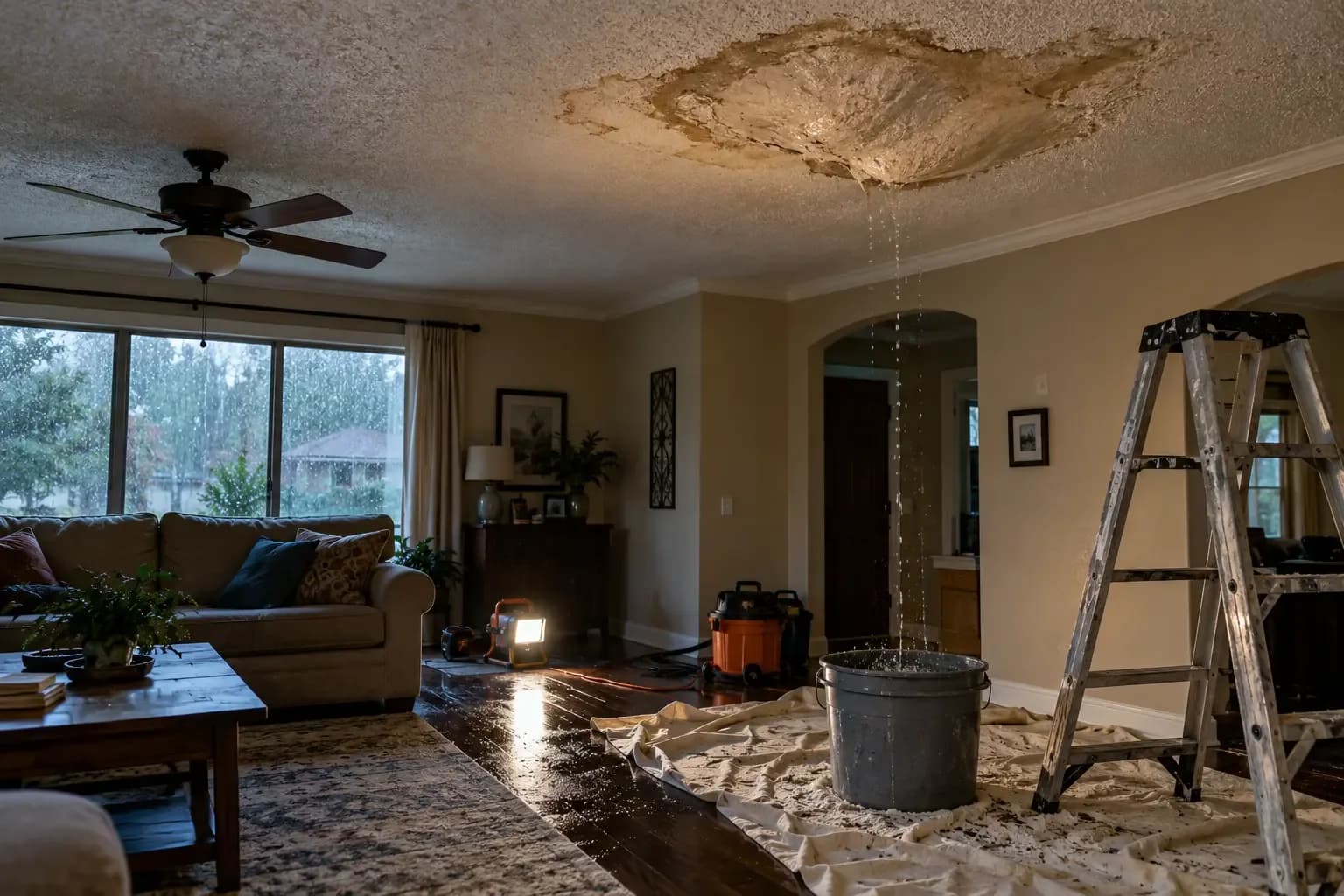
A brown ring on the ceiling is the bottom of the problem, not the problem. Above it there is usually wet insulation resting on the drywall, and wet blown-in insulation loses most of its R-value while it stays damp.
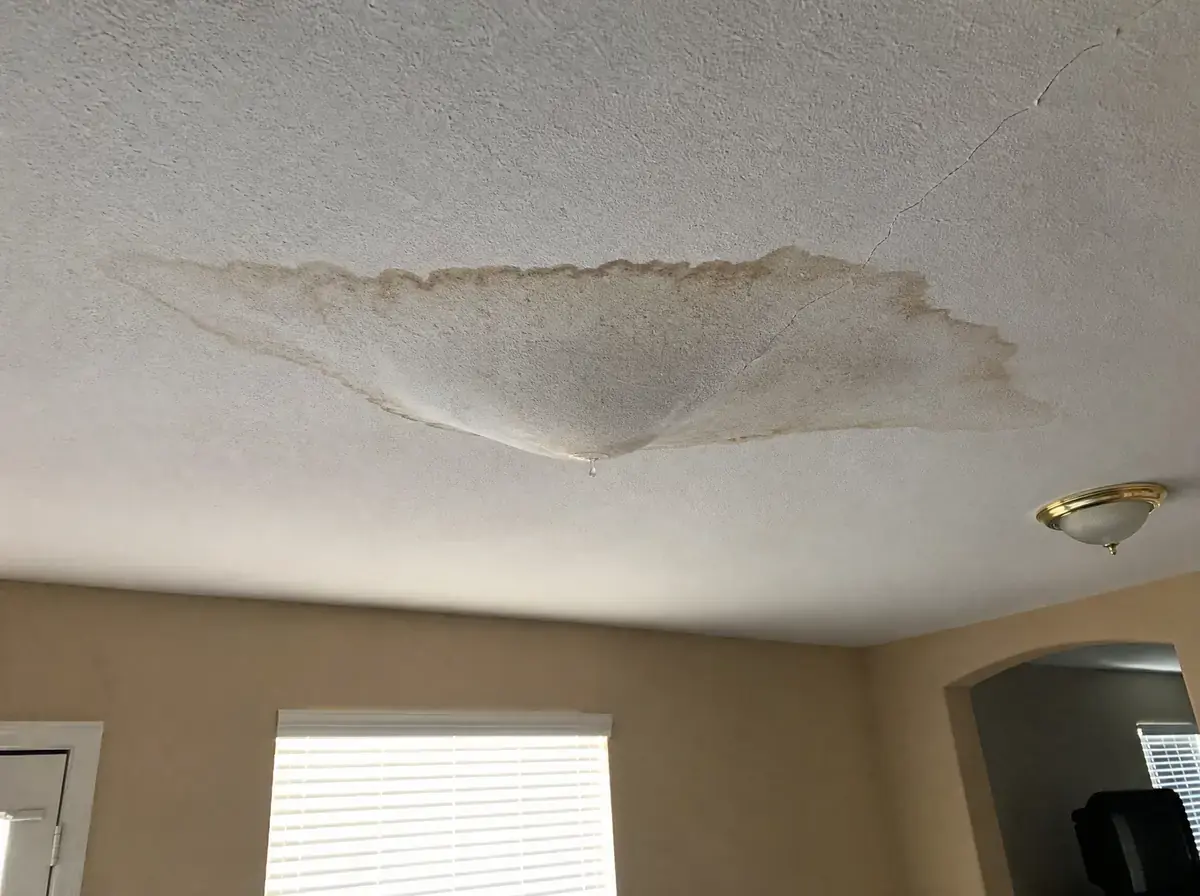 Before, wet from above
Staining and a soft spot in the ceiling drywall, saturated insulation sitting on top of it, and a leak path that has to be traced before anything is patched.
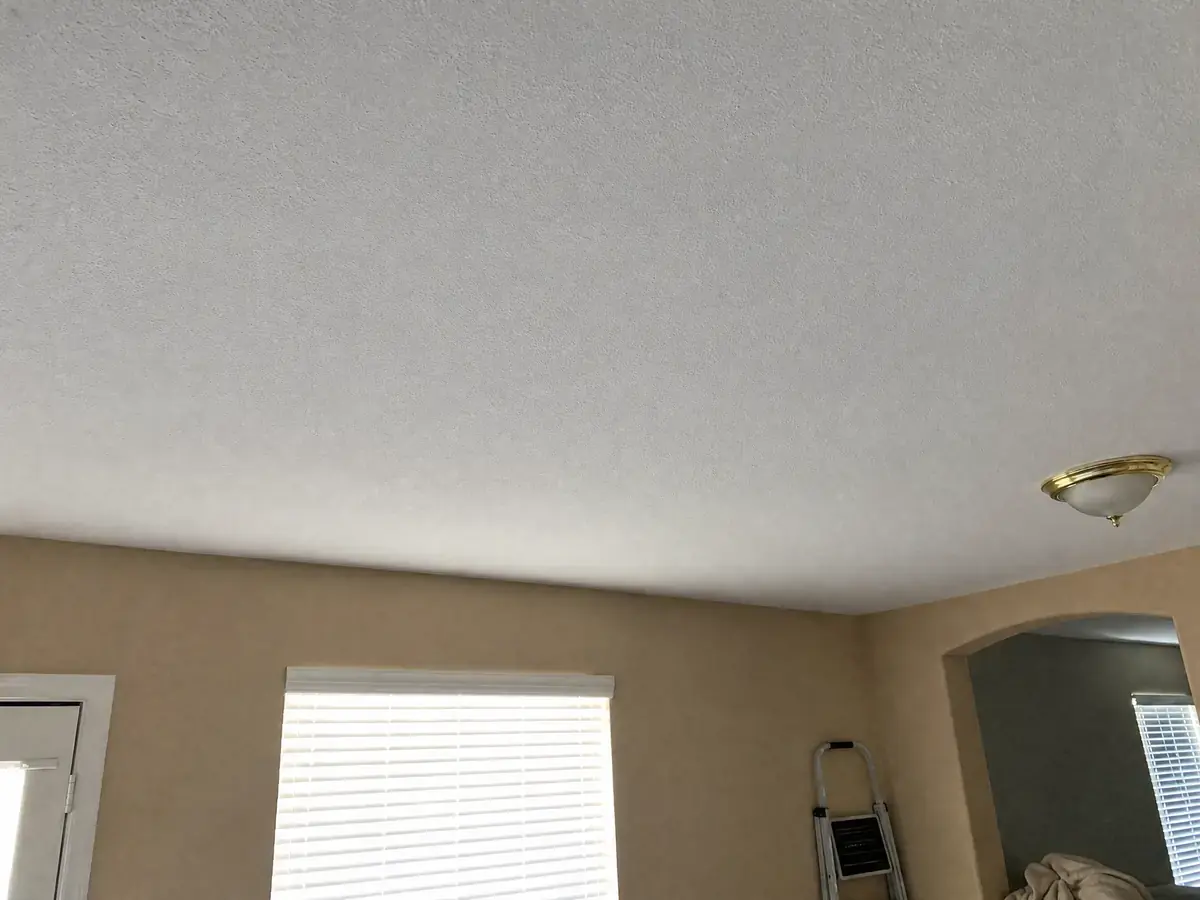 After, dried and rebuilt
Wet insulation removed, the cavity and framing dried to standard, then the ceiling closed, textured and painted once the readings hold.
Standing water? Call now, we answer 24/7.
A real local person picks up, then a crew heads your way.
Who we are
We put the things most companies keep vague in writing: real price ranges for this market, the standards we work to, and a moisture log your adjuster can read.
24/7
A real local person answers, day or night
24-48 hrs
The critical window to limit secondary damage
~25 mi
Served from our San Marcos hub across Hays, Comal & Caldwell
S500
The ANSI/IICRC drying standard our process follows
One local team handles every stage, so you are not juggling separate vendors.
Start hereFast removal of standing water with truck-mounted and portable units before it soaks into more material.
See emergency water extraction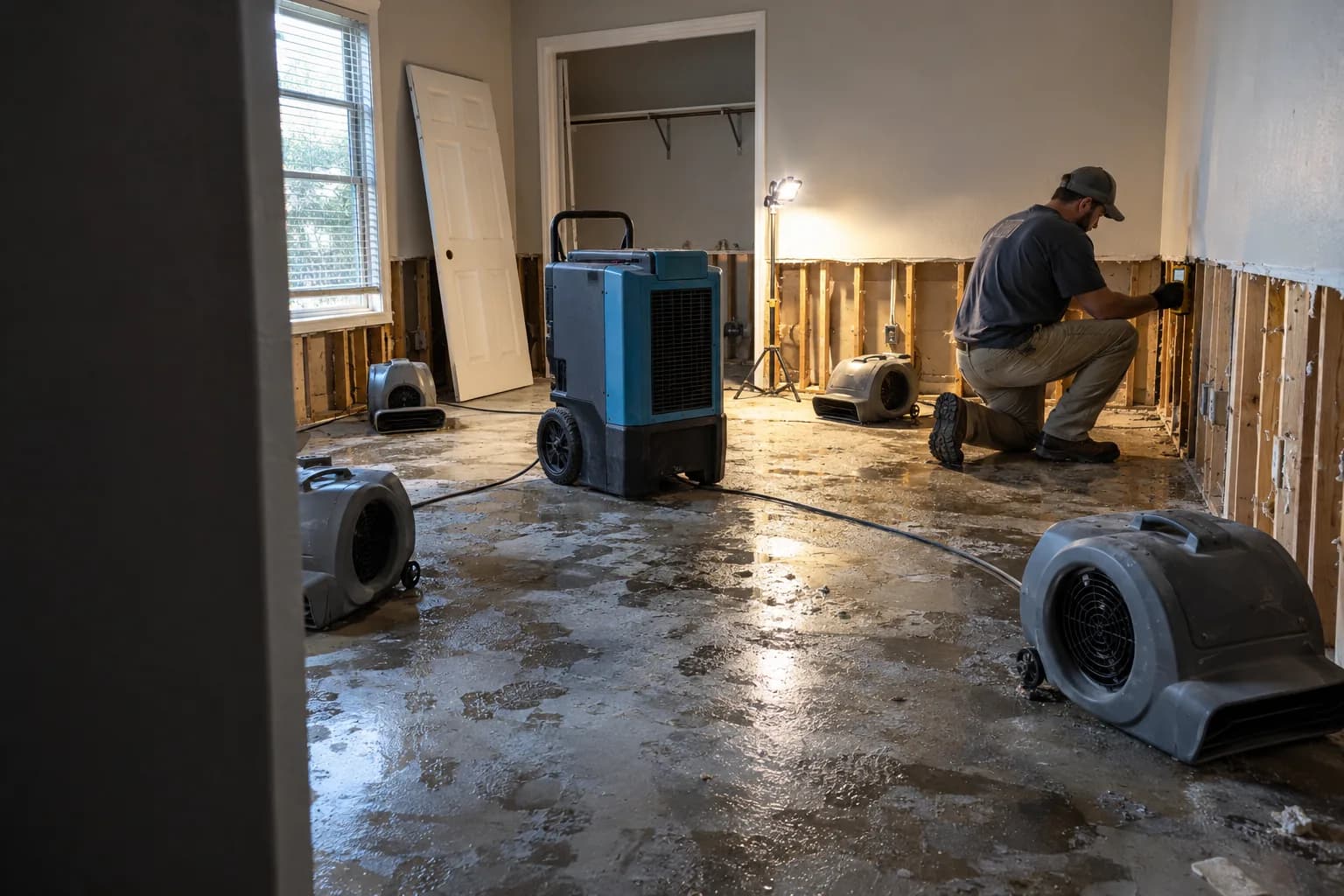
Air movers and LGR dehumidifiers with daily moisture readings, dried to a documented standard.
See structural drying
Muck-out and restoration after river flooding and flash floods along the San Marcos and Blanco Rivers.
See flood damage cleanupFAQ
Straight answers to what San Marcos homeowners ask most, on cost, insurance, mold timelines, and what to do first.

24/7
A real local team across Hays, Comal & Caldwell counties. Every job dried to a documented standard.
Have a question on your mind?
Get a quoteA brown or yellow ceiling stain means water has leaked above that spot, either recently or in the past. Water has been here. The most common sources are plumbing in the floor above, an upstairs bathroom, or a roof breach, with HVAC condensate a frequent culprit in summer. The stain forms where water finally exits the drywall, not where the leak started, so the source is often feet away. Until it is found and dried, painting over the stain only hides it, and it usually returns.
Yes, a sagging or bulging ceiling is an urgent safety risk because it is holding trapped water that adds weight the drywall was never meant to carry. Get out from under it. Keep everyone clear, move furniture and valuables away, and place a bucket below the lowest point. Do not poke or puncture it yourself, since releasing the water improperly can bring the whole section down. Call for help so the water can be relieved and the cavity dried safely.
A professional separates the two with moisture tracing and thermal imaging rather than guessing, because the stain rarely sits directly under the source. Weather is the tell. Roof leaks usually worsen during or right after rain and trace back to attic insulation and the roof deck, while plumbing leaks often persist regardless of weather and trace to a pipe, a tub, or a shower pan above. Tracing the moisture pattern up to the highest wet point reveals the true source so the right repair gets made the first time.
It depends on how saturated the drywall is and how long it stayed wet. Catch it early. Lightly affected drywall caught early can often be dried in place and the stain sealed and repainted, while drywall that has sagged, bulged, or stayed wet long enough to lose its strength usually has to be cut out and replaced. We dry the cavity, insulation, and framing to standard first, then make the call on what can be saved. See our San Marcos cost guide for what ceiling repair typically runs.
Tell us straight what is happening and we will tell you the next step. We pick up, then we are on the way.
A real local person answers, 24/7. Tell us what is happening and we are on the way.