San Marcos water damage guide
Mold in Air Ducts: Signs, Removal, and Cost in San Marcos, TX
Mold in air ducts is one of the most oversold problems in this trade, and the reason is a smell. The AC kicks on in July, something musty comes out of the vents, and within a week somebody has quoted a few thousand dollars to remediate the whole duct system. Most of the time that smell is not coming from the ducts at all. It is coming from a wet coil eighteen inches inside the air handler cabinet. Worth knowing before you authorize anything. The EPA does not recommend cleaning air ducts on a routine basis, and says plainly that duct cleaning has never been shown to actually prevent health problems.
Published · Updated
How Do You Know If You Have Mold in Your Air Ducts?
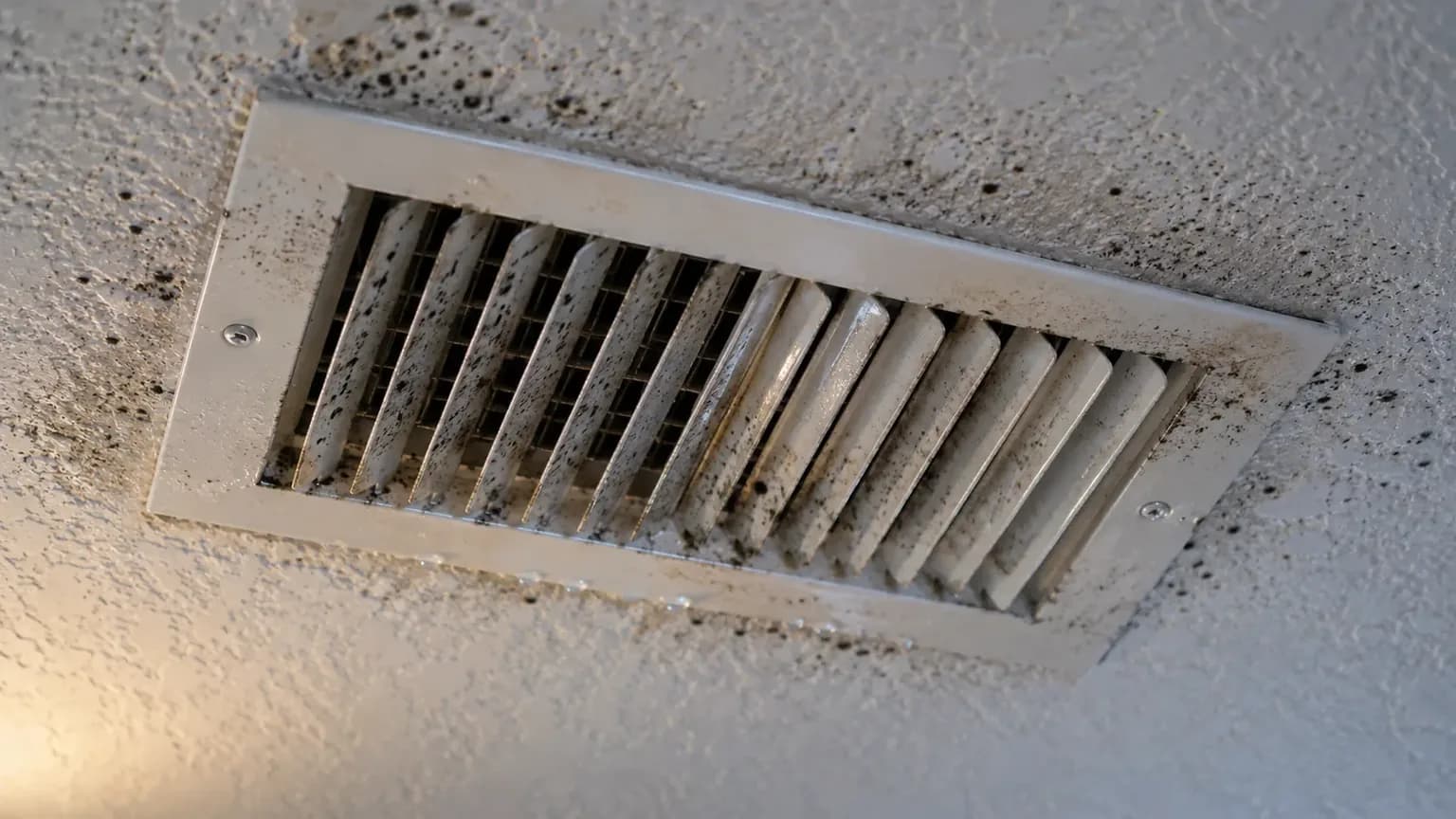
You usually cannot tell from smell alone. A musty odor when the AC starts more often comes from biological film on the wet evaporator coil and condensate pan than from the duct runs. Confirmed mold in ducts means visible growth on duct surfaces, which the EPA says a provider should show you directly.
That last point is the one to hold onto. EPA guidance is explicit that you should ask the service provider to show you any mold they claim exists, and that a positive determination of whether something is mold can be made only by an expert, sometimes only with laboratory analysis. A photo of a dusty return grille is not a diagnosis. Neither is a flashlight pointed six inches into a supply register while someone tells you what you are looking at.
| Situation | EPA position | What to do first |
|---|---|---|
| Musty smell only, nothing visible | Not a reason to clean ducts | Open the air handler, inspect coil and condensate pan |
| Substantial visible mold on hard-surface duct interior | Cleaning should be considered | Ask to be shown it, confirm it is mold |
| Insulation or flex duct wet or moldy | Cannot be effectively cleaned | Remove and replace that section |
| Vermin infestation, or debris actually released into rooms | Cleaning should be considered | Address the entry point too |
| Routine, on a schedule, no symptoms | Not recommended | Nothing, fix humidity instead |
If you are working through a musty odor with nothing visible anywhere, a musty smell with no visible mold walks the whole diagnostic tree, of which the HVAC system is only one branch.
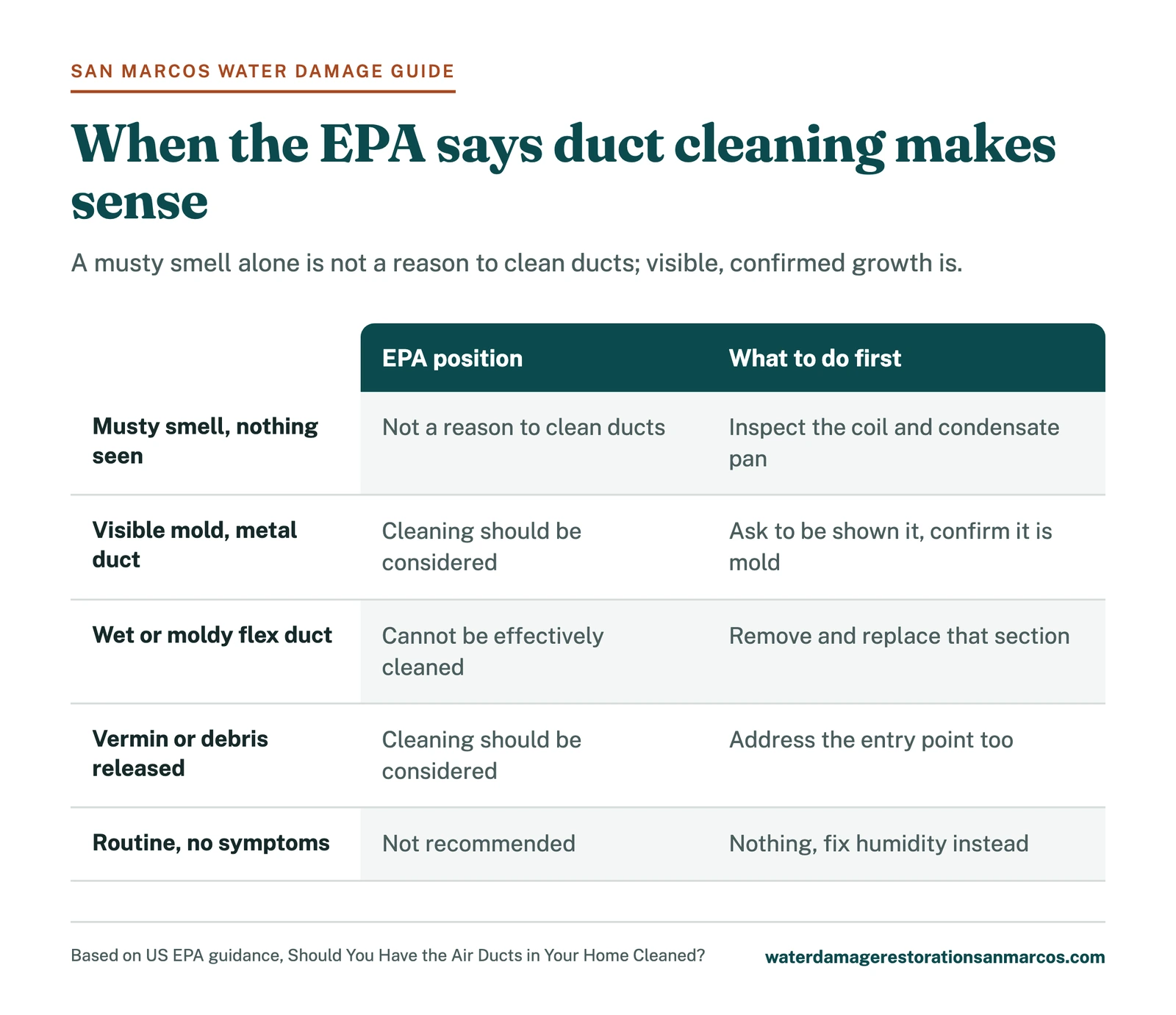
Text version of this infographic
When the EPA says duct cleaning makes sense. A musty smell alone is not a reason to clean ducts; visible, confirmed growth is.
| Item | EPA position | What to do first |
|---|---|---|
| Musty smell, nothing seen | Not a reason to clean ducts | Inspect the coil and condensate pan |
| Visible mold, metal duct | Cleaning should be considered | Ask to be shown it, confirm it is mold |
| Wet or moldy flex duct | Cannot be effectively cleaned | Remove and replace that section |
| Vermin or debris released | Cleaning should be considered | Address the entry point too |
| Routine, no symptoms | Not recommended | Nothing, fix humidity instead |
Based on US EPA guidance, Should You Have the Air Ducts in Your Home Cleaned?
Why Your AC Smells Musty When It Turns On
Here is the mechanical explanation almost nobody offers before quoting.
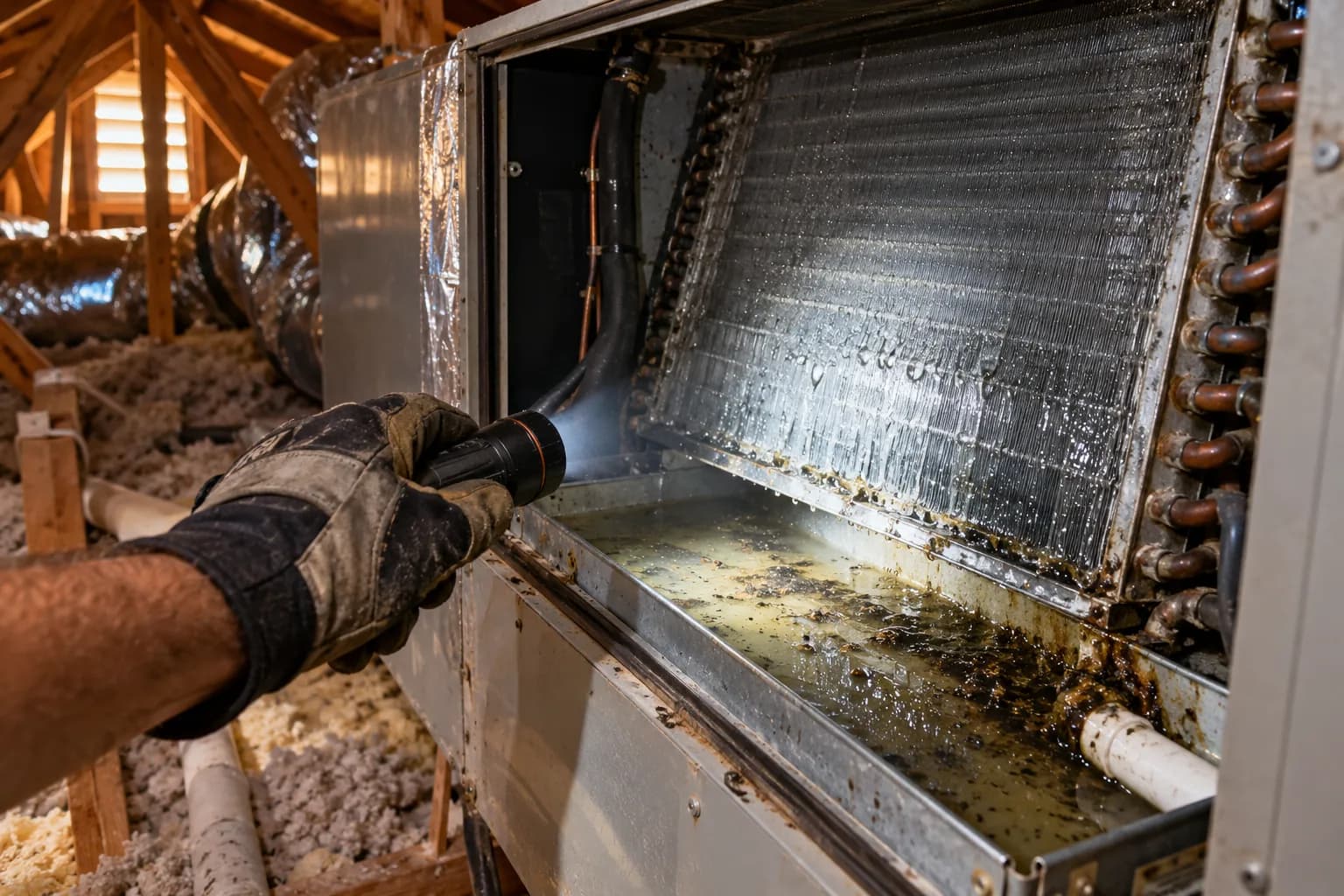
Your evaporator coil is the coldest surface in the house. Warm humid air crosses it, water condenses out, and that water drains into a condensate pan and out through a drain line. Through a San Marcos summer, when outdoor dew points sit high for weeks at a stretch, that coil and pan are wet essentially all the time. Wet surface plus organic dust equals biological film, and the moment air first moves across it after the blower has been off, you smell it. Technicians call the result dirty-sock syndrome, and it is a cabinet problem, not a duct-run problem.
The commercial consequence is the whole point. Cleaning a coil and clearing a condensate pan and drain line is routine HVAC service work. Remediating an entire duct system is a $3,000 to $10,000 project. Those are not remotely the same purchase, and the smell alone does not distinguish them. Anyone quoting the second one without opening the air handler cabinet and showing you the coil has skipped the diagnosis and gone straight to the invoice.
There is a San Marcos-specific wrinkle worth knowing. A lot of homes here, along with much of the newer stock in Kyle and Buda, run an attic-mounted air handler. That puts the whole assembly in an unconditioned space that hits 130 degrees in August, with a condensate drain line that runs a long lazy path to daylight and clogs with biological slime. When it clogs, the pan overflows. That water does not politely stay in the attic. It wets duct insulation on its way down and then shows up as a ceiling stain in the room below, which is a genuine water loss and a genuine mold risk rather than a smell. That overflow is where our HVAC condensate line and appliance leak cleanup work starts.
What the EPA Actually Says About Duct Cleaning
Every duct-cleaning sales page in this vertical skips this section, so here it is in full.
The EPA does not recommend that air ducts be cleaned routinely, only as needed. It states that duct cleaning has never been shown to actually prevent health problems. It identifies three circumstances where cleaning should be considered. That means substantial visible mold growth inside hard-surface ducts or on other heating and cooling components, ducts infested with vermin, or ducts clogged with excessive dust and debris that is actually being released into the home. Those three are the only circumstances the guidance names.
Two further EPA points matter for anyone weighing a quote. First, if the conditions causing mold growth are not corrected, mold growth will recur. Cleaning a system while the coil stays wet and the humidity stays high buys you a season at best. Second, research has not demonstrated the effectiveness of sealants and biocides in duct cleaning, nor their potential adverse health effects. So an add-on line item for fogging a biocide or spraying an encapsulant through the system is not supported by the evidence, whatever the brochure says.
None of that means duct mold is imaginary. It means the bar for doing the work is visible, confirmed growth rather than an odor and a sales visit. Ask to be shown it. Ask what makes it mold rather than dust or dirt. If nobody can answer, you have learned what you needed to know about the quote.
Sheet Metal vs Flex Duct, Why Material Decides the Bill
Two houses on the same street can get quotes thousands of dollars apart for what sounds like the same problem, and the reason is usually what the ducts are made of.
Bare sheet metal duct has a hard, non-porous interior. Growth on that surface can be physically removed and the duct returned to service. Fiber glass duct liner and flexible duct are different animals entirely. They are porous, and once wet they hold moisture inside the material where no brush reaches. EPA guidance is direct about this. If insulated air ducts get wet or moldy, the insulation cannot be effectively cleaned and should be removed and replaced.
That single sentence decides the scope. A sheet metal system with confirmed surface growth is a cleaning job. A flex duct system that has been wet is a replacement job, run by run, and replacement costs more than cleaning every time. This is also why older rental stock near Texas State tends toward the expensive answer. Flex duct degrades, the inner liner tears, insulation compacts and absorbs, and by the time anyone looks closely the honest recommendation is new duct rather than clean duct. A company that tells you it can clean wet flex duct back to good is either not reading the guidance or not telling you about it.
How Mold in an HVAC System Is Actually Remediated
Real remediation of a contaminated system follows the same logic as remediation anywhere else, which ANSI/IICRC S520 sets out as the standard for mold work. Here that means isolate, filter, remove what cannot be cleaned, then correct the moisture.
In practice that means sealing the affected supply registers and the return plenum along with the work area, so spores do not distribute through the house during the work, running negative air with HEPA filtration so the pressure gradient carries contamination out of the building rather than into the next room, physically removing growth from cleanable surfaces, cutting out and replacing porous components that cannot be cleaned, and then fixing whatever kept the system wet. Skip the last step and the EPA's recurrence warning applies directly.
One scope trap specific to Texas. If growth has stayed inside the equipment and the duct runs, you are dealing with a system. If it has moved out past the boots and into the ceiling, the wall cavity, or the insulation around them, the affected area can cross 25 contiguous square feet, and at that point Texas rules change what is legally required. In practice that means a TDLR-licensed remediator, a written protocol from a separately licensed mold assessment consultant, and a notification filed with the state. Our guide to what mold remediation costs by area of the home explains what crossing that line does to the invoice, and the mold remediation in San Marcos page covers the containment method in detail.
What HVAC Mold Removal Costs in San Marcos
| Scope | What it covers | Market cost range |
|---|---|---|
| Standalone mold inspection | Assessment, no lab sampling | ~$250–$400 |
| Coil and condensate pan service | Air handler cabinet, not duct runs | HVAC service call pricing, well below full remediation |
| HVAC system or ductwork mold remediation | System cleaning or component replacement | ~$3,000–$10,000 |
| System plus multi-room spread | Containment across zones, heavy demolition | ~$10,000–$30,000 |
Those are published market figures, not a rate card of ours. The spread inside that $3,000 to $10,000 band is almost entirely a materials question. How many runs are cleanable sheet metal and how many are porous components that have to come out. Ask for the quote broken down that way, by run and by material, rather than as a single system-wide number. A quote that cannot be broken down that way was not built from an inspection.
Why San Marcos Systems Grow Mold
Humidity does most of the work. The EPA recommends keeping indoor relative humidity below 60 percent, ideally between 30 and 50 percent, to limit mold growth, and through a Central Texas summer that is a mechanical target rather than a matter of opening a window. Once water is present, mold can begin growing within 24 to 48 hours (ANSI/IICRC S500 and S520), which is a short fuse for a condensate overflow nobody noticed. The seasonal mechanics are covered further in how summer humidity drives mold in Central Texas and in how fast mold grows after water damage.
Equipment sizing is the underrated culprit. An oversized system cools the thermostat's air fast, shuts off, and never runs long enough to pull real moisture out of the house. The rooms feel cold and clammy at the same time, the coil stays wet between short cycles, and the humidity that feeds growth never leaves. A higher MERV filter will not fix that, and a restrictive one on an undersized blower can make the coil sweat worse. Cleaning that system without addressing the short-cycling is the exact scenario the EPA's recurrence warning describes.
Two local conditions finish the picture. Attic air handlers, common across San Marcos, Kyle, and Buda, sit in heat and drain through lines that clog. And in flood-exposed areas along the San Marcos and Blanco Rivers, a system that keeps running during or right after a water loss pulls contaminated air across the return side and distributes it through the house, which turns a contained ground-floor problem into a whole-system one. If a home in Blanco Gardens has taken river water, shutting the system down is part of the first hour.
When It Is an HVAC Contractor's Job and When It Is Ours
Straight answer, because the division matters and plenty of companies blur it.
Coil cleaning, condensate pan and drain line service, blower and cabinet work, refrigerant, duct replacement, and system sizing are HVAC contractor work. That is licensed mechanical trade work, and it is where the coil-and-pan cause of a musty smell actually gets fixed. Mold remediation is ours. The short version is containment, HEPA filtration, negative air, removal of contaminated porous material, drying the moisture source, and documenting the whole thing for your insurer. Water damage from a condensate overflow, including the wet ceiling and insulation under an attic air handler, is squarely ours.
The two jobs overlap, and the sequence runs the same way. Get the system diagnosed first, because that tells you whether you have a coil problem or a contamination problem, and the answer changes the budget by an order of magnitude. We answer 24/7 in San Marcos and across Hays County, and if the honest answer after looking is that you need an HVAC technician and not a remediation crew, that is what we will tell you.
Written by the Water Damage Restoration San Marcos team
Local water-damage restoration in San Marcos, TX and Hays County. Our guidance follows the ANSI/IICRC S500 and S520 reference standards the industry plans around. Questions about your situation? Call (512) 778-8417, we answer 24/7.