San Marcos water damage guide
How Much Does Mold Remediation Cost in San Marcos, TX?
Mold remediation cost in San Marcos usually runs about $15 to $30 per square foot of affected area, and most residential jobs land between $1,200 and $3,750 (HomeGuide and Angi 2026 market data). The number that decides your bill, though, is not printed on any national cost chart. It is 25 square feet. Texas law changes what a company is legally allowed to do at that line, and crossing it turns one invoice into two. Most homeowners learn this after they have already signed off on a scope. What follows is the market range by area of the home, what the per-square-foot price actually buys, and the one question worth asking before anyone opens a wall.
Published · Updated
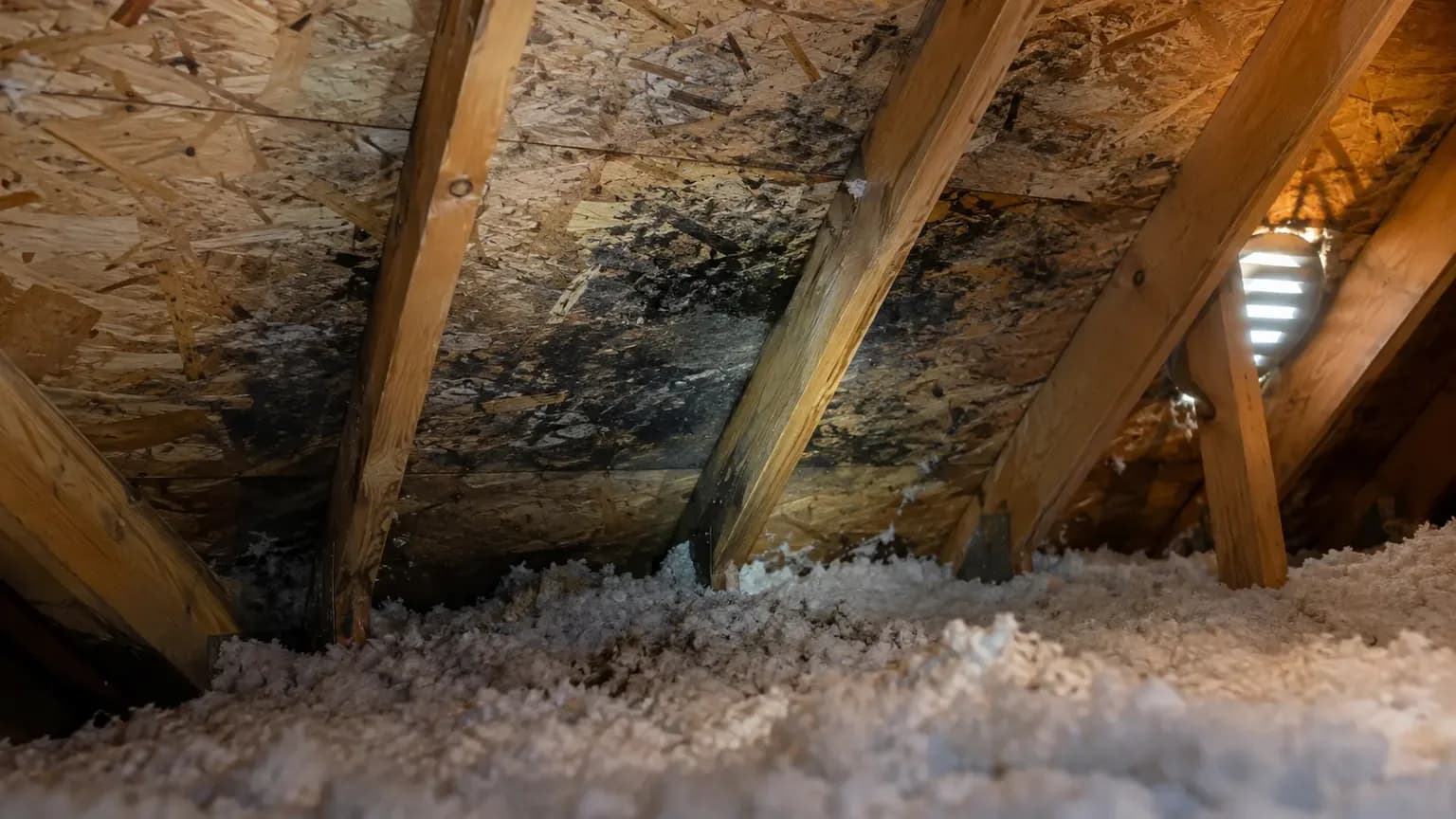
How Much Does Mold Remediation Cost in San Marcos, TX?
Mold remediation generally runs about $15 to $30 per square foot of affected area, with most residential jobs totaling roughly $1,200 to $3,750. Small contained growth can start near $500. Area of the home, how far mold has spread into wall cavities, and Texas licensing rules above 25 contiguous square feet drive the difference.
| Area affected | What usually drives it | Market cost range |
|---|---|---|
| Bathroom or small contained spot | Surface growth, limited cavity work | ~$500–$3,000 |
| Crawl space | Access and size | ~$1,500–$4,000 |
| Attic | Insulation and sheathing involvement | ~$1,500–$6,000 |
| Attic with insulation, rafters or decking affected | Material removal and rebuild | ~$7,000–$15,000 |
| HVAC system or ductwork | System cleaning or component replacement | ~$3,000–$10,000 |
| Multi-room or whole-house spread after flooding | Containment across zones, heavy demolition | ~$10,000–$30,000 |
The national average sits near $2,368, which is a decent sanity check and a poor prediction of any single job. These are market figures, not a price list from one company. If a quote you are holding sits well outside the band for your area of the home, that is worth asking about in writing.
What the Per-Square-Foot Price Actually Buys
There is a real difference between cleaning mold and remediating it, and that gap is why people feel overcharged.
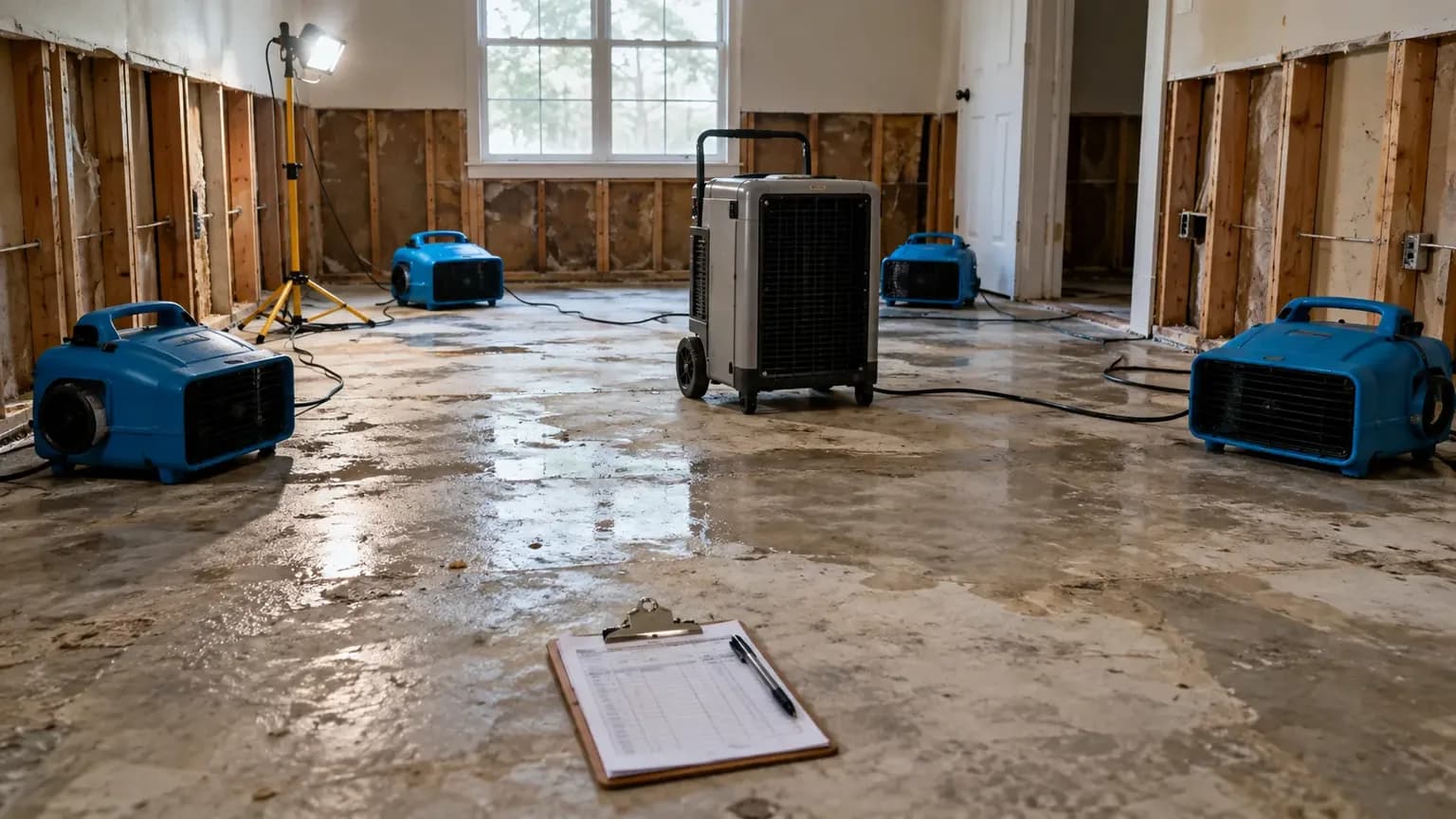
Cleaning is someone wiping a surface with a biocide. Remediation, as defined by ANSI/IICRC S520, the industry standard for mold work, means sealing the affected area behind plastic barriers, running a negative air machine with HEPA filtration so spores leave the building instead of moving into the next room, cutting out and bagging porous materials that cannot be saved, treating what remains with an antimicrobial, then drying the moisture that fed the growth. On a job needing full containment, the barriers and negative air setup take a crew most of a morning before anyone touches mold.
That last step decides whether you pay once or twice. Mold is a symptom. If the supply line behind the vanity is still weeping, remediation buys you a clean cavity and a repeat visit in four months. Any scope for mold remediation in San Marcos that does not name the moisture source and who is fixing it is an incomplete scope, whatever the price says.
Small jobs carry a floor. Most firms hold a minimum invoice of roughly $500 to $1,500 regardless of area, because containment and mobilization cost the same for six square feet as for sixty. And if you are chasing a musty smell with no visible mold, pay for the inspection before the remediation. Scoping blind is how small problems get priced like large ones.
The 25-Square-Foot Rule That Changes Your Texas Bill
Here is what the national cost guides leave out.
Texas regulates mold work through the Texas Department of Licensing and Regulation under the Mold Assessors and Remediators rules (Texas Occupations Code ch. 1958), and it turns on one number. 25 contiguous square feet of affected area. Under it, a remediator can legally do the work with no mold license. At 25 contiguous square feet or more, three requirements trigger together. A TDLR-licensed remediator must perform the work. It must follow a written protocol from a licensed mold assessment consultant. And a notification must be filed with TDLR before work starts.
| Affected area | What Texas requires | What it adds to the bill |
|---|---|---|
| Under 25 contiguous sq ft | No mold license required for the remediation | Remediation only, one invoice |
| 25 contiguous sq ft or more | TDLR-licensed remediator, written protocol from a separately licensed mold assessment consultant, notification filed with TDLR | Two separate invoices, protocol and clearance testing (inspection commonly ~$250–$400, more with lab sampling) |
The word doing the work there is contiguous. It means connected affected area, not the sum of every spot in the house, and it is measured by what is actually affected once the wall is open rather than by the stain on the painted side. This is where two honest estimates diverge. A bathroom wall that looks like a small patch can open into a wet cavity running the length of the vanity, and the job crosses the threshold in the first ten minutes of demolition. A company that raises that possibility before quoting is scoping. One that names a flat price for "the mold in the bathroom" without measuring is guessing, and the guess gets resolved in its favor later.
The second consequence matters more than the paperwork. Texas requires the consultant who writes the protocol and the remediator who performs the work to be separate parties, so the company that tests cannot also remediate the same job above the threshold. A free inspection followed by remediation of whatever turns up cannot legally apply at 25 contiguous square feet or more. It also describes the exact conflict of interest the rule exists to prevent. The party with a financial reason to find a bigger problem being the party that measures it.
Two questions for anyone quoting mold work in Hays County. What affected square footage did you measure, and what is your TDLR license number. Both answers belong in writing, and you should ask us the same two questions before you hire us. We will tell you which side of 25 square feet we think you are on before quoting, including when the honest answer is that you are under it and barely need us.
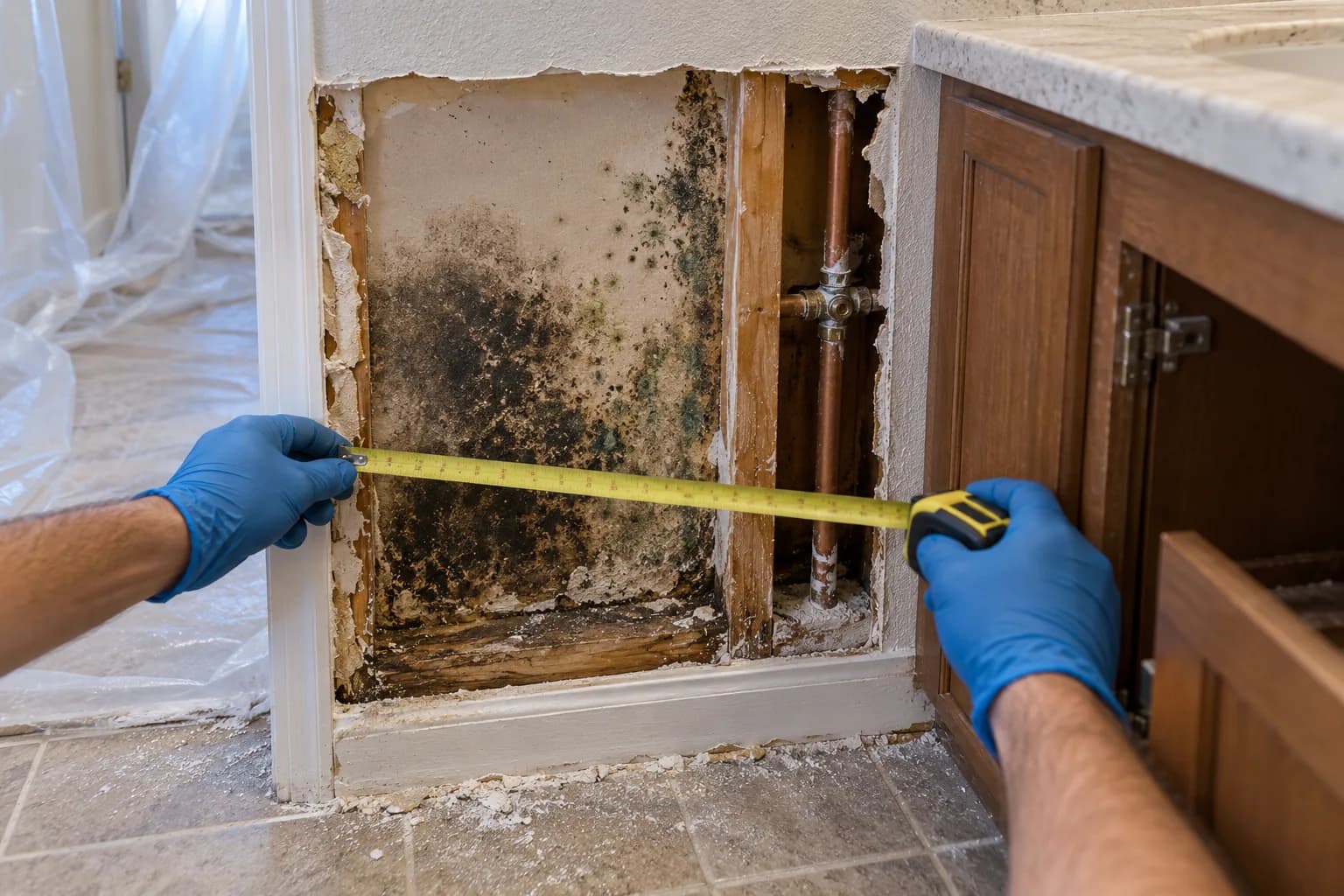
Mold Remediation Cost by Area of the Home
What moves a job within its band, or out of it, is almost always how far the moisture traveled.
Bathrooms and small contained spots ($500 to $3,000) are the cheapest and the most often oversold. Surface growth on grout or on the paint side of drywall with a dry cavity behind it is a small job. The same patch with a leaking supply line behind it is not.
Crawl spaces ($1,500 to $4,000) price mostly on access. A crawl a technician can move through costs less than one requiring belly-crawling around ductwork at identical square footage.
Attics ($1,500 to $6,000) are where San Marcos homes surprise people. Growth on the underside of the decking with dry insulation holds that range. Once mold reaches the insulation, rafters, or roof decking, the job becomes removal and rebuild at roughly $7,000 to $15,000. Blown-in insulation cannot be remediated in place, so it comes out and gets replaced.
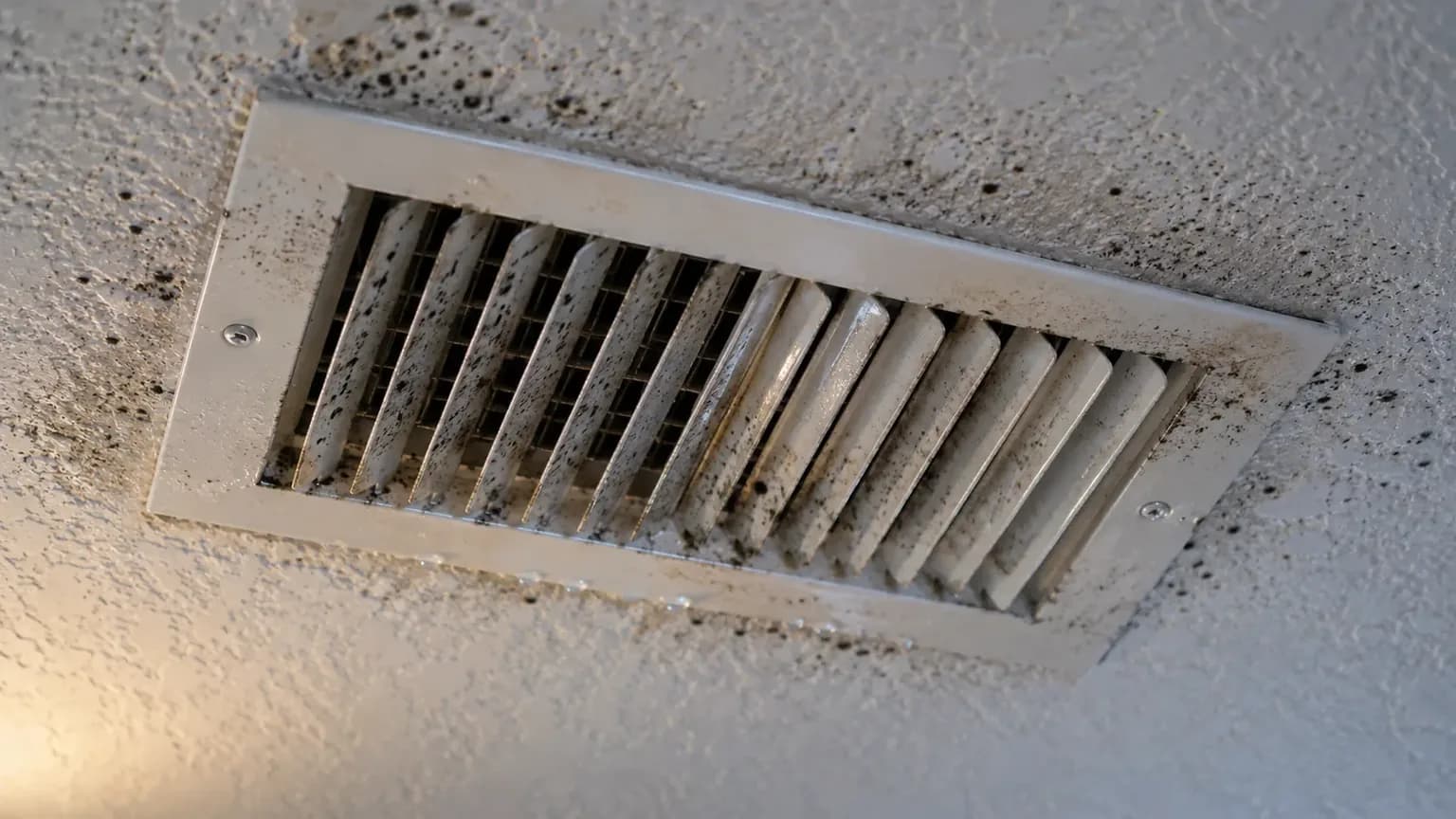
HVAC systems and ductwork ($3,000 to $10,000) escalate quietly. An air handler distributes spores to every room it serves, so a duct problem is a whole-house problem even when nothing is visible elsewhere. Flex duct usually gets replaced rather than cleaned. Before you authorize any of it, read what the EPA actually says about mold in air ducts, because a musty AC smell is usually the coil rather than the duct runs.
Multi-room and whole-house spread ($10,000 to $30,000) generally follows a flood or a leak that ran unnoticed for weeks. At that point mold cost stops being a mold conversation, so read what water damage restoration costs in San Marcos alongside this. Mitigation and mold work are scoped and billed as separate phases.
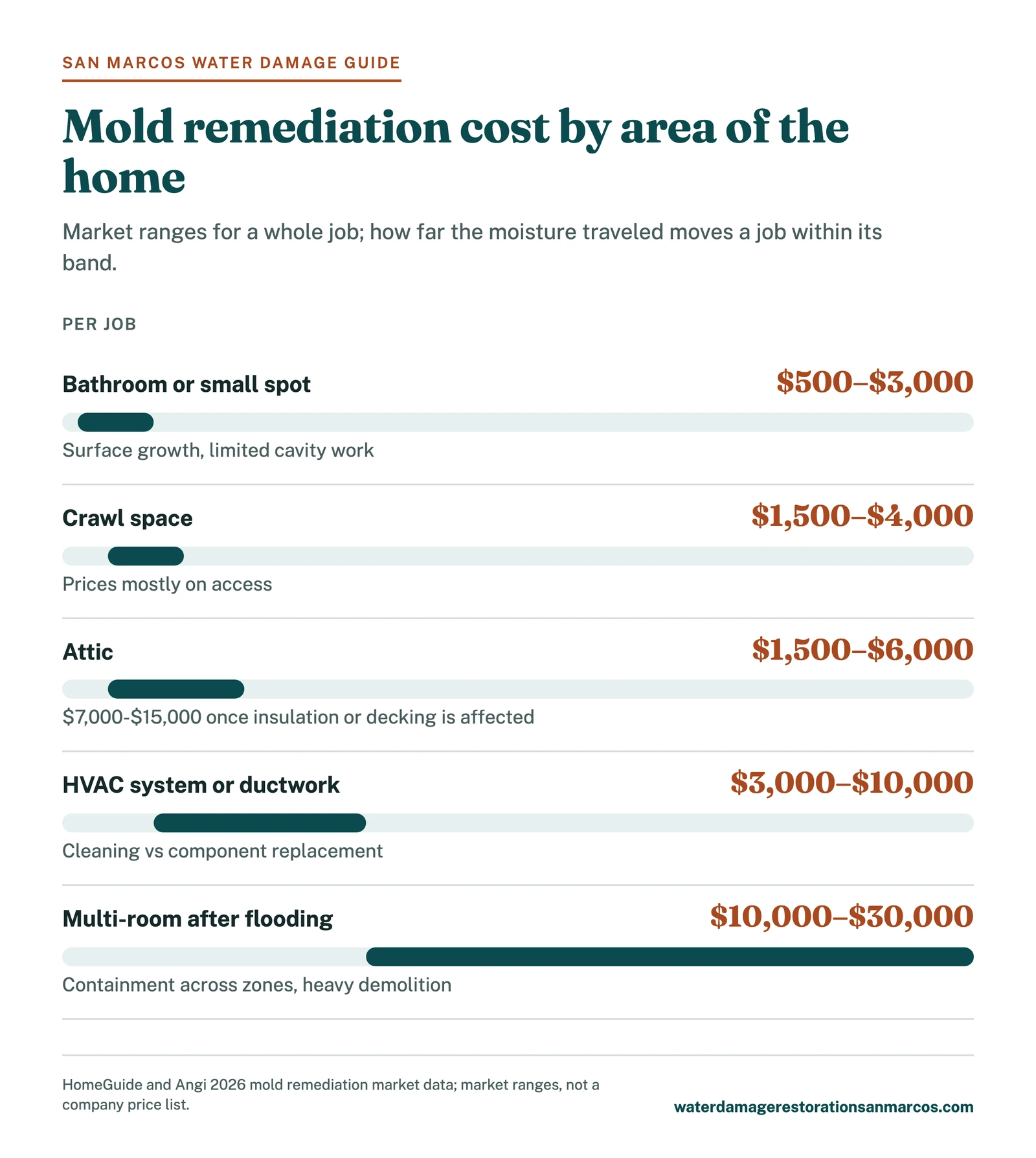
Text version of this infographic
Mold remediation cost by area of the home. Market ranges for a whole job; how far the moisture traveled moves a job within its band.
- Bathroom or small spot: $500 to $3,000 per job. Surface growth, limited cavity work
- Crawl space: $1,500 to $4,000 per job. Prices mostly on access
- Attic: $1,500 to $6,000 per job. $7,000-$15,000 once insulation or decking is affected
- HVAC system or ductwork: $3,000 to $10,000 per job. Cleaning vs component replacement
- Multi-room after flooding: $10,000 to $30,000 per job. Containment across zones, heavy demolition
HomeGuide and Angi 2026 mold remediation market data; market ranges, not a company price list.
Does Insurance Cover Mold Remediation in Texas?
Sometimes, and the answer turns on the cause rather than the mold.
A standard Texas homeowners policy generally treats mold following a sudden, accidental, covered water loss as part of that claim. A supply line bursts, you file, the resulting mold is usually in scope. Mold traced to a slow drip under a sink, a roof that needed replacing two years ago, or humidity in an unconditioned space is normally excluded as maintenance. Many Texas policies also carry a mold sublimit well below the dwelling limit, so mold can be covered and still be capped. Find that number before you agree to a scope, because it changes what you are deciding. Our guide on whether homeowners insurance covers water damage in Texas covers how carriers separate sudden from gradual.
One thing most homeowners never hear. After licensed remediation in Texas you can obtain a Certificate of Mold Damage Remediation, and an insurer given that certificate may not then make an adverse underwriting decision on a residential property policy because of that prior mold damage. That is a real reason to keep the licensed paperwork instead of treating it as overhead, and one of the few cases where the compliant path is also the cheaper one.
Rentals are their own argument, and San Marcos has plenty around Texas State. Responsibility follows the cause and the lease. Mold from a building failure, a roof leak or failed plumbing, is usually the landlord's. Mold from a tenant's own overflow, or a leak noticed and never reported, can land on the tenant. Either way, report it in writing with photographs and a date on the day you find it. Verbal reports to a leasing office have a way of not existing later.
Why San Marcos Mold Jobs Price Differently
Central Texas humidity is why a leak here becomes a mold job faster than the same leak in Phoenix. Mold can begin growing within 24 to 48 hours of water intrusion (ANSI/IICRC S500 and S520), and the EPA recommends keeping indoor relative humidity under 60 percent, ideally 30 to 50 percent, to limit growth. Through a San Marcos August, outdoor dew points make that a mechanical problem rather than a matter of opening windows. A house that loses air conditioning for a few days in summer can develop surface growth with no leak at all, which is why how fast mold grows after water damage matters more here than national guidance suggests.
Construction adds to it. Much of the housing stock in San Marcos, Kyle, and Buda is slab-on-grade, and water reaching a slab wicks into the bottom plates and the lower courses of drywall rather than draining. That is cavity moisture, and cavity moisture is the specific condition that pushes a job across the 25-square-foot line.
Then flooding. San Marcos sits in Flash Flood Alley between the San Marcos and Blanco Rivers, and mold following river water is not the same product as mold following a clean supply line. Flood water is Category 3, so porous materials come out and get disposed of regardless of how salvageable they look. Post-flood mold in Blanco Gardens prices near the top of its band for that reason, not because someone inflated it.
How to Read a Mold Estimate and Spot Padding
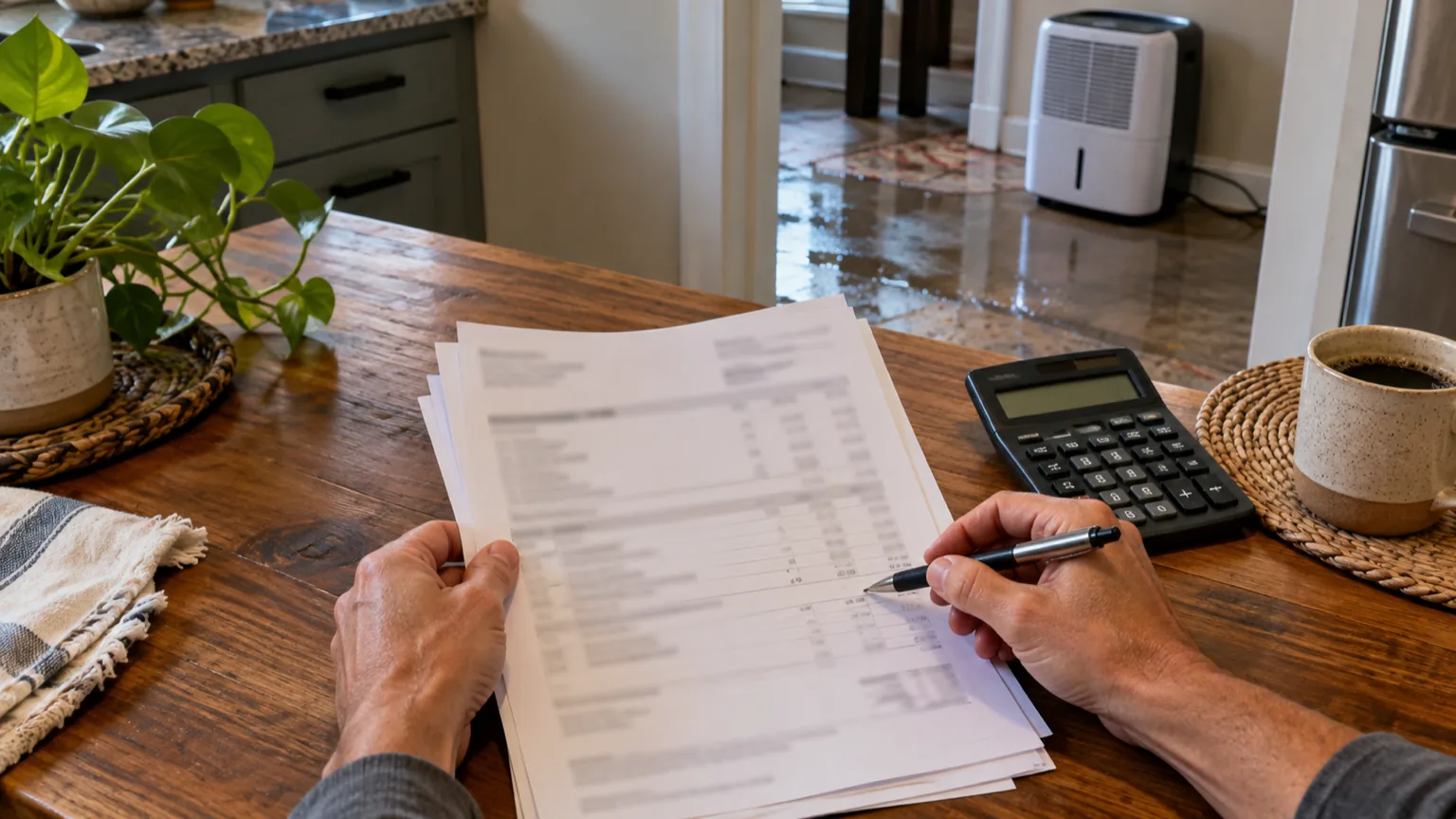
A fair mold estimate has four things on it, and a padded one is usually missing at least two. It states affected square footage as a measured number rather than a description. It separates containment setup, remediation labor, material disposal, and equipment day rates into their own lines instead of one lump sum. It names the moisture source and who is fixing it. And above the threshold it identifies the licensed assessor whose protocol is being followed, with clearance testing as its own line item, because the clearance check is what proves the work succeeded.
The failure modes here are documented and unsubtle. Consumer reporting on restoration overbilling includes a $15,000 bill against a $5,000 approved scope, and a $900 line item for minor materials. The mold version is scope inflation. A job measured at 60 square feet when 20 were affected, or whole-house duct remediation bolted onto a contained bathroom problem. Neither is detectable once the drywall is back up, which is why the measurement matters more than the price. How to avoid getting overcharged goes deeper on reading the estimate.
If a company will not put affected square footage in writing before work starts, that is your answer.
Written by the Water Damage Restoration San Marcos team
Local water-damage restoration in San Marcos, TX and Hays County. Our guidance follows the ANSI/IICRC S500 and S520 reference standards the industry plans around. Questions about your situation? Call (512) 778-8417, we answer 24/7.