San Marcos water damage guide
San Marcos, TX Flood Season Preparation for Homeowners
San Marcos flood season preparation starts long before the first spring storm, because the rivers here do not give much notice. The city sits in Flash Flood Alley, where the San Marcos and Blanco Rivers can rise from calm to dangerous in hours, as the 2015 Memorial Day flood proved when the Blanco crested at a record of about 40.21 feet and destroyed more than 2,000 homes across Hays County. Spring through early summer is peak flash-flood season here. The single step that helped 2015 survivors recover fastest, arranging flood insurance, has to happen weeks ahead, so the work of getting ready belongs to the quiet months, not the morning the forecast turns.
Published · Updated

Why San Marcos Floods So Fast
Limestone is the short answer. The ground around San Marcos is thin soil over hard limestone, which sheds rain instead of soaking it up, so a hard storm runs straight off the hills and into the San Marcos and Blanco Rivers.
Add the steep terrain of the Balcones Escarpment and several watersheds feeding the same corridor, and a calm river can turn into a record crest within hours.
That is what makes our flooding different from a slow, rising-creek event you can watch coming for days. The rise is fast. The 2015 floods are the local archetype, and they happened twice in one year. Twice that year. If you want the full picture, our breakdown of why Flash Flood Alley floods so fast explains the geology, and the lessons from the San Marcos 2015 flood walk through what the water actually did to homes here. The takeaway for preparation is simple. Warning windows are short, so readiness has to be built in advance.
How to Prepare for Flood Season in San Marcos, TX
To prepare for San Marcos flood season, arrange NFIP flood insurance early because it has a 30-day waiting period and homeowners policies exclude flooding. Photograph your belongings, move valuables and documents up high, clear gutters and drainage, build an emergency kit, and plan an evacuation route. The San Marcos and Blanco Rivers can rise fast in spring.
Here is the checklist, in the order that matters most.
- Buy flood insurance now, weeks before the season, because the 30-day wait means a policy bought when rain is already in the forecast does nothing for the storm that is coming.
- Photograph and inventory every room and your valuables, then store the file off-site.
- Move valuables and documents up high, off the floor and out of low rooms. Get them up.
- Clear gutters, drains, and yard drainage so water moves away from the house. Keep them clear.
- Stage sandbags or barriers if you sit low or near the river corridor, because the time to find them is on a dry afternoon, not the night the water is already at the curb.
- Check or add a sump pump in basements, crawl spaces, or low utility areas.
- Build an emergency kit with water, medications, flashlights, and chargers. Pack it early.
- Plan an evacuation route and a place to go, and learn the local river gauges.
Work the top of that list first. The early items cost the least and prevent the most.
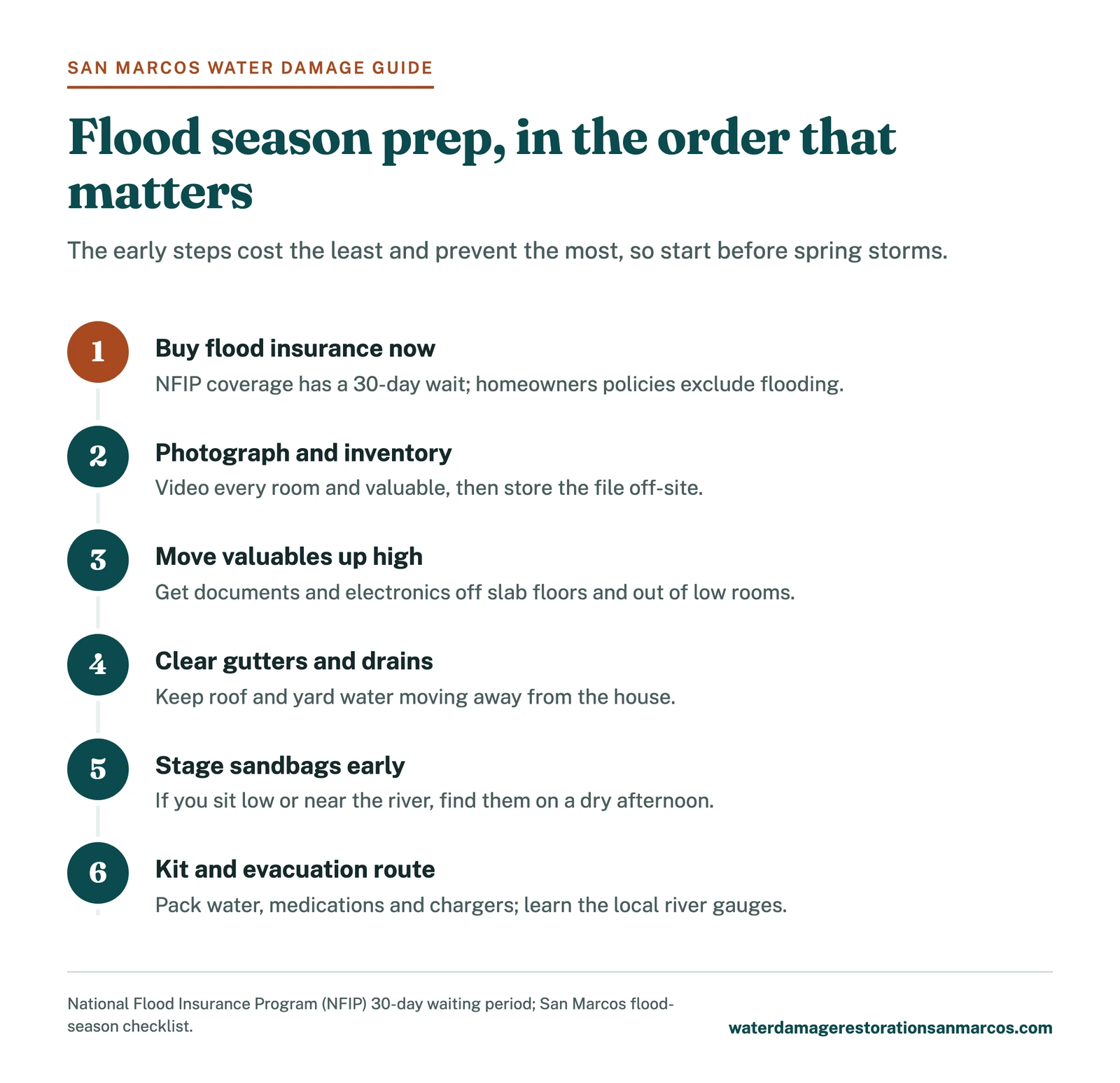
Text version of this infographic
Flood season prep, in the order that matters. The early steps cost the least and prevent the most, so start before spring storms.
- Buy flood insurance now. NFIP coverage has a 30-day wait; homeowners policies exclude flooding.
- Photograph and inventory. Video every room and valuable, then store the file off-site.
- Move valuables up high. Get documents and electronics off slab floors and out of low rooms.
- Clear gutters and drains. Keep roof and yard water moving away from the house.
- Stage sandbags early. If you sit low or near the river, find them on a dry afternoon.
- Kit and evacuation route. Pack water, medications and chargers; learn the local river gauges.
National Flood Insurance Program (NFIP) 30-day waiting period; San Marcos flood-season checklist.
Get Flood Insurance Early (the 30-Day Wait)
This is the step people skip until it is too late. A standard Texas homeowners policy does not cover flooding from rising river or surface water, full stop. Flood coverage comes through a separate policy, usually the National Flood Insurance Program, and the NFIP has a 30-day waiting period before it takes effect.
Buying it when the forecast already shows rain does nothing for that storm. Too late by then. The homeowners who recovered fastest after 2015 were the ones who had arranged flood coverage and photographed their belongings months earlier, before the river was anywhere near flood stage. Worth repeating. Living outside a mapped flood zone does not make you exempt. Plenty of 2015's flooded homes were not in high-risk zones. Our guide to flood insurance vs homeowners insurance in Texas lays out exactly what each policy does and does not cover.
Document Your Belongings Now
Do it before anything happens. Walk through every room with your phone and shoot video of the walls, the floors, the furniture, and the contents of closets and cabinets. Open drawers. Capture serial numbers on big electronics and appliances, then store the file off-site.
A flood claim moves faster when you can show what was there before the water. Store that footage in the cloud or email it to yourself, so it survives even if the house does not. Send it offsite. This is the cheapest insurance step there is, and it costs nothing but twenty minutes on a dry afternoon.
Protect the House
Water finds the low ground, so raise what you can. Lift electronics, irreplaceable papers, and anything stored on slab floors up onto shelves or higher floors before the season starts, since slab-level water rises first and ruins whatever sits on the concrete.
Keep it raised. In a flood-prone home, keeping the bottom two feet of every room clear of valuables is a habit worth building.
Then manage where water goes. Clean gutters and downspouts so roof water drains away from the foundation, grade soil to slope away from the house, and keep yard drains clear of leaves and mulch. If you sit low or near the river, stage sandbags before you need them, and learn where your main water and gas shutoffs are so you can kill utilities safely if water gets in. A sump pump in a low utility room or crawl space buys you time when the ground saturates.
Know your flood-cleanup plan before you need it, Call our local team (Secondary button)

Have an Emergency and Evacuation Plan
Decide now, not in the dark. Build a kit you can grab in one trip. That means bottled water, a few days of medications, flashlights, phone chargers, a battery pack, copies of key documents, and cash. Keep it somewhere everyone in the house can reach.
Then settle the plan. Pick an evacuation route to higher ground and a backup, agree on where the household will meet, and learn to check the local river gauges during heavy rain so you are reading the river, not guessing. The rule that saves lives here is the simplest one. Turn around, don't drown. Most flood deaths happen in vehicles, and a foot of moving water can carry off a car. If water is rising and the route is questionable, leave early on foot to high ground rather than gambling on a drive.
If Flooding Happens, Act Fast Afterward
Move quickly once it is safe. River and street floodwater is contaminated Category 3 water, carrying sewage and whatever the current picked up, so do not wade through it without protection and do not let kids or pets near it. Treat soaked carpet, pad, and drywall as hazardous, not salvageable.
The clock matters here. In our humid climate, mold can take hold within roughly 24 to 48 hours of materials staying wet, so professional extraction and drying need to start fast. Photograph the damage before you move anything, for your claim, then get help in. Document it first. Fast, documented flood damage cleanup in San Marcos is what keeps a flood from turning into a mold problem that drags on for months. Honest note to close on. Preparation reduces loss, it does not eliminate the risk. The river will do what it does. What you control is how ready you are when it does.
Written by the Water Damage Restoration San Marcos team
Local water-damage restoration in San Marcos, TX and Hays County. Our guidance follows the ANSI/IICRC S500 and S520 reference standards the industry plans around. Questions about your situation? Call (512) 778-8417, we answer 24/7.